
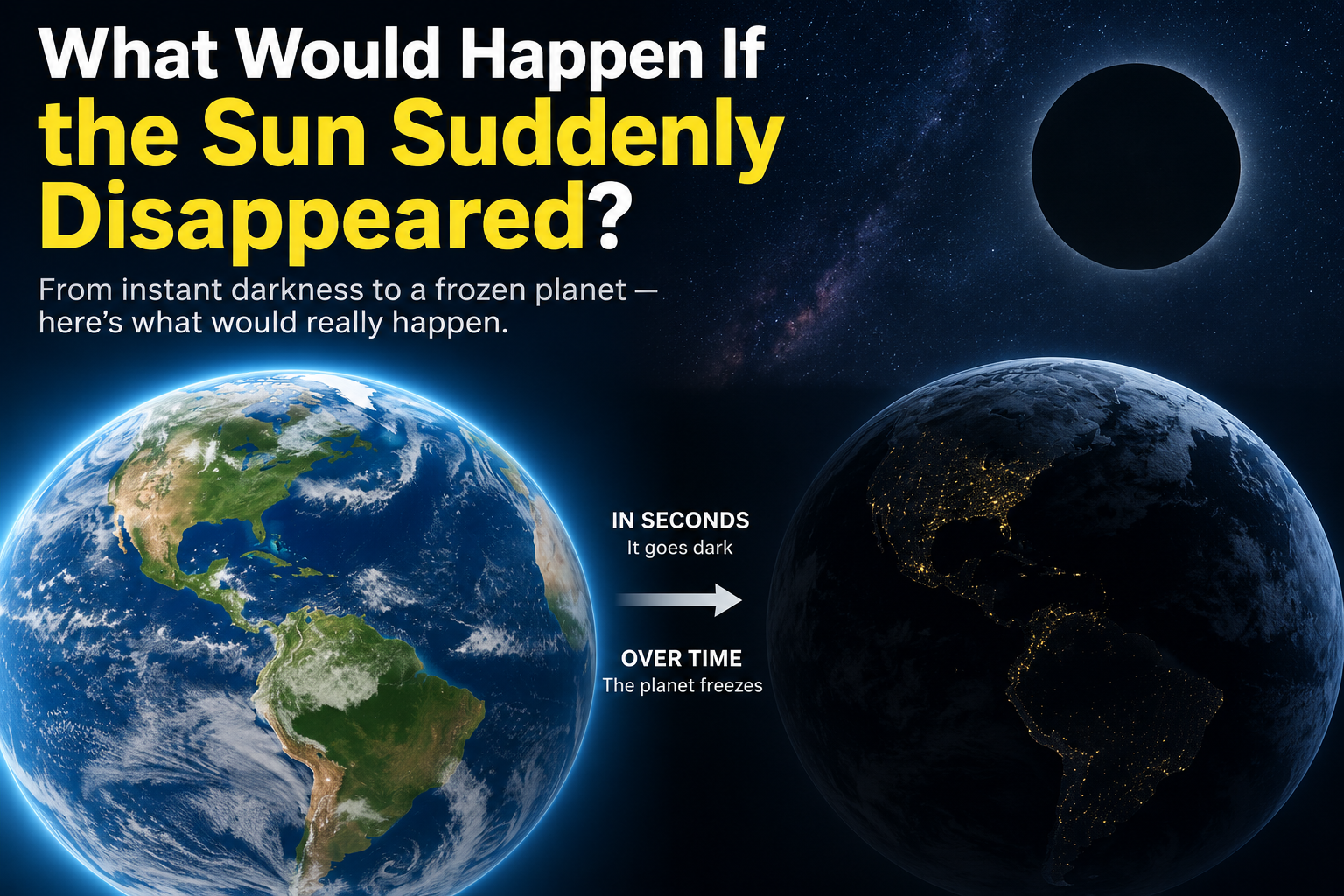
What Would Happen If the Sun Suddenly Disappeared?
Sun disappeared scenarios are a thought experiment that has fascinated scientists and curious minds alike: what would actually happen if the sun disappeared right now, without warning? While this scenario is physically impossible — stars don’t just disappear — working through what would happen step by step reveals fascinating truths about light, gravity, and just how deeply life on Earth depends on our nearest star.
To keep things clear, this article breaks the scenario down into separate stages, from the first eight minutes to hundreds of thousands of years later, using explanations grounded in real physics from NASA scientists and astronomers.
Table of Contents
- Nothing Happens for the First 8 Minutes and 20 Seconds
- Earth Would Stop Orbiting and Fly Off in a Straight Line
- Darkness Would Fall Instantly — And the Moon Would Go Dark Too
- Photosynthesis Would Stop Immediately
- The Temperature Drop Would Take Longer Than You Think
- The Oceans Would Not Freeze Right Away
- Oxygen Would Actually Last About 1,000 Years
- Life Near the Ocean Floor Could Survive Almost Unaffected
- Earth Would Eventually Reach Temperatures Colder Than Pluto
- Could This Actually Happen in Real Life?
1. Nothing Happens for the First 8 Minutes and 20 Seconds
Here’s the most surprising part of this scenario: even if the Sun vanished at this exact moment, nothing on Earth would change right away. Both light and gravity travel at the same finite speed — the speed of light — and the Sun is about 8 light-minutes away from Earth. According to the National Radio Astronomy Observatory (NRAO), this means we wouldn’t notice anything unusual until roughly 8 minutes and 20 seconds after the Sun disappeared.
During this window, Earth would continue orbiting completely normally — circling a Sun that, unknown to anyone, was already gone.
2. Earth Would Stop Orbiting and Fly Off in a Straight Line
Once those 8 minutes and 20 seconds pass, gravity’s pull would vanish along with the Sun’s light. Earth currently moves at roughly 30 kilometers (about 19 miles) per second along its curved orbital path, with the Sun’s gravity constantly bending that path into a loop. Without that gravity, Earth wouldn’t stop or slow down — it would simply continue moving in a straight line, at the same speed, in whatever direction it happened to be traveling at that instant.
Importantly, nobody on the surface would feel a jolt or shift, since the entire planet — and everything on it — would coast together at exactly the same velocity, the same way passengers don’t feel the motion of a smoothly moving train.
3. Darkness Would Fall Instantly — And the Moon Would Go Dark Too
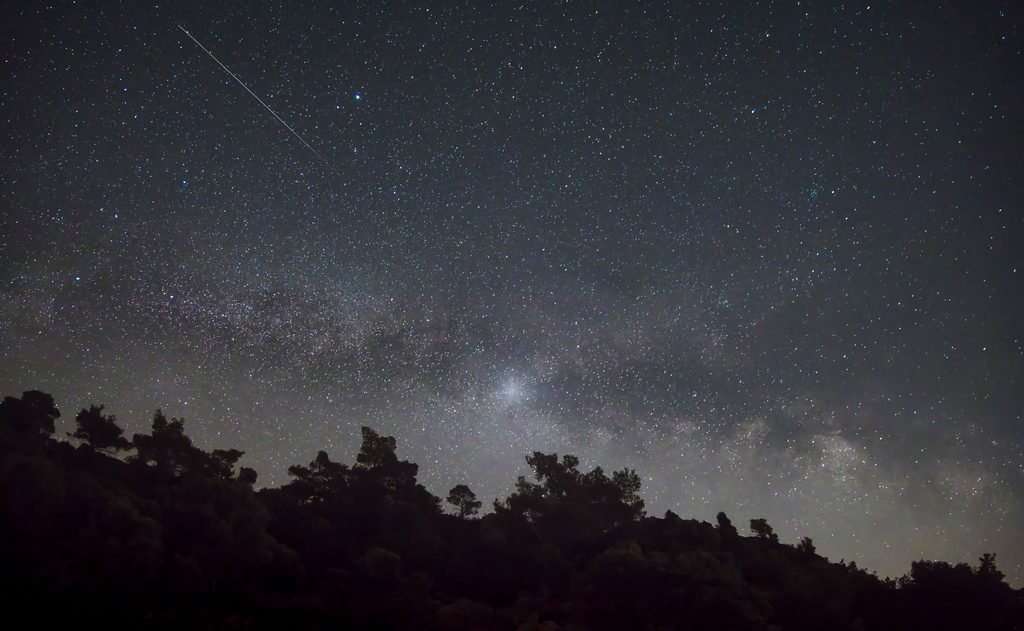
The moment those 8 minutes and 20 seconds end, the last rays of sunlight would reach Earth, and then true darkness would follow — lit only by distant starlight. According to NRAO, this darkness would extend to the Moon as well, since the Moon has no light of its own and only appears bright because it reflects sunlight. With no more sunlight to reflect, the Moon would go completely dark within moments of Earth losing its own daylight.
For anyone looking up at a full moon at the exact moment this happened, the transition from a bright night sky to complete darkness would be sudden and total.
4. Photosynthesis Would Stop Immediately
With sunlight gone, every plant on Earth that relies on photosynthesis would immediately lose its energy source. Photosynthesis is the process plants use to convert sunlight into chemical energy, and without it, the base of most food chains on the planet’s surface would collapse almost instantly.
This wouldn’t just affect plants directly — nearly every surface ecosystem on Earth ultimately depends on photosynthesis somewhere in its food chain, meaning the effects would ripple outward extremely quickly to animals, and eventually, to humans.
5. The Temperature Drop Would Take Longer Than You Think
While darkness would be immediate, Earth’s temperature wouldn’t crash all at once. According to LiveScience’s coverage citing physicist Sarah Sadavoy, Earth’s atmosphere and oceans hold a significant amount of stored heat, meaning the initial temperature drop would happen gradually over the first few days and weeks, rather than instantly.
However, cooling would continue steadily from there, since Earth would have no ongoing heat source to replace what continuously radiates away into space.
6. The Oceans Would Not Freeze Right Away
One counterintuitive detail is that Earth’s oceans wouldn’t freeze solid quickly, even as surface temperatures plummeted. As covered by Futura-Sciences, surface ice that forms first actually acts as an insulating layer, slowing further heat loss from the water underneath. Because of this, deep ocean water could remain liquid for hundreds of thousands of years, even as the surface above froze over completely.
This insulating effect is similar to how a frozen lake can still have liquid water underneath its icy surface, just on a much larger, planet-wide scale.
7. Oxygen Would Actually Last About 1,000 Years
A common assumption is that humanity would quickly suffocate once plants stopped producing oxygen through photosynthesis. In reality, according to physicist David Stevenson of the California Institute of Technology, atmospheric oxygen would persist for roughly 1,000 years even without any replenishment from plant life, since Earth’s atmosphere already holds a massive existing reserve.
This means suffocation would not be the immediate crisis facing humanity. Long before oxygen became scarce, the collapse of food chains, extreme cold, and total darkness would already have made the surface uninhabitable for humans and most animals.
8. Life Near the Ocean Floor Could Survive Almost Unaffected
Not all life on Earth depends on sunlight. Deep beneath the ocean surface, particularly near hydrothermal vents, entire ecosystems already exist that have never relied on the Sun at all. These communities — including tube worms, certain shrimp species, and various microbes — draw their energy instead from chemical reactions and heat rising from Earth’s interior.
As long as Earth’s internal tectonic activity continues, which doesn’t depend on the Sun in any way, these deep-sea ecosystems could continue functioning largely unaffected, potentially outlasting nearly every form of surface life by a significant margin.
9. Earth Would Eventually Reach Temperatures Colder Than Pluto
Given enough time, Earth’s surface would cool dramatically. Physicist David Stevenson notes that temperatures would eventually stabilize around minus 400 degrees Fahrenheit — the point where heat still leaking from Earth’s core equals the tiny amount of heat the planet radiates into space. This is roughly the same frigid temperature currently found on Pluto, a world that sits far from the Sun’s warmth.
Eventually, near the surface, temperatures would approach an even colder baseline of about minus 454 degrees Fahrenheit — the temperature of the cosmic microwave background radiation left over from the Big Bang, which represents close to the coldest temperature found anywhere in the universe.
10. Could This Actually Happen in Real Life?
It’s worth emphasizing clearly: this entire scenario is a physics thought experiment, not a realistic prediction. Stars like the Sun don’t simply vanish — they undergo gradual, well-understood processes over billions of years, eventually expanding, cooling, and fading in ways that are nothing like an instantaneous disappearance.
The value of this exercise isn’t predicting the future — it’s understanding, in a clear and structured way, just how completely life on Earth depends on the Sun for light, warmth, and the energy that powers nearly every ecosystem on the planet’s surface.
Timeline: What Would Happen If the Sun Disappeared
| Time After Disappearance | What Happens |
|---|---|
| 0 to 8 minutes, 20 seconds | Nothing — Earth still orbits normally |
| 8 minutes, 20 seconds | Darkness falls; Earth flies off in a straight line |
| Moments later | The Moon goes completely dark |
| Immediately after | Photosynthesis stops everywhere |
| Days to weeks | Surface temperatures begin dropping steadily |
| Hundreds of thousands of years | Deep oceans remain liquid due to insulating ice |
| ~1,000 years | Atmospheric oxygen still hasn’t run out |
| Very long term | Surface temperature approaches -400°F (colder than Pluto) |
| Eventually | Near-surface temperature nears cosmic background level (-454°F) |
Frequently Asked Questions
How long would it take for us to notice the Sun disappeared? About 8 minutes and 20 seconds, since both light and gravity from the Sun take that long to reach Earth.
Would Earth immediately freeze if the Sun disappeared? No. While darkness would be instant, Earth holds enough stored heat that surface cooling would happen gradually over days and weeks, and deep oceans could remain liquid for far longer due to insulating surface ice.
Would humans suffocate from lack of oxygen? Not quickly. Atmospheric oxygen would likely last around 1,000 years even without plant life replenishing it — cold, darkness, and food chain collapse would pose a far more immediate threat.
Could any life on Earth survive? Yes. Deep-sea ecosystems near hydrothermal vents, which rely on chemical energy and Earth’s internal heat rather than sunlight, could continue largely unaffected for a very long time.
Is it actually possible for the Sun to suddenly disappear? No. This is a physics thought experiment, not a realistic scenario. Stars change gradually over billions of years through well-understood processes, not instant disappearance.
Conclusion
The idea of the Sun suddenly vanishing reveals just how deeply Earth’s climate, ecosystems, and even our sense of day and night depend on a star 93 million miles away. From the eerie eight-minute delay before we’d even notice, to deep-sea life that could quietly continue for ages in total darkness, this thought experiment is a powerful reminder of how central the Sun is to nearly everything happening on our planet’s surface.
(Related reading: Space: 10 Amazing Facts About the Universe)