
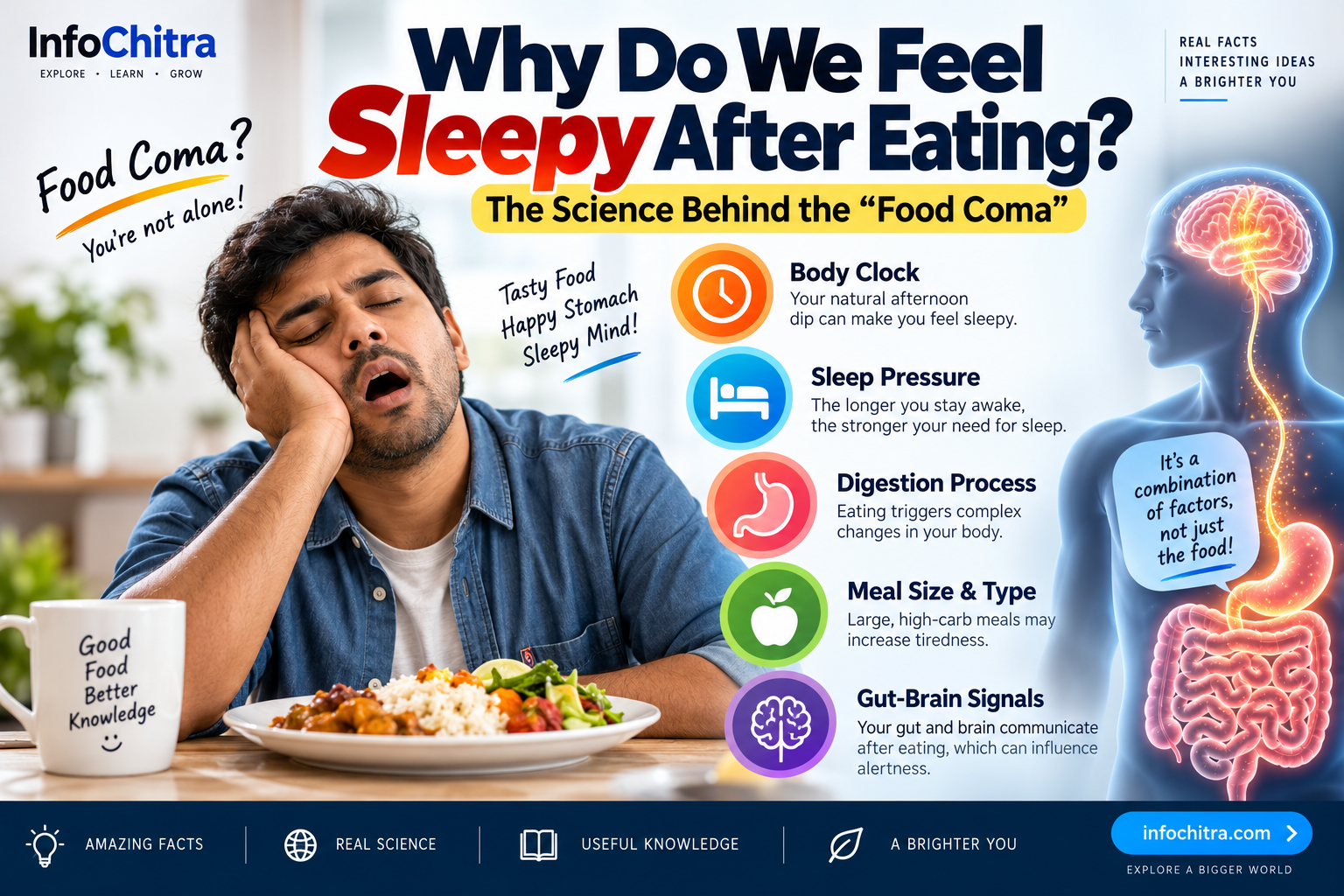
Why Do We Feel Sleepy After Eating?
Have you ever finished lunch and suddenly felt like taking a nap?
Your eyes become heavy, your concentration drops, and even simple work feels difficult. Many people call this a “food coma.” Scientists refer to the phenomenon as postprandial somnolence, meaning sleepiness or drowsiness after eating.
It is particularly common after lunch because eating can coincide with a natural afternoon decline in wakefulness. But food itself can also contribute to the feeling.
So, why do we feel sleepy after eating?
The answer isn’t simply that your blood “moves away from your brain” to digest food. That popular explanation is considered a myth; research points instead to a combination of circadian rhythms, sleep pressure, meal-related physiological changes, hormones and other factors.
Let’s look at what is actually happening.
What Is Postprandial Somnolence?
Postprandial somnolence is the scientific term for sleepiness after a meal.
It can range from mild tiredness to a strong desire to sleep. Research has objectively documented increased sleepiness after meals in some people, although it does not happen equally to everyone or after every meal.
The effect is often particularly noticeable after lunch because two things can overlap:
You have just eaten + your body’s natural afternoon rhythm is already reducing alertness.
That combination can make the post-lunch slump feel especially strong.
1. Your Body Clock Plays a Major Role

One of the biggest reasons people feel sleepy after lunch isn’t actually the food itself.
Your body has an internal circadian rhythm that influences sleepiness and alertness throughout the day.
During the early afternoon, the signals that promote wakefulness naturally dip. This is often called the afternoon slump or post-lunch dip.
That means you might feel tired around 2 or 3 PM even if you haven’t eaten a huge meal.
When lunch happens during this period, the meal and the natural dip can occur at the same time.
That’s why:
Lunch + afternoon circadian dip = stronger feeling of sleepiness for some people.
2. Sleep Pressure Has Been Building All Day

Another factor is sleep pressure.
The longer you stay awake, the stronger your body’s drive to sleep becomes.
By lunchtime, you’ve already been awake for several hours. If you also slept poorly the previous night, that sleep pressure can be stronger.
So when you finish eating, you may suddenly notice tiredness that was already developing.
Adenosine is one of the important molecules involved in sleep-wake regulation, and its accumulation during wakefulness contributes to sleep pressure.
In simple terms:
Less sleep at night → more sleep pressure during the day → stronger post-meal tiredness.
3. Eating Triggers Changes Throughout Your Body

Eating isn’t just putting food into your stomach.
A meal triggers a complex physiological response involving the digestive system, hormones, metabolism and communication between the gut and brain.
These changes can influence how alert or relaxed you feel after eating.
Research has suggested that gut-brain signalling and hormonal pathways may contribute to post-meal sleepiness.
Scientists are still studying the exact mechanisms, so there isn’t one single switch that explains everyone’s experience.
4. A Large Meal Can Make You Feel More Tired
Have you ever felt much sleepier after a large festive meal than after a small breakfast?
Meal size can matter.
Studies have found that eating a solid meal can increase sleepiness compared with consuming an equivalent amount of water, although individual responses vary.
A large meal also means your digestive system has more work to do.
That doesn’t mean your body is “shutting down” to digest food. Instead, digestion is one part of a much larger set of physiological processes occurring after eating.
5. Some Meals May Make Sleepiness More Noticeable

The type of food you eat can also influence how you feel afterward.
Meals high in refined carbohydrates or very large, energy-dense meals are often associated with stronger feelings of post-meal tiredness, although research on the exact effect of meal composition is not completely consistent.
For example, a meal dominated by:
- Refined carbohydrates
- Sugary foods or drinks
- Large portions
- Heavy, energy-dense foods
may leave some people feeling more sluggish.
However, it would be inaccurate to say that one particular food automatically causes sleepiness.
Controlled studies have sometimes found little difference in post-meal sleepiness between meals with different fat and carbohydrate compositions.
So the overall picture is more complicated than:
“Carbohydrates make you sleepy.”
6. Why Does Lunch Make Us Sleepier Than Breakfast?

This is where timing becomes important.
Imagine two meals of similar size:
Breakfast: 8:00 AM
Lunch: 1:00 PM
You may feel more sleepy after lunch because by early afternoon:
- You’ve been awake longer.
- Sleep pressure has increased.
- Circadian wakefulness is naturally dipping.
- The meal adds another physiological stimulus.
Therefore, the same person can eat breakfast without feeling particularly tired but feel sleepy after lunch.
The afternoon timing is an important part of the explanation.
7. Poor Sleep Can Make the “Food Coma” Worse
If you didn’t sleep enough last night, don’t be surprised if lunch makes you feel exhausted.
The meal may not be the main problem.
You may already have accumulated substantial sleep pressure.
For example:
Good night’s sleep → lunch → mild tiredness
versus
Poor night’s sleep → lunch → strong urge to sleep
Sleep deprivation is therefore an important factor when trying to understand why someone feels unusually tired after meals.
8. What About the Famous “Blood Goes to Your Stomach” Explanation?
You’ve probably heard this:
“After eating, your body sends blood to your stomach, so less blood reaches your brain and you become sleepy.”
It sounds logical, but it’s an oversimplification.
The brain has mechanisms that maintain its blood supply across many normal physiological conditions. Research has challenged the idea that post-meal sleepiness is simply caused by blood being diverted away from the brain toward the digestive system.
Scientists instead investigate a combination of:
- Gut-brain signalling
- Hormonal changes
- Circadian rhythms
- Sleep pressure
- Metabolic responses
- Meal size and composition
So “blood leaves the brain after eating” isn’t a good explanation for the food coma.
9. Why Do Some People Feel Extremely Sleepy After Eating?
People don’t all respond to meals in exactly the same way.
Post-meal sleepiness can be influenced by:
Sleep quality
Poor sleep can increase daytime sleepiness.
Meal size
Large meals may produce stronger post-meal effects.
Meal timing
Lunch often overlaps with the natural afternoon dip.
Food composition
Certain meal patterns may make tiredness more noticeable in some people.
Individual biology
People differ in their circadian rhythms and responses to meals.
Health conditions
Excessive or persistent sleepiness can sometimes be associated with conditions such as sleep apnea, diabetes, anemia or thyroid disorders.
10. How Can You Reduce Sleepiness After Eating?

You don’t necessarily need to eliminate every bit of post-meal tiredness.
But if it interferes with work, studying or driving, some simple habits may help.
Eat a balanced meal
Instead of relying heavily on refined carbohydrates or very large portions, aim for a balanced meal containing protein, fiber-rich foods and appropriate portions.
Avoid oversized meals
A very large meal can leave you feeling uncomfortable and sluggish.
Stay hydrated
Dehydration can contribute to tiredness, so maintain adequate fluid intake.
Take a short walk
Light activity after eating can help you feel more alert rather than immediately sitting or lying down.
Get some daylight
Exposure to natural light can support daytime alertness and your body’s circadian rhythm.
Prioritize nighttime sleep
If you’re consistently sleeping too little, changing your lunch alone won’t solve the underlying problem.
Sleep Foundation also recommends smaller balanced meals, hydration, light activity and daylight as practical ways to reduce post-meal fatigue.
Should You Sleep After Eating?
Feeling a little sleepy after lunch isn’t automatically a problem.
If you have the opportunity, a short nap may be reasonable for some people.
However, if you’re extremely sleepy after nearly every meal, falling asleep unintentionally, or experiencing other symptoms such as dizziness or significant fatigue, it is worth discussing the pattern with a healthcare professional.
And one important safety point:
Don’t drive or operate machinery if you’re struggling to stay awake.
Is the “Food Coma” Actually Real?
Yes — the feeling is real.
But “food coma” is an informal expression, not a diagnosis.
The scientific term is postprandial somnolence, and research has documented post-meal changes in sleepiness. At the same time, the exact biological mechanisms are complex and aren’t fully explained by a single cause.
So the next time you feel sleepy after lunch, it isn’t necessarily because your body has “turned off.”
It may be the combined effect of:
Food + digestion-related signals + sleep pressure + your body clock + your individual response.
Frequently Asked Questions
Why do I feel sleepy after eating?
Post-meal sleepiness can result from several factors, including your circadian rhythm, accumulated sleep pressure, meal size, food composition and physiological changes triggered by eating.
Why do I get sleepy after lunch but not breakfast?
Lunch often occurs during the natural afternoon dip in alertness, after you’ve already been awake for several hours. This can make sleepiness more noticeable after lunch.
Does eating carbohydrates make you sleepy?
Carbohydrate-heavy meals can be associated with increased sleepiness in some circumstances, but research findings are not completely consistent. Meal size, timing and individual factors also matter.
Is feeling sleepy after eating a sign of diabetes?
Not necessarily. Occasional sleepiness after a meal is common. However, persistent or unusually strong fatigue, especially when accompanied by other symptoms, may deserve medical evaluation.
Does eating turkey really make you sleepy?
Turkey contains tryptophan, an amino acid involved in serotonin and melatonin production, but eating turkey alone doesn’t explain the typical “food coma.” The overall meal, its size and timing are also important.
How can I stop feeling sleepy after eating?
Try reasonable portions, balanced meals, adequate hydration, a short walk and enough nighttime sleep. If excessive sleepiness happens regularly, consider discussing it with a healthcare professional.
🔗 Continue Reading
Want to understand more about the human body and the surprising things it does every day?
The Human Body: 10 Amazing Facts You Never Knew