
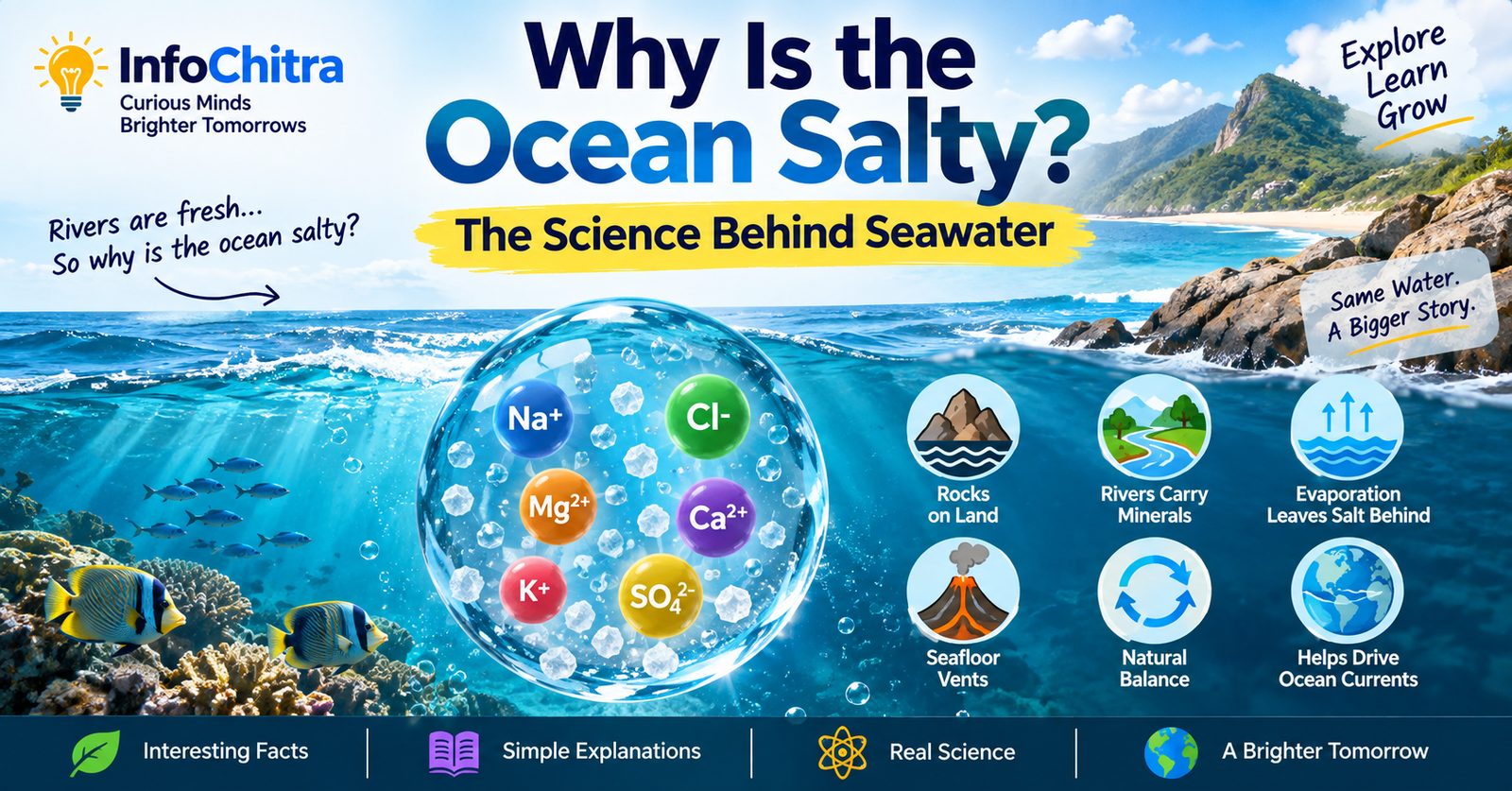
Why Is the Ocean Salty? The Science Behind Seawater
Have you ever wondered why the ocean is salty while most rivers and lakes are not?
If rivers continuously carry freshwater into the ocean, it seems logical to ask why the ocean doesn’t eventually become fresh.
The answer is connected to rocks, rain, rivers, the seafloor, evaporation and the Earth’s water cycle.
Ocean water contains dissolved minerals and salts that have accumulated through natural processes over very long periods of time. The average salinity of seawater is about 35 parts per thousand, meaning roughly 3.5% of seawater’s weight comes from dissolved salts.
So, why is the ocean salty?
Let’s follow the journey of those dissolved minerals from land to the sea.
The Simple Answer: Rocks Are One of the Main Sources
One of the biggest sources of the ocean’s dissolved salts is surprisingly simple:
Rocks on land.
When rain falls on land, it isn’t chemically identical to pure water. Rainwater absorbs carbon dioxide from the atmosphere, making it slightly acidic. As rainwater moves over and through rocks, it gradually breaks down minerals and releases dissolved ions.
Streams and rivers then carry these dissolved materials toward the ocean.
The process can be simplified like this:
Rain → Rocks → Dissolved minerals → Rivers → Ocean
This doesn’t mean that rivers are completely free of dissolved minerals. In fact, rivers contain many dissolved substances.
The difference is that the concentration is generally much lower than in seawater.
How Does Salt Get From Rocks Into the Ocean?
Imagine rain falling on a mountain.
Some of the water flows across the surface, while some enters cracks and soil. As it moves, the water interacts with rocks and minerals.
Over time, small quantities of minerals dissolve into the water.
That water eventually reaches:
- Streams
- Rivers
- Lakes
- Estuaries
- Coastal waters
- Oceans
The amount carried by an individual raindrop is tiny.
But Earth has been running this natural process for an enormous length of time.
That makes a major difference.
According to the NOAA explanation of ocean salinity, rocks on land are a major source of salts dissolved in seawater.
What Is Actually in Seawater?

When people hear the word “salt,” they often think only about the table salt used in cooking.
But seawater contains many different dissolved ions.
The two most abundant are:
Sodium and chloride.
These are the components associated with ordinary sodium chloride, or table salt.
NOAA says sodium and chloride together account for about 85% of the dissolved ions in seawater, while USGS describes them as making up more than 90% of dissolved ions depending on how the dissolved-ion composition is expressed.
Seawater also contains ions such as:
- Magnesium
- Sulfate
- Calcium
- Potassium
- Bicarbonate
There are also many other substances present in much smaller amounts.
So when we say “ocean salt,” we are really talking about a complex mixture of dissolved substances rather than only the salt sitting in a kitchen container.
Why Are Rivers Usually Not Salty?
This is one of the most interesting parts of the question.
If rivers carry dissolved minerals into the ocean, why don’t rivers taste as salty as seawater?
The main reason is concentration.
Freshwater rivers can contain dissolved minerals, but their salt concentration is generally much lower than that of seawater.
Rain continuously adds relatively fresh water to rivers, while rivers are also constantly moving water downstream.
The ocean, on the other hand, is the enormous receiving basin for water and dissolved material coming from countless rivers around the world.
NOAA explains that rivers bring dissolved salts and minerals to the ocean, while the ocean’s salinity is influenced by several other processes as well.
So a river isn’t necessarily “salt-free.”
It is simply much less salty than the ocean.
Evaporation Makes the Difference Even More Important
There is another major part of the story:
Evaporation.
When sunlight heats ocean water, some water molecules escape into the atmosphere as water vapor.
But the dissolved salts do not evaporate with the water.
The salt stays behind.
This means:
Ocean water → evaporation → water vapor leaves → dissolved salts remain
The water vapor later becomes clouds and eventually returns as precipitation.
The salt doesn’t simply follow the water through the atmosphere.
This is one reason evaporation can increase salinity in particular ocean regions. NASA notes that areas with high evaporation tend to have saltier surface waters, while heavy rainfall and river input can make surface waters fresher.
But Why Doesn’t the Ocean Become Saltier Forever?
This is an important question.
If rivers keep bringing dissolved minerals into the ocean and evaporation leaves salts behind, shouldn’t the ocean become increasingly salty forever?
Not necessarily.
The ocean has natural processes that also remove dissolved materials.
For example, some dissolved substances are used by marine organisms. Others can become incorporated into sediments or react with rocks and minerals.
Ocean water also interacts with the seafloor.
NOAA explains that salt inputs and outputs are roughly balanced over long periods, meaning the ocean is not simply becoming saltier every year without limit.
So the ocean has something like a natural chemical balance:
Salt enters → salt is transformed or removed → long-term balance
That balance is one reason the average salinity of the major ocean basins has remained relatively stable over long periods.
The Seafloor Also Adds Minerals
The story doesn’t begin and end on land.
The ocean floor itself contributes dissolved minerals.
Deep beneath the ocean, seawater can enter cracks in the Earth’s crust. The water is heated by Earth’s internal heat and reacts with surrounding rocks.
Eventually, this chemically altered water can return to the ocean through hydrothermal vents.
These vents can release dissolved minerals and metals into the surrounding seawater.
Underwater volcanic activity can also contribute minerals to the ocean.
So the ocean receives dissolved substances from both above and below:
Land → rivers → ocean
and
Seafloor → hydrothermal activity → ocean
Why Doesn’t Evaporation Leave Salt on the Ocean Surface?

You might imagine that if evaporation leaves salt behind, the surface of the ocean should eventually become covered with a huge layer of salt.
That doesn’t happen because the ocean is constantly moving and mixing.
Waves, winds, currents and other processes distribute dissolved substances throughout the water.
At the same time, rain and river water add freshwater in many regions, while evaporation removes freshwater in others.
NASA explains that differences in salinity are important for understanding the global water cycle and ocean circulation.
So the ocean isn’t a giant still container.
It is a constantly moving system.
Why Are Some Parts of the Ocean Saltier Than Others?
The entire ocean doesn’t have exactly the same salinity everywhere.
Salinity can vary because of factors such as:
- Evaporation
- Rainfall
- River discharge
- Melting or freezing of ice
- Ocean currents
- Mixing between different water masses
For example, areas with strong evaporation can become saltier because freshwater leaves while dissolved salts remain.
Heavy rainfall can have the opposite effect by adding freshwater.
River discharge can also lower the salinity of nearby coastal waters.
NOAA notes that ocean salinity varies with temperature, evaporation and precipitation, with regional patterns across the world’s oceans.
Salt Helps Move Ocean Water Around the Planet
Ocean salt isn’t just interesting chemistry.
It also plays an important role in Earth’s climate system.
Salt changes the density of seawater.
Temperature affects density too.
When seawater becomes colder and saltier, it can become dense enough to sink.
This sinking and movement of water is part of the large-scale circulation of the oceans.
NASA explains that differences in dissolved salt content play an important role in moving seawater and the heat it carries around the globe.
This means that the salt in the ocean is connected to something much bigger:
Earth’s climate system.
For more about Earth’s natural systems, you can also explore our article on Why Does Ice Float on Water? and our explanation of Why Do We Have Seasons?.
Can Humans Drink Seawater?
No — not as a normal source of drinking water.
Seawater contains far more dissolved salt than the human body can safely handle.
When the kidneys process excess salt, they need water to help remove it. Drinking seawater can therefore make the body’s water balance worse rather than providing useful hydration.
This is why seawater must be desalinated before it can be used as drinking water.
Desalination technologies can remove dissolved salts from seawater and produce freshwater, although the process requires energy and infrastructure.
Is Ocean Water the Same as Table Salt Mixed With Water?

Not exactly.
If you put table salt into a glass of water, you create a simple salt solution.
Seawater is much more complicated.
It contains a mixture of many dissolved ions and other substances, not just sodium chloride.
That is why scientists use the broader term salinity when describing the concentration of dissolved salts in seawater.
The average ocean salinity is about 35 parts per thousand, or roughly 3.5% by weight.
The Ocean’s Salt Has a Very Long History
The salt in today’s ocean wasn’t added all at once.
It accumulated through natural geological and chemical processes over enormous periods of Earth’s history.
Rain interacted with rocks.
Rivers transported dissolved minerals.
Volcanic activity contributed materials.
Hydrothermal systems interacted with the ocean floor.
Marine organisms and geological processes removed some substances.
Evaporation concentrated salts in the remaining seawater.
Over geological time, these processes helped create the salty oceans we know today.
So the next time you stand beside the sea and taste salt in the water, you’re experiencing the result of a planet-scale geological and water-cycle process.
Frequently Asked Questions
Why is the ocean salty?
The ocean is salty mainly because dissolved minerals from rocks are carried by rainwater, streams and rivers into the sea. Seafloor hydrothermal activity and underwater volcanic processes also contribute dissolved materials.
Why are rivers not as salty as oceans?
Rivers do contain dissolved minerals, but their concentration is usually much lower. Rivers also continuously receive freshwater from precipitation and transport water downstream.
Does evaporation make the ocean saltier?
Evaporation removes freshwater while leaving dissolved salts behind, which can increase salinity in areas where evaporation is strong.
Will the ocean keep getting saltier forever?
No. The ocean has natural processes that remove or transform dissolved materials. Over long periods, salt inputs and outputs are approximately balanced.
What is the average salinity of seawater?
Average seawater salinity is approximately 35 parts per thousand, or about 3.5% by weight.
What are the main salts in seawater?
Sodium and chloride are the most abundant dissolved ions in seawater. Magnesium and sulfate are also significant components.
Why can’t humans drink seawater?
Seawater contains too much dissolved salt for the human body to use safely as drinking water. Drinking it can worsen dehydration rather than solve it.
Does ocean salt affect climate?
Yes. Salinity affects seawater density and contributes to large-scale ocean circulation, which helps move heat around the planet.
Conclusion
So, why is the ocean salty?
The answer is not simply “because salt is in the ocean.”
It is a story involving rain, rocks, rivers, evaporation, the seafloor, volcanic activity and Earth’s water cycle.
Rain slowly breaks down rocks and carries dissolved minerals into rivers. Rivers transport those minerals to the sea. Hydrothermal vents and underwater volcanic activity add more dissolved materials from beneath the ocean. Meanwhile, evaporation removes freshwater while leaving salts behind.
At the same time, natural processes remove and transform dissolved substances, helping maintain a long-term balance in ocean salinity.
The result is one of Earth’s most important chemical systems:
Rocks → Rain → Rivers → Ocean → Evaporation → Water Cycle
And that salty ocean isn’t just something we see at the beach. Its chemistry helps influence ocean circulation, climate and life across the planet.
If you enjoyed this explanation, explore more everyday science questions on InfoChitra, including Why Does Ice Float on Water?, Why Does the Moon Change Shape?, and Why Is the Sky Blue?.