
Why Does Your Shadow Change Size During the Day?
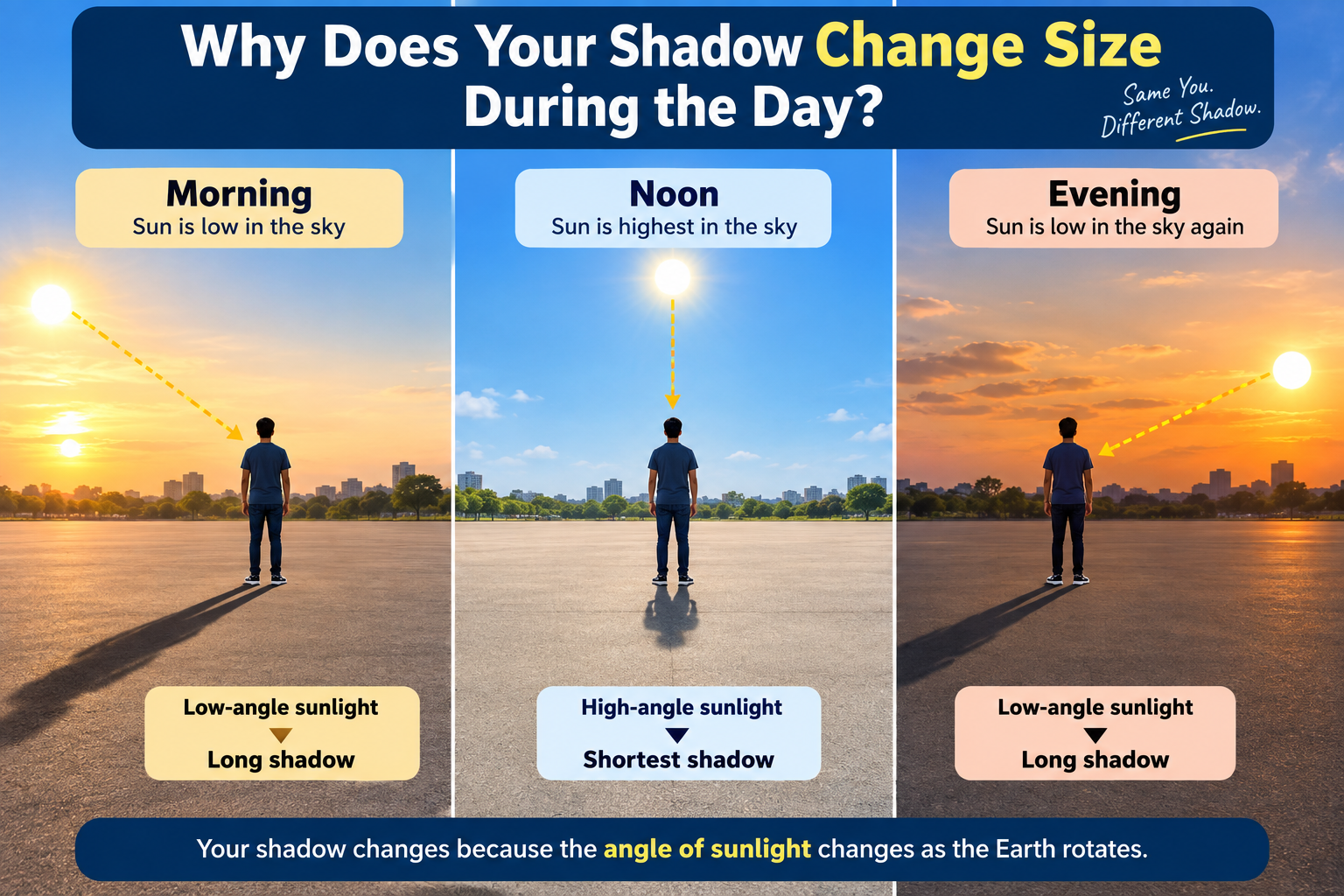
Have you ever noticed that your shadow can look very long in the morning, much shorter around noon, and long again in the evening?
You may stand in exactly the same place, but your shadow doesn’t stay the same size.
So, why does your shadow change size during the day?
The simple answer is this:
Your shadow changes because the angle of sunlight reaching you changes as the Sun appears to move across the sky.
When the Sun is low near the horizon, sunlight reaches you at a shallow angle and your shadow stretches a long way across the ground. When the Sun is higher in the sky, the light comes down at a steeper angle, making your shadow much shorter.
Let’s see exactly how this works.
What Is a Shadow?
Before understanding why a shadow changes size, it helps to understand what a shadow actually is.
A shadow forms when an object blocks some or all of the light coming from a light source.
In everyday life, the main light source is the Sun.
When sunlight travels toward the ground and something such as a person, tree, building or pole gets in its way, the object blocks the light behind it. The darker region created on the ground or another surface is the shadow.
The important thing to remember is that a shadow does not have a fixed size.
Its size and direction depend largely on the position and angle of the light source.
That is why the same person can have dramatically different shadows at different times of the day.
Why Does Your Shadow Change Size During the Day?
The biggest reason is the changing angle of the Sun in the sky.
The Sun appears to travel from east to west during the day because Earth rotates on its axis.
As the Sun’s apparent position changes, the angle at which sunlight reaches the ground changes too.
That changes the length of the shadow.
Think about shining a flashlight at an object.
If you hold the flashlight almost horizontally, the object can cast a long shadow.
But if you move the flashlight higher so that the light shines more directly downward, the shadow becomes much shorter.
Sunlight works in a similar way.
Why Is Your Shadow Long in the Morning?
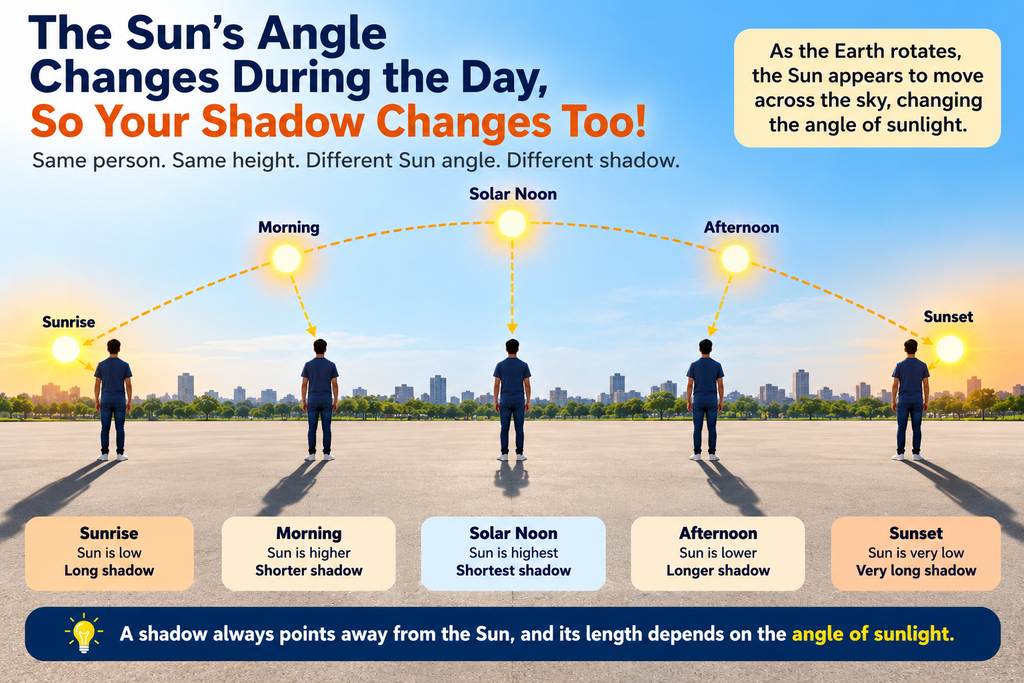
Early in the morning, the Sun is relatively low in the eastern sky.
Its rays reach the ground at a shallow angle.
Because the sunlight is coming from a low angle, the shadow of an object stretches a long distance in the opposite direction.
So if you stand outside soon after sunrise, you may see a surprisingly long shadow.
NASA explains that when the Sun is close to the horizon, shadows are stretched to greater lengths.
Morning pattern:
Low Sun → Low-angle sunlight → Long shadow
For example, imagine a person who is 1.7 metres tall.
In the early morning, that person’s shadow can extend several metres depending on the Sun’s elevation and the location.
The person hasn’t changed height.
The angle of the sunlight has changed.
Why Does the Shadow Become Shorter?
As the morning continues, the Sun appears to climb higher into the sky.
The sunlight now reaches the ground at a steeper angle.
The shadow therefore doesn’t need to stretch as far.
As the Sun gets higher:
Higher Sun → Steeper sunlight → Shorter shadow
This is why you can sometimes watch your shadow getting noticeably shorter as the morning progresses.
Why Is Your Shadow Shortest Around Noon?
Around local solar noon, the Sun reaches its highest point in the sky for that day.
This is when shadows are generally at their shortest. NASA notes that the shortest shadow occurs when the Sun reaches its highest point in its daily path.
But there is an important detail:
Solar noon is not necessarily exactly 12:00 on your clock.
It depends on your location, date and time zone.
So when we say “noon” in terms of shadows, we are talking about the time when the Sun is highest in the sky at your particular location.
In some parts of the tropics, the Sun can even be almost directly overhead at certain times of the year. On those occasions, objects can cast extremely short shadows — and in some locations there are special zero-shadow days when the Sun is directly overhead at solar noon.
Why Does Your Shadow Get Longer Again in the Afternoon?
After solar noon, the Sun begins to appear lower in the western sky.
The angle of incoming sunlight becomes shallower again.
As a result, your shadow starts stretching out once more.
The pattern is essentially a mirror image of the morning:
Morning:
Long → Short
Around solar noon:
Shortest
Afternoon:
Short → Long
Near sunset:
Very long
NASA describes this same daily pattern: shadows become longer after noon as the Sun moves back toward the horizon.
Why Is Your Shadow Very Long Near Sunset?
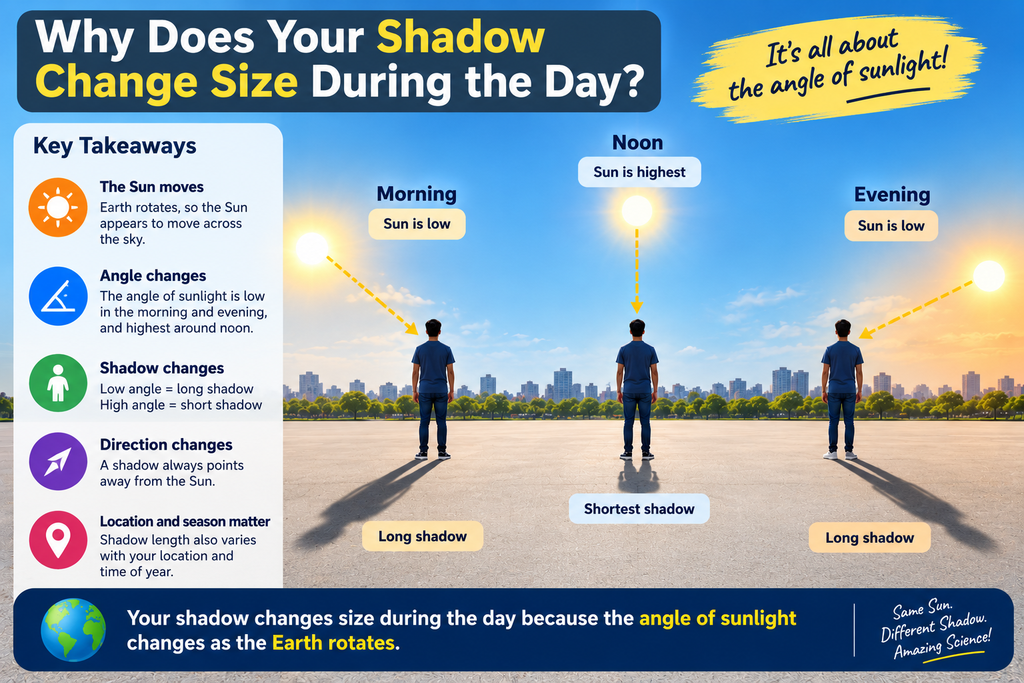
Near sunset, the Sun is once again very low in the sky.
The sunlight reaches the ground at a shallow angle.
That causes objects to cast very long shadows.
This is also why late-afternoon sunlight can make even small objects, bumps and surface features cast prominent shadows. NASA observations show how low Sun angles produce much longer shadows.
So the basic daily cycle looks like this:
| Time of day | Sun’s position | Shadow |
|---|---|---|
| Morning | Low | Long |
| Late morning | Higher | Shorter |
| Solar noon | Highest | Shortest |
| Afternoon | Lower | Longer |
| Evening | Very low | Very long |
Does the Shadow Only Change Size?
No.
Your shadow can change both its length and its direction.
This happens because the Sun changes position across the sky.
In the morning, the Sun is generally in the east, so your shadow points roughly toward the west.
Later, as the Sun moves across the sky, the direction of your shadow changes.
By evening, when the Sun is in the west, your shadow points roughly toward the east.
NASA describes this relationship clearly: a shadow points away from the Sun.
So your shadow is actually giving you information about where the Sun is in the sky.
Does Earth Rotate or Does the Sun Move?
This is where things become even more interesting.
The Sun appears to move across our sky from east to west, but the main reason for this daily movement is Earth’s rotation.
Earth rotates on its axis.
As Earth turns, different parts of the planet face toward or away from the Sun.
From our point of view, this makes the Sun appear to travel across the sky.
And because the Sun’s apparent position changes, the angle of sunlight changes.
That causes the changing size and direction of shadows.
So the chain is:
Earth rotates → Sun appears to move across the sky → sunlight angle changes → shadow changes
Why Doesn’t Everyone Have the Same Shadow Length?
The shadow of the same object can be very different depending on where you are on Earth.
Latitude matters because the Sun doesn’t appear at the same height in the sky everywhere.
The time of year also matters because Earth’s axis is tilted and Earth moves around the Sun.
For example, NASA explains that the angle of incoming sunlight varies with both time of day and latitude, affecting illumination and shadow patterns.
This means that a 1-metre stick can produce very different shadow lengths in:
- Chennai
- Delhi
- London
- New York
- near the equator
- near the Arctic Circle
The Sun’s position in the sky is different in each location.
Can You Use a Shadow to Tell the Time?
Yes — at least approximately.
Long before modern clocks became common, people observed the movement of shadows to track the passage of time.
This led to the development of sundials.
A simple sundial uses a stationary object called a gnomon. As the Sun appears to move across the sky, the gnomon’s shadow changes position.
By marking those positions, people could estimate the time.
Space: 10 Amazing Facts About the Universe
NASA educational material demonstrates how the length and position of a shadow change throughout the day and how these changes can be used in a sundial.
So your shadow isn’t just something you see on the ground.
It can act like a natural clock.
Try This Simple Shadow Experiment
You don’t need a laboratory to see the science for yourself.
All you need is:
- A sunny day
- A straight stick
- A flat piece of ground
- Chalk or small objects
- A clock or phone
Step 1: Place the stick
Put the stick upright on the ground where it will receive sunlight throughout the day.
Step 2: Mark the shadow
Mark the end of the stick’s shadow and write down the time.
Step 3: Repeat
Do the same thing every 30 or 60 minutes.
Step 4: Compare
Look at the marks at the end of the day.
You should see that the shadow:
Starts long → becomes shorter → reaches its shortest point → becomes longer again.
You will also notice that the shadow’s direction changes during the day.
NASA recommends a similar shadow-marking activity for observing how shadow length changes over time.
Can a Shadow Ever Almost Disappear?
Yes.
If the Sun is almost directly overhead, an upright object can have a very short shadow.
In certain tropical locations, there are even days when the Sun is directly overhead at solar noon and objects can produce extremely small or effectively zero shadows.
NASA calls these zero-shadow days and notes that their dates depend on latitude.
This doesn’t happen everywhere.
It is mainly possible in locations between the Tropic of Cancer and Tropic of Capricorn.
Does the Shadow Change Because the Sun Gets Bigger or Smaller?
No.
The Sun isn’t changing its size every few hours.
The main reason your shadow changes during the day is the changing angle of sunlight.
When the Sun is low, the light travels across the ground at a shallow angle and produces long shadows.
When the Sun is high, the light approaches more directly and produces shorter shadows.
So the next time you see a huge shadow in the morning and a tiny one around midday, remember:
The object hasn’t changed. The light has changed.
The Simple Science Behind Your Shadow
The whole phenomenon can be summarized in one simple idea:
The lower the Sun is in the sky, the longer the shadow. The higher the Sun is, the shorter the shadow.
That’s why:
Morning → Long shadow
Solar noon → Shortest shadow
Evening → Long shadow
And because the Sun’s position also changes from east to west, the direction of the shadow changes too.
What looks like an ordinary shadow is actually a visible demonstration of Earth’s rotation and the changing geometry of sunlight.
Frequently Asked Questions
Why is my shadow longer in the morning?
The Sun is lower in the sky in the morning, so sunlight reaches the ground at a shallower angle. This makes your shadow stretch farther.
Why is my shadow shortest at noon?
Around local solar noon, the Sun reaches its highest point in the sky for that day. This produces the shortest shadow of the day in most situations.
Why does my shadow get longer again in the evening?
After solar noon, the Sun becomes lower in the western sky. The lower angle of sunlight creates a longer shadow.
Does the shadow change direction too?
Yes. A shadow generally points away from the light source, so as the Sun’s position changes across the sky, the shadow’s direction changes too.
Can shadows tell us the time?
Yes. Sundials use the changing position of a shadow to estimate time.
Does the season affect shadow length?
Yes. The Sun’s height in the sky also changes with season and latitude, so the same object can produce different shadow lengths at different times of the year.
Conclusion
Your shadow may look simple, but it is actually a small science experiment happening every day.
In the morning, the Sun is low and your shadow stretches out.
As the Sun rises higher, your shadow becomes shorter.
Around solar noon, it reaches its shortest length.
Then, as the Sun moves lower toward the western horizon, your shadow becomes longer again.
The next time you see your shadow change during the day, you are watching the changing angle of sunlight — and the effects of Earth’s rotation — right in front of you.
A shadow doesn’t change because the object changes. It changes because the light changes.