
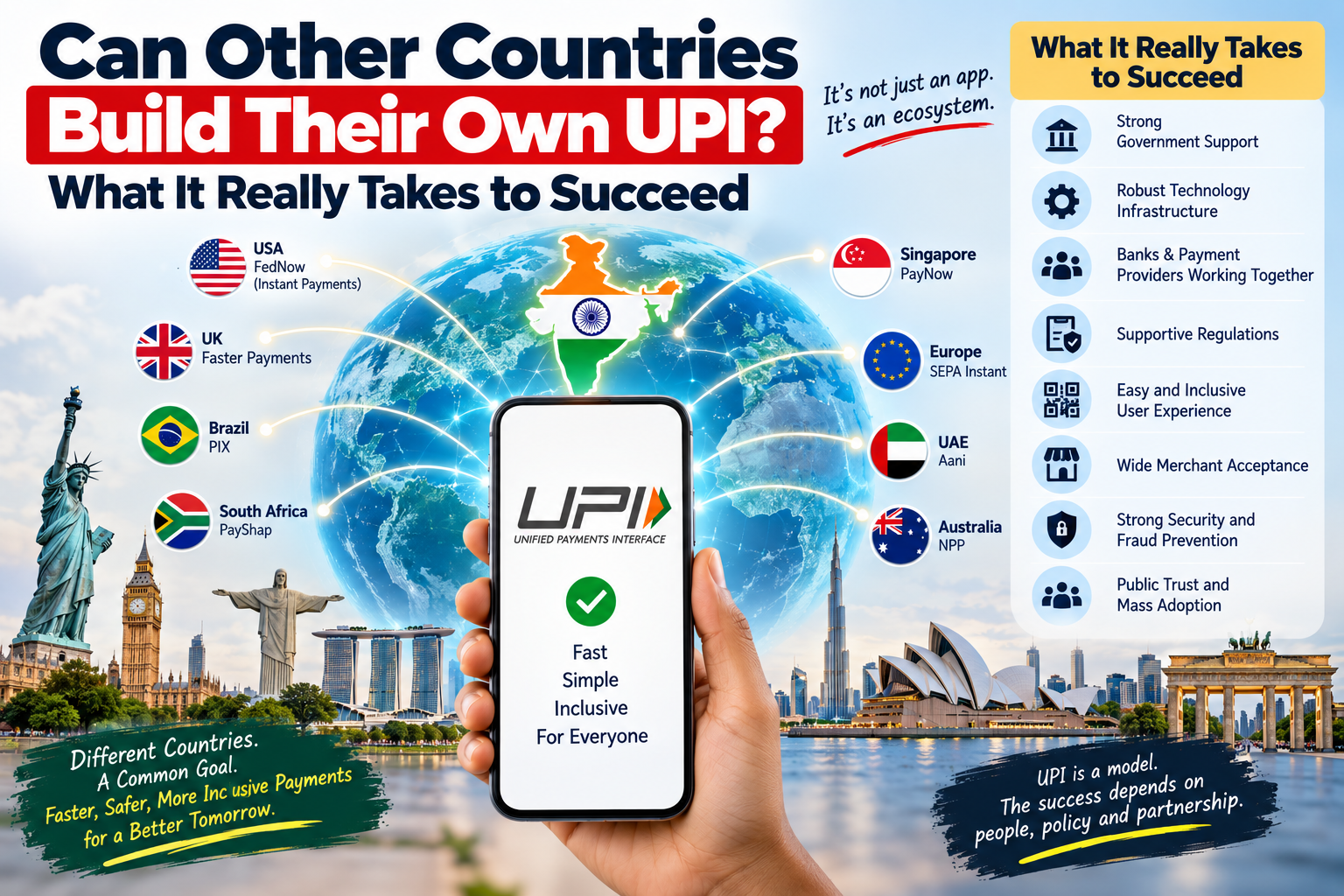
Can Other Countries Build Their Own UPI? What It Really Takes to Succeed
India’s UPI has become the gold standard of digital payments, processing over 24 billion transactions a month by 2026. Naturally, this raises an obvious question: if UPI works this well, why can’t every country simply copy it? Some nations already have — with remarkable success. Others, including the world’s largest economy, are still struggling to get there. So what actually separates success from failure when a country tries to build its own UPI?
The answer isn’t about technology at all. It’s about structure, incentives, and political will — and the countries that have succeeded prove exactly what’s required.
Table of Contents
- Brazil Already Did It — And Pix Is Beating Credit Cards
- Thailand’s PromptPay Reached Near-Total Population Coverage
- Singapore Took a Slower, More Cautious Path
- So Why Hasn’t the US Built Its Own UPI Yet?
- Lesson 1: You Need One Central Authority, Not Many Competing Ones
- Lesson 2: Banks Need Strong Incentives to Join and Interoperate
- Lesson 3: Low Costs Can Accelerate Mass Adoption
- Lesson 4: Building Fresh Beats Retrofitting Old Systems
- Lesson 5: Successful Payment Systems Can Disrupt Existing Revenue Models
- Can Any Country Do This? Realistically, Yes — But It Takes the Right Ecosystem
1. Brazil Already Did It — And Pix Is Beating Credit Cards
Brazil’s Pix system, launched by the country’s central bank in late 2020, is arguably the clearest proof that UPI-style success can be replicated. By 2024, Pix had already surpassed the combined number of credit and debit card transactions in Brazil. According to a 2026 study covered by Reuters, Pix accounted for 42% of Brazil’s online purchases, narrowly overtaking credit cards at 41%, and is projected to reach 50% of e-commerce transactions by 2028.
Perhaps most tellingly, Pix has brought more than 70 million previously unbanked Brazilians into the formal financial system — almost exactly the kind of financial inclusion story UPI is known for in India.
2. Thailand’s PromptPay Reached Near-Total Population Coverage
Thailand offers an even more extreme success story. Launched in 2017 by the Bank of Thailand, PromptPay had registered more than 77 million users by early 2025 — a number that actually exceeds Thailand’s total population of roughly 70 million, since many people register multiple identifiers. By mid-2025, the system was clearing more than 74 million transactions every single day, with account-to-account payments capturing 44% of e-commerce value and 43% of point-of-sale value — the highest share of any market in Southeast Asia.
PromptPay has also expanded beyond Thailand’s borders, linking with Singapore’s PayNow, Malaysia’s DuitNow, and Indonesia’s QRIS for cross-border QR payments — something even UPI is still working toward internationally.
3. Singapore Took a Slower, More Cautious Path
Singapore’s PayNow, also launched in 2017, took a somewhat different route. Rather than aiming for Brazil or Thailand’s explosive growth curve, Singapore focused on building interoperability carefully — linking PayNow with Thailand’s PromptPay in April 2021 as the first bilateral instant payment system link in the ASEAN region. Singapore is now studying a second generation of PayNow, including proposals to bridge it with other local QR schemes.
This slower, more deliberate approach shows that UPI-style success doesn’t require a single explosive rollout — steady, well-coordinated expansion can work just as well over time.

4. So Why Hasn’t the US Built Its Own UPI Yet?
This brings us back to the world’s largest economy, which remains the clearest example of a UPI-style system struggling to gain traction. The US actually has two competing instant payment networks — The Clearing House’s RTP (launched 2017) and the Federal Reserve’s FedNow (launched 2023) — but as of 2024, only about 58% of financial institutions offering instant payments used both networks, and major banks including Bank of America, Citigroup, and PNC still hadn’t joined FedNow at all.
Unlike countries that have concentrated their instant-payment infrastructure under a single national framework, the United States has developed multiple instant-payment networks and relies on financial institutions choosing to participate in them.
5. Lesson 1: You Need One Central Authority, Not Many Competing Ones
Every successful case shares one structural feature: a single, powerful central authority designed the system and pushed it through. In India, that’s the NPCI. In Brazil and Thailand, it’s the central bank directly. The US, by contrast, has payment infrastructure fragmented across thousands of individual banks, the Federal Reserve, and private companies — each protecting its own territory, with no single entity holding both the authority and the mandate to unify them.
Without this central authority, a country ends up with exactly what the US has: two incompatible, competing networks instead of one shared standard.
6. Lesson 2: Banks Need Strong Incentives to Join and Interoperate
In every success story, banks had strong incentives to join and interoperate — whether through regulatory encouragement, central bank coordination, or clear commercial benefits of joining a shared network. FedNow, by contrast, relies on financial institutions choosing to participate, and while adoption has grown steadily, some of the largest, most influential banks have been slower to join, which can limit how quickly the network reaches full-scale interoperability.
When incentives to join and interoperate aren’t strong enough for the players with the most market power, systemic change becomes more difficult, regardless of how good the technology itself is.
7. Lesson 3: Low Costs Can Accelerate Mass Adoption
UPI’s explosive adoption in India was driven partly by regulatory frameworks promoting low or zero fees for small transactions, removing much of the financial friction that might otherwise discourage everyday users. Brazil followed a similar pattern — Pix is generally free for individuals, though some fees can apply in certain business or high-value scenarios. In the US, real-time payment networks operate within an established card and banking ecosystem that already generates substantial revenue through existing fee structures, which can mean less immediate commercial pressure to shift toward a lower-cost alternative.
Any country hoping to replicate UPI’s success would benefit from keeping everyday transaction costs low, since affordability appears to meaningfully accelerate how quickly ordinary users adopt a new payment system.
8. Lesson 4: Building Fresh Beats Retrofitting Old Systems
Brazil designed Pix as an entirely new, central-bank-led instant payment infrastructure launched in 2020. India’s path was somewhat different: UPI was built over the country’s existing IMPS (Immediate Payment Service) infrastructure, extending it with a new layer that enabled the app-based, interoperable experience users know today. Both approaches relied on strong central coordination, but they didn’t follow the exact same technical path. The US, in contrast, carries decades of existing card and banking infrastructure without the same degree of centralized coordination guiding its evolution, making a unified overhaul far more technically and politically complicated.
This helps explain why newer, smaller economies without deeply entrenched payment incumbents — including Singapore, Thailand, and the UK — have generally moved faster than economies with older, more established financial systems.

9. Lesson 5: Successful Payment Systems Can Disrupt Existing Revenue Models
Perhaps one of the more uncomfortable dynamics behind UPI-style success is this: a low-cost, instant payment system can meaningfully shift revenue away from existing players in the payments industry. In Brazil, card networks have seen their market share affected as Pix has grown — and Brazil’s central bank has faced scrutiny, including a US trade practices probe, over its dual role as both Pix’s operator and the financial system’s regulator, with concerns raised specifically by American card companies watching their business model come under pressure.
Countries where card companies and large banks hold significant political and economic influence may find it more challenging to advance similar reforms quickly, even when the underlying technology is sound.
10. Can Any Country Do This? Realistically, Yes — But It Takes the Right Ecosystem
Based on the pattern across India, Brazil, Thailand, and Singapore, successfully building a UPI-style system requires several conditions working together: strong institutional coordination, broad participation by banks and payment providers, affordable everyday payments, effective technical infrastructure, and a regulatory and commercial environment that supports widespread adoption.
Emerging economies without deeply entrenched card industries — across parts of Africa, Southeast Asia, and Latin America — are generally better positioned to replicate this success than mature, developed economies where card companies and large banks hold significant political influence. This is precisely why smaller, newer economies have often moved faster than economic giants like the United States.
UPI-Style Systems Around the World at a Glance
| Country | System | Launch Year | Status in 2026 |
|---|---|---|---|
| India | UPI | 2016 | 24.5+ billion transactions/month |
| Brazil | Pix | 2020 | Surpassed combined card transactions |
| Thailand | PromptPay | 2017 | 77M+ registrations, 74M+ daily transactions |
| Singapore | PayNow | 2017 | Cross-border links with Thailand, Malaysia |
| United States | FedNow / RTP | 2023 / 2017 | Two competing, non-interoperable networks |
Frequently Asked Questions
Has any country actually replicated UPI’s success? Yes. Brazil’s Pix and Thailand’s PromptPay are widely considered success stories, with Pix surpassing combined card transactions in Brazil and PromptPay reaching near-total population coverage in Thailand.
Why hasn’t the US managed to build a UPI-style system? The US has developed multiple instant-payment networks rather than a single unified system, and broader interoperability has taken time to build as financial institutions choose how and when to participate — a different path from countries that coordinated a single national framework from the outset.
What is the single most important factor for success? There is no single factor that guarantees success. Strong institutional coordination, broad participation, interoperability, affordable payments and a convenient user experience all matter.
Do UPI-style systems need to be free to use? Not necessarily. However, keeping everyday digital payments affordable can reduce friction and encourage mass adoption. Different countries can use different pricing models depending on their financial ecosystem.
Which countries are best positioned to build similar systems next? Emerging economies without deeply entrenched card industries — particularly in parts of Africa, Southeast Asia, and Latin America — are generally seen as better positioned than mature economies with powerful existing card and banking industries.
Conclusion
UPI’s success was never just a matter of clever engineering — it was the product of strong institutional coordination, broad participation from banks and payment providers, affordable everyday transactions, and a regulatory environment that supported widespread adoption. Brazil and Thailand show this combination can be replicated elsewhere, while the United States illustrates how a more fragmented path can shape a slower, less unified journey toward the same goal. The building blocks for the next UPI already exist in many places — the real question for any country is how effectively it can bring institutions, incentives, and infrastructure together.
(Related reading: UPI and Digital Payments in India 2026: 10 Ways India Is Leading the World)