
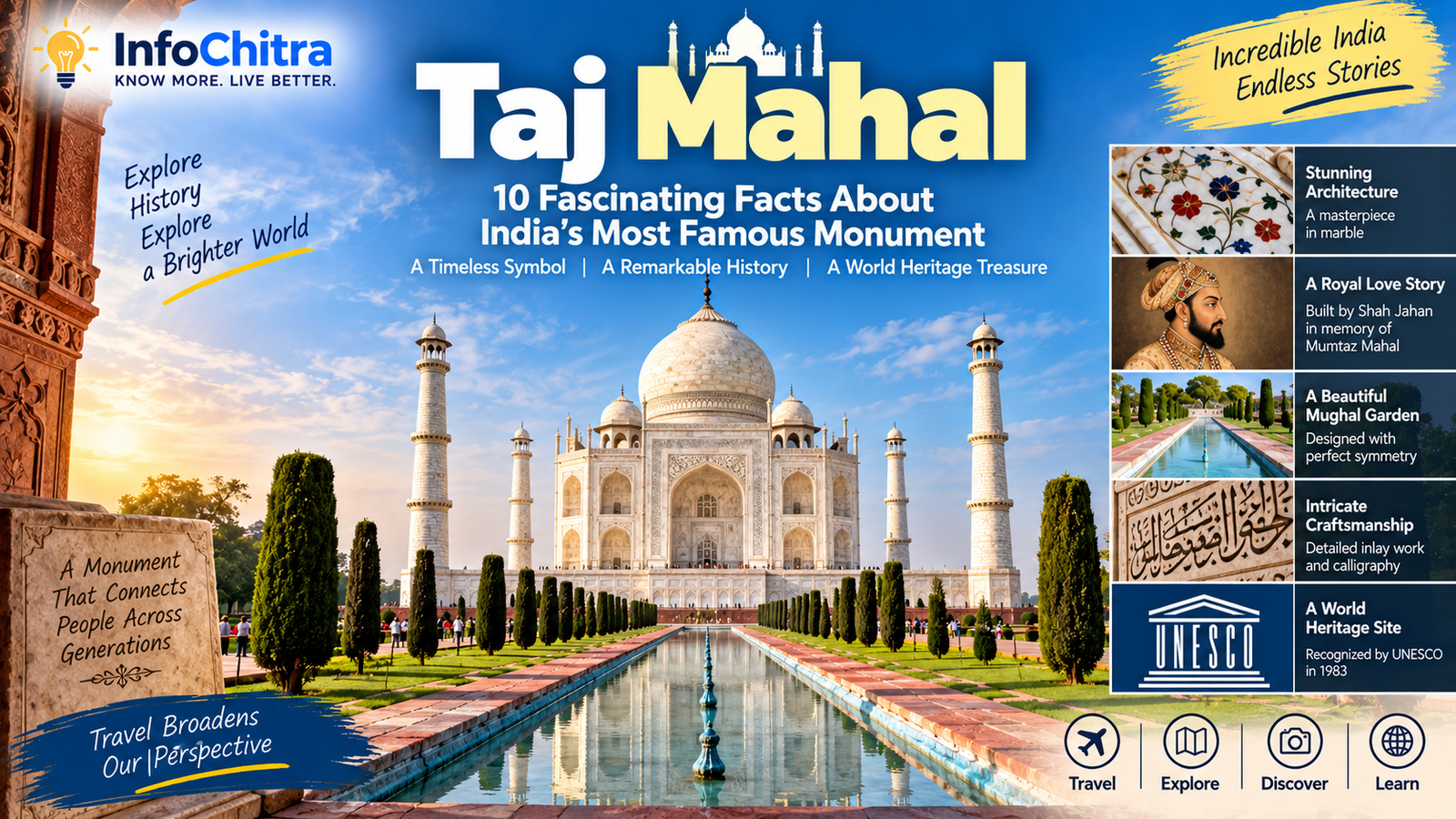
Taj Mahal: 10 Fascinating Facts About India’s Most Famous Monument
Few monuments in the world are as instantly recognizable as the Taj Mahal.
Standing beside the Yamuna River in Agra, Uttar Pradesh, the monument is famous for its white marble architecture, enormous dome, gardens, intricate stone inlay and remarkable symmetry. But the Taj Mahal is much more than a beautiful building.
It is a masterpiece of Mughal architecture, a monument connected with the history of Emperor Shah Jahan and Mumtaz Mahal, and a UNESCO World Heritage Site.
UNESCO describes the Taj Mahal as one of the universally admired masterpieces of world heritage and identifies it as an outstanding achievement of Indo-Islamic architecture.
Here are 10 fascinating facts that help explain why the Taj Mahal continues to attract visitors from around the world.
1. The Taj Mahal Is in Agra, India
The Taj Mahal is located in Agra, in the Indian state of Uttar Pradesh.
It stands on the right bank of the Yamuna River, within a large Mughal garden complex covering nearly 17 hectares.
Agra was an important centre of the Mughal Empire, and the city contains several major historical monuments.
The nearby Agra Fort is another UNESCO World Heritage Site and was closely connected with the Mughal rulers.
For travellers, this makes Agra particularly important because several major historical attractions can be explored in the same trip.
2. Shah Jahan Ordered Its Construction
The Taj Mahal was commissioned by Mughal Emperor Shah Jahan in memory of his wife Mumtaz Mahal.
According to UNESCO, construction of the main monument began in 1632, and the principal mausoleum was completed in 1648. Some parts of the larger complex were completed later, with the mosque, guest house, main gateway and other elements forming part of the finished complex.
The monument therefore represents not only architectural achievement but also an important chapter in Mughal history.
3. It Was Built Mainly With White Marble
The brilliant appearance of the Taj Mahal comes largely from its use of white marble.
But marble is only part of the story.
The complex also uses red sandstone and decorative inlay work involving precious and semi-precious stones. UNESCO highlights the detailed marble relief work and stone inlay as important elements of the monument’s artistic character.
The combination of white marble, colourful stone inlay, gardens and changing daylight gives the monument a distinctive appearance.
4. The Taj Mahal Is Famous for Its Symmetry
One of the most striking features of the Taj Mahal is its carefully balanced design.
The main mausoleum follows a highly organized plan, with a central chamber surrounded by other architectural elements. Four minarets stand at the corners of the main platform.
UNESCO describes the monument as having exceptional balance, symmetry and harmonious integration of architectural elements.
This symmetry is not accidental. It was an important part of the architectural concept behind the complex.
5. The Four Minarets Are Part of the Design
The four minarets surrounding the main mausoleum are among the Taj Mahal’s most recognizable features.
They provide visual balance to the central structure and enhance the three-dimensional appearance of the monument.
UNESCO notes that the minarets contribute both spatial reference and visual depth to the overall architectural composition.
Together with the central dome, they create the iconic silhouette that has become associated with the Taj Mahal worldwide.
6. The Taj Mahal Is Surrounded by a Mughal Garden
The monument is set within a large charbagh-style garden.
The garden is organized using pathways and water channels that create geometric divisions.
Interestingly, the mausoleum itself is positioned toward one end of the garden rather than directly in its centre. UNESCO identifies this as an important feature of the Taj Mahal’s architectural and garden planning because it creates depth and perspective in the approach to the monument.
The reflecting pool and garden pathways also contribute to the famous visual composition of the Taj Mahal.
7. The Main Tomb Is Not the Actual Grave Chamber
Many visitors may not realize that the highly decorated cenotaphs visible inside the main tomb are not the actual burial chambers.
The upper cenotaphs are symbolic representations.
UNESCO explains that the actual graves are located in the lower tomb chamber, or crypt, beneath the main chamber. The cenotaph of Shah Jahan was placed beside that of Mumtaz Mahal after his death.
This arrangement follows a broader tradition found in Mughal imperial tomb architecture.
8. Thousands of Skilled Artisans Contributed to the Monument
The Taj Mahal was not the work of a single craftsman.
UNESCO records that artisans including masons, stone-cutters, inlayers, carvers, painters, calligraphers and dome builders were brought together for the project. Craftspeople came from different parts of the Mughal Empire as well as from Central Asia and Iran.
UNESCO identifies Ustad-Ahmad Lahori as the principal architect associated with the Taj Mahal.
The monument therefore represents the combined skills of many specialists working within a highly organized construction project.
9. The Taj Mahal Became a UNESCO World Heritage Site in 1983
The Taj Mahal was inscribed on the UNESCO World Heritage List in 1983.
UNESCO considers it an outstanding example of Indo-Islamic architectural achievement and recognizes its exceptional artistic and architectural qualities.
The monument is also protected and managed by the Archaeological Survey of India (ASI), according to UNESCO’s World Heritage documentation.
Its international recognition has helped establish the Taj Mahal as one of the world’s most important cultural heritage sites.
10. The Taj Mahal Is More Than Just One Building
When people think about the Taj Mahal, they usually picture the famous white marble mausoleum.
But the Taj Mahal is actually a larger architectural complex.
The UNESCO World Heritage property includes the main tomb, mosque, guest house, main gateway, garden and associated structures.
The mosque and guest house are positioned on opposite sides of the central mausoleum, contributing to the overall balance of the complex.
This is an important reason why the Taj Mahal should be understood as a complete architectural composition rather than simply a single marble tomb.
Indus Valley Civilization: 10 Fascinating Facts About One of the World’s Earliest Civilizations
Frequently Asked Questions
Why was the Taj Mahal built?
The Taj Mahal was commissioned by Mughal Emperor Shah Jahan in memory of his wife Mumtaz Mahal.
Where is the Taj Mahal located?
The Taj Mahal is located in Agra, Uttar Pradesh, India, on the right bank of the Yamuna River.
When was the Taj Mahal built?
Construction of the main mausoleum began in 1632 and was completed in 1648. Some elements of the wider complex were completed later.
Who built the Taj Mahal?
The project was commissioned by Shah Jahan and involved numerous skilled artisans and specialists. UNESCO identifies Ustad-Ahmad Lahori as the principal architect.
Is the Taj Mahal a UNESCO World Heritage Site?
Yes. The Taj Mahal was inscribed on the UNESCO World Heritage List in 1983.
What is the Taj Mahal made of?
The main mausoleum is faced primarily with white marble, while the wider complex also uses red sandstone and decorative inlay with precious and semi-precious stones.
Is Shah Jahan buried inside the Taj Mahal?
Yes. Shah Jahan’s actual grave is in the lower tomb chamber beside the grave of Mumtaz Mahal. The cenotaphs visible in the upper chamber are symbolic.
Conclusion
The Taj Mahal is one of India’s greatest architectural and cultural landmarks.
Its importance comes from much more than its famous white marble exterior. Its carefully planned gardens, symmetrical architecture, intricate craftsmanship, Mughal history and UNESCO-recognized heritage value make it an extraordinary destination for travellers and history enthusiasts alike.
More than three centuries after its construction, the Taj Mahal continues to demonstrate how architecture can preserve history, culture and human creativity across generations.
For anyone visiting India, experiencing the Taj Mahal in person offers an opportunity to see one of the world’s most celebrated monuments while also discovering the much larger history of Agra and the Mughal era.
Why Is the Sky Blue? The Science Behind the Blue Sky