
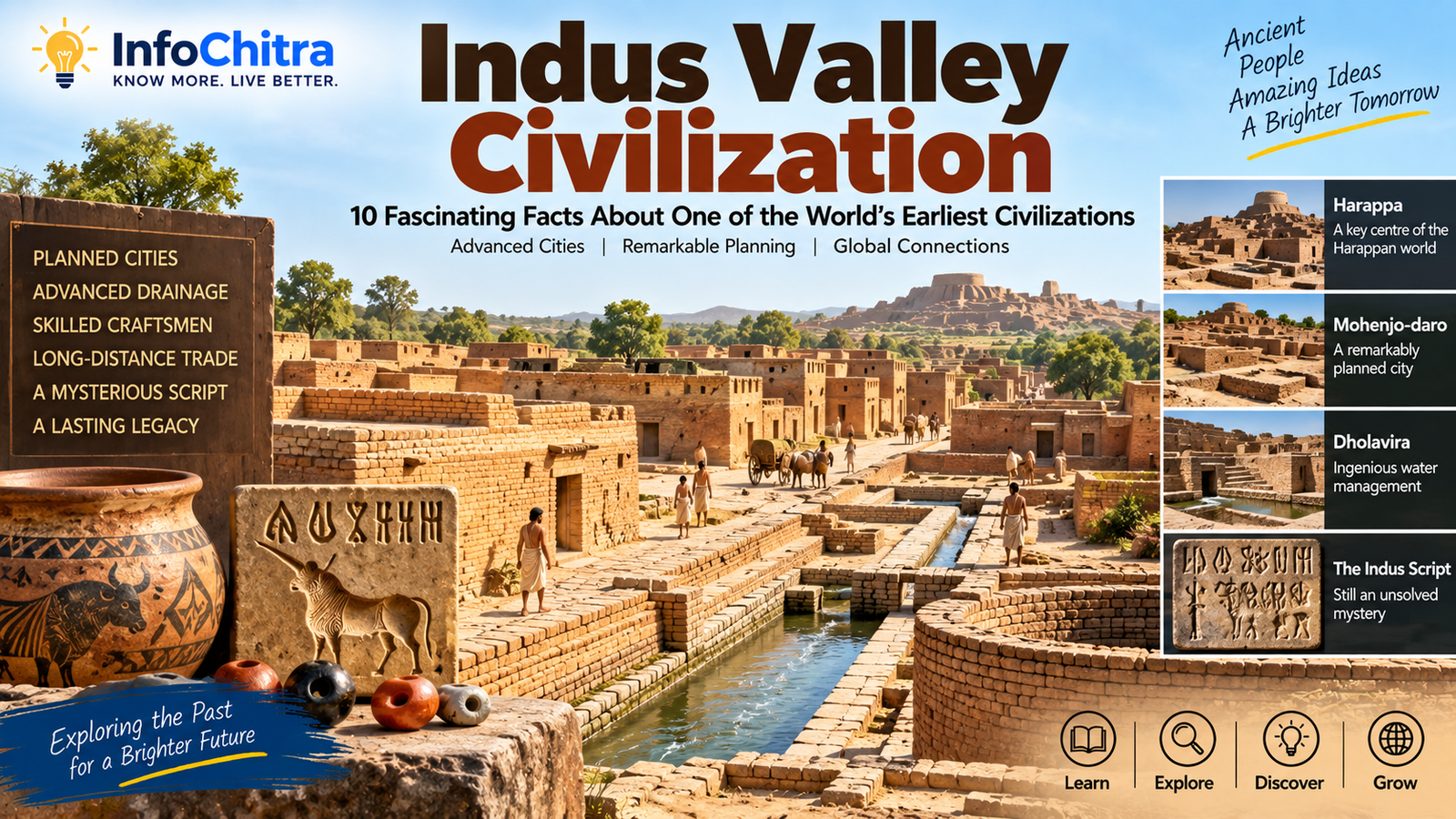
Indus Valley Civilization: 10 Fascinating Facts About One of the World’s Earliest Civilizations
Thousands of years ago, long before the rise of modern cities, people in South Asia were already building carefully planned settlements, managing water resources and participating in long-distance trade.
The Indus Valley Civilization, also called the Harappan Civilization, was one of the major Bronze Age civilizations of the ancient world. Its settlements extended across parts of present-day India and Pakistan, with important archaeological sites including Harappa, Mohenjo-daro, Dholavira and several others.
What makes this civilization particularly fascinating is the combination of impressive archaeological evidence and unanswered questions. Researchers have found planned streets, drainage systems, reservoirs, craft workshops and evidence of international trade, while the civilization’s script remains undeciphered.
The National Museum of India identifies the Harappan Civilization as one of the world’s oldest civilizations and highlights major centres including Harappa, Mohenjo-daro, Dholavira, Kalibangan, Lothal and Rakhigarhi.
Let’s look at ten important facts that help explain why this ancient civilization remains so significant.
1. It Was a Bronze Age Civilization
The Indus Valley Civilization belongs to the Bronze Age.
Its mature urban phase is generally dated to around 2600–1900 BCE, although the broader Harappan cultural tradition began earlier and continued in different forms afterward.
Archaeological discoveries include numerous copper and copper-alloy objects, which are among the reasons the civilization is classified within the Bronze Age. The National Museum’s Harappan gallery includes examples of metalwork alongside other evidence of the civilization’s artistic and technological development.
Metalworking, however, was only one part of Harappan achievement. Their urban organization and management of water are equally important.
2. Its Settlements Covered a Huge Area
The name “Indus Valley Civilization” can be misleading if it suggests that Harappan settlements existed only beside the Indus River.
Archaeological sites associated with the civilization are spread across a much wider region of South Asia.
Among the best-known are Harappa, Mohenjo-daro, Dholavira, Rakhigarhi, Lothal and Kalibangan. The National Museum of India lists these and other centres as important parts of the Harappan archaeological record.
This broad geographical distribution is one reason historians frequently use the term Harappan Civilization.
3. Harappa Gave the Civilization Its Other Name
Harappa, in present-day Punjab, Pakistan, is one of the key archaeological sites associated with this civilization.
UNESCO’s description of the archaeological site records occupation stretching from the fourth to the second millennium BCE. The mature Harappan phase at Harappa is generally placed around 2600–1900 BCE.
The civilization’s alternative name, Harappan Civilization, comes from this important site.
Harappa also demonstrates that the civilization developed over a long period rather than appearing suddenly as a fully formed urban society.
Why Is the Sky Blue? The Science Behind the Blue Sky
4. Mohenjo-daro Was a Remarkably Planned City
Mohenjo-daro is probably the most famous Harappan urban site.
Located in present-day Sindh, Pakistan, it contains extensive archaeological remains dating back to the third millennium BCE.
UNESCO describes Mohenjo-daro as one of the best-preserved urban settlements of South Asia from this period. Its lower city was laid out with streets intersecting in an orderly pattern, while archaeological evidence includes wells, drainage, sanitation infrastructure and public structures.
For a city that is roughly five thousand years old, this level of urban organization is remarkable.
5. Water and Sanitation Were Central to Harappan Urban Life
One of the most striking characteristics of Harappan cities is the attention given to water management and sanitation.
At Mohenjo-daro, archaeologists have identified wells, drains and soak pits alongside its organized streets. UNESCO notes the site’s elaborate drainage and sanitation arrangements.
Dholavira provides an equally impressive example from present-day Gujarat.
Its inhabitants built reservoirs and water-management systems suited to an environment where water was limited. UNESCO identifies these systems as one of the site’s outstanding technological achievements.
The evidence suggests that water management was incorporated into the design of the settlement itself.
6. Dholavira Shows How the Harappans Adapted to a Dry Environment
Dholavira is particularly important for understanding the Indian side of the Harappan world.
Located on Khadir Island in Gujarat, the settlement was occupied from approximately 3000 to 1500 BCE, according to UNESCO. The site contains a fortified city, residential areas, reservoirs, drainage systems, workshops and a cemetery.
Its water infrastructure is especially notable.
Rather than depending entirely on naturally available water, the inhabitants developed systems for collecting and storing water. The city’s layout also demonstrates deliberate urban planning and the use of local resources.
Dholavira was added to the UNESCO World Heritage List in 2021.
7. Harappan Communities Participated in Long-Distance Trade
The Harappans were connected to trade networks extending well beyond their immediate surroundings.
Archaeological evidence from Dholavira points to interaction with other Harappan settlements and with regions associated with Mesopotamia and the Oman Peninsula.
Harappan craft production included objects made from copper, shell, stone, semi-precious stones, terracotta, gold and ivory.
Dholavira also contains evidence of specialized bead production.
These discoveries demonstrate that Harappan communities were not isolated settlements. They participated in networks through which raw materials, finished products and cultural influences could move across considerable distances.
8. The Indus Script Has Not Been Deciphered
One of the civilization’s greatest mysteries is its writing system.
Researchers have found inscriptions and symbols on seals and other archaeological objects, but the Indus script has not been conclusively deciphered.
That means historians still cannot confidently read these inscriptions as they can with many other ancient writing systems.
A successful decipherment could potentially provide information about subjects such as administration, trade, social organization and language.
Until that happens, archaeology remains our principal source for reconstructing Harappan life.
9. The Civilization Did Not Simply Disappear Overnight
Another common misconception is that the Indus Valley Civilization was suddenly destroyed by one event.
The archaeological evidence instead points toward a more complicated and gradual transformation of Harappan urban society.
Researchers have proposed several possible contributing factors, including changes in climate and monsoon patterns, changes to river systems, environmental pressures and changes in economic networks.
OpenStax notes that the decline took place in stages and that its precise cause remains uncertain. Environmental and river-related changes are among the explanations considered by researchers.
Therefore, it is better to describe this as a gradual decline and transformation of the mature urban system rather than claiming that one event destroyed the entire civilization.
10. It Changed Our Understanding of Ancient South Asia
The importance of the Indus Valley Civilization goes beyond its age.
The archaeological record demonstrates that complex urban societies existed in South Asia thousands of years ago and developed sophisticated approaches to city planning, water management, construction, craft production, trade and resource use.
Mohenjo-daro provides evidence of organized urban planning and sanitation, while Dholavira demonstrates sophisticated water management and settlement design.
At the same time, major questions remain unanswered. We still cannot conclusively read the Indus script, and many aspects of Harappan political and social organization remain subjects of archaeological research.
That combination of evidence and mystery makes the civilization especially compelling.
Frequently Asked Questions
When did the Indus Valley Civilization exist?
The mature Harappan urban phase is generally dated to approximately 2600–1900 BCE, although the broader cultural tradition existed for a considerably longer period. Harappa’s archaeological sequence extends from the fourth into the second millennium BCE.
Where was the Indus Valley Civilization located?
It occupied a large area of South Asia, including parts of present-day India and Pakistan. Major sites include Harappa, Mohenjo-daro, Dholavira, Rakhigarhi, Lothal and Kalibangan.
Are the Indus Valley Civilization and Harappan Civilization the same?
They generally refer to the same broad archaeological civilization. “Harappan Civilization” is often used because the archaeological evidence extends far beyond the immediate Indus River valley.
Was Mohenjo-daro part of the Indus Valley Civilization?
Yes. Mohenjo-daro was one of its major urban centres and provides extensive evidence of planned streets, drainage, wells and other urban infrastructure.
Has the Indus script been deciphered?
No. The script has not been conclusively deciphered, so many details about the written language and records of the civilization remain unknown.
Why did the Indus Valley Civilization decline?
There is no single universally accepted answer. Evidence indicates a complex process involving changes in settlement patterns, environment, climate, river systems and economic networks.
Is Dholavira part of the Indus Valley Civilization?
Yes. Dholavira was an important Harappan settlement in present-day Gujarat and became a UNESCO World Heritage Site in 2021.
Conclusion
The Indus Valley Civilization represents one of the most remarkable chapters in ancient South Asian history.
The planned streets of Mohenjo-daro, the water reservoirs of Dholavira, the evidence of specialized craftsmanship and the connections with distant trading regions all reveal a society capable of sophisticated organization thousands of years ago.
Yet some of its most important questions remain open.
Its script is still undeciphered, the precise nature of its political organization is uncertain, and the reasons behind the transformation of its urban centres continue to be investigated.
That combination of archaeological achievement and unanswered questions is precisely why the Indus Valley Civilization remains an important subject for anyone interested in the history of human civilization.
How to Study Smarter: 10 Proven Techniques That Actually Work