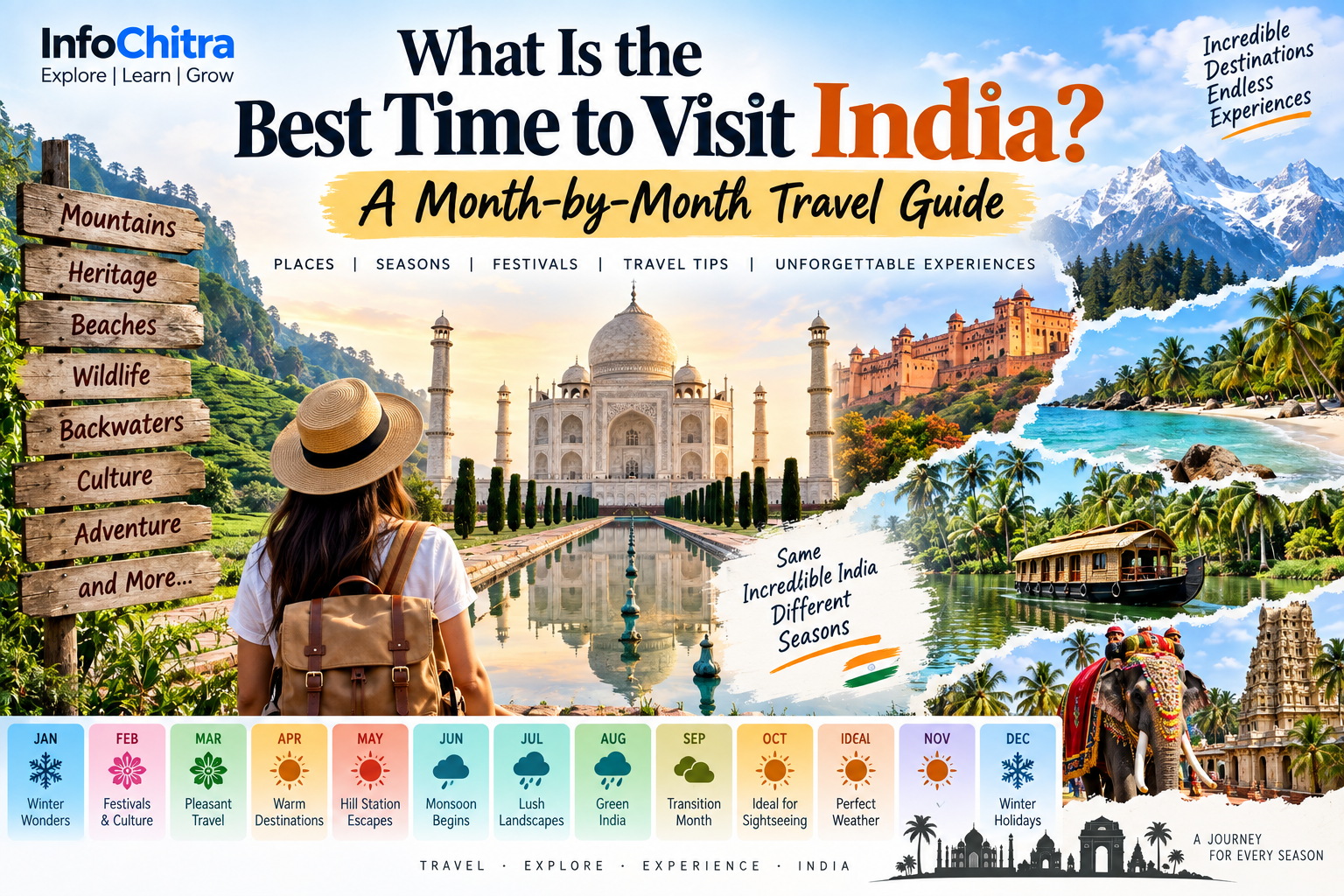
What Is the Best Time to Visit India? A Month-by-Month Travel Guide
India is one of the world’s most geographically diverse travel destinations.
You can find snow-covered mountains in the north, tropical beaches in the south, deserts in the west, lush forests in the northeast, historic cities, wildlife reserves and thousands of kilometres of coastline.
That diversity creates one important travel question:
What is the best time to visit India?
The answer depends on where you want to go and what you want to do.
There isn’t one perfect month for the entire country. India’s climate varies significantly between regions. The official Incredible India travel portal highlights different seasonal experiences across the country, from winter in the Himalayas to summer escapes in hill stations and monsoon landscapes.
So instead of simply saying “visit India from October to March,” let’s look at the country month by month and understand when different types of travel work best.
The Short Answer: What Is the Best Time to Visit India?
For many first-time travellers planning a broad trip across popular parts of India, October to March is often the most comfortable period.
But this is only a general rule.
For example:
- Himalayan destinations: timing depends heavily on snow and altitude.
- Rajasthan: cooler months are generally more comfortable for sightseeing.
- South India: conditions can differ significantly from northern India.
- Hill stations: summer can actually be an excellent time to visit.
- Monsoon destinations: rainfall can make landscapes greener and more dramatic.
Even within one state, conditions can vary.
For example, official tourism information lists very different monthly temperature ranges for Delhi, Madurai and Gangtok.
That is why destination matters more than a single national travel calendar.
Konark Sun Temple: 10 Fascinating Facts About India’s Architectural Wonder
India Travel Seasons at a Glance
| Season | Approximate period | What to expect |
|---|---|---|
| Winter | December–February | Cooler weather across many regions; snow in higher Himalayas |
| Spring | Late February–April | Pleasant in many areas; colourful festivals and changing landscapes |
| Summer | April–June | Hot in many plains; hill stations become attractive |
| Monsoon | Varies by region | Rain, greenery, waterfalls and different travel conditions |
The official Incredible India portal describes spring as generally pleasant, summer as hot in the plains but attractive in hill regions, monsoon as a lush period, and winter as a snowy season in Himalayan areas.
January — Excellent for Many North and Central India Trips
January is part of India’s winter season.
For travellers interested in historic cities, monuments and cultural sightseeing, cooler weather can make long days outdoors more comfortable.
Popular possibilities include:
- Delhi
- Rajasthan
- Agra
- Gujarat
- Madhya Pradesh
- Parts of South India
Higher Himalayan destinations can be extremely cold and snowy.
If your dream is to experience snow, January can be attractive for destinations such as Gulmarg, Manali and Auli, although actual conditions vary from year to year. Incredible India specifically highlights winter sports and snowy experiences in Himalayan destinations during December–February.
Best for:
Heritage, culture, winter travel and snow experiences.
February — One of the Most Comfortable Months
February continues the winter season in much of India but gradually moves toward spring.
It can be a good month for sightseeing because temperatures in many destinations are more manageable than during the hotter months.
This can work particularly well for:
- Rajasthan
- Delhi
- Agra
- Gujarat
- Central India
- Some southern destinations
For travellers who want to combine several destinations, February can offer a useful balance between comfortable weather and outdoor activities.
Best for:
Multi-city trips, heritage tourism and comfortable sightseeing.
March — Spring Begins
March is a transition month.
Northern India gradually becomes warmer, while many parts of the country can still be comfortable for travel earlier in the month.
India’s official tourism portal describes spring as running roughly from late February through April, with pleasant conditions in many regions and festivals including Holi, Baisakhi, Gudi Padwa and Ugadi.
March can therefore be particularly interesting for travellers who want:
- Festivals
- Cultural experiences
- Heritage
- Wildlife
- Early spring landscapes
Best for:
Festivals, culture and spring travel.
Golden Temple: 10 Fascinating Facts About India’s Holiest Sikh Shrine
April — Consider the Region Carefully

April is when the heat begins becoming a serious consideration in many parts of India.
Northern plains and central India can become increasingly hot.
But that doesn’t mean April is a bad month to travel.
It simply means you should choose your destination carefully.
Hill stations such as:
- Shimla
- Ooty
- Darjeeling
- Munnar
can provide a cooler alternative to the plains.
Incredible India specifically recommends India’s hill regions as summer escapes from the heat of the plains.
Best for:
Hill stations, mountains and cooler destinations.
May — Choose Hills Over Hot Plains
May is among the hottest months in many parts of India.
For example, official tourism information for Delhi shows average monthly temperature ranges reaching very high levels during May.
If you’re planning a trip during May, consider:
- Himalayan destinations
- Hill stations
- Higher-altitude areas
- Some coastal destinations
Destinations such as Ooty, Darjeeling, Shimla and Munnar can offer a very different experience from India’s hot plains.
Best for:
Hill stations and high-altitude escapes.
June — Mountains Become More Attractive
June can still be extremely hot in many inland areas.
However, the Himalayan region and hill stations can become increasingly appealing.
This is also a transition period because India’s monsoon system begins affecting different regions at different times.
Travel conditions can therefore vary significantly depending on the destination.
Best for:
Mountains, hill stations and carefully planned regional trips.
July — Monsoon Travel Begins to Change the Experience

July is strongly associated with India’s monsoon period, although rainfall timing and intensity vary considerably across the country.
Instead of thinking:
Rain = bad travel
it is better to think:
Rain = a different kind of travel experience.
Green landscapes, waterfalls, forests and backwaters can become particularly attractive.
Incredible India highlights monsoon landscapes, waterfalls, lush forests and backwater experiences as part of India’s seasonal travel appeal.
However, heavy rainfall can also affect transport and outdoor plans in some locations.
Best for:
Green landscapes, waterfalls, nature and monsoon experiences.
Taj Mahal: 10 Fascinating Facts About India’s Most Famous Monument
August — Green India
August continues the monsoon season in many regions.
This can be a beautiful time for travellers who enjoy:
- Green landscapes
- Waterfalls
- Forests
- Photography
- Fewer-crowd experiences
But travellers should always check local weather and travel conditions before booking.
India is too geographically diverse for one national monsoon rule.
For example, even official destination pages show substantial differences in climate across places such as Gangtok, Madurai and Delhi.
Best for:
Nature, photography and lush landscapes.
September — A Useful Transition Month
September can be an interesting month for travel because conditions begin changing in many parts of India.
Some areas may still experience substantial rainfall, while others begin becoming more comfortable.
Mountain landscapes can look especially green after the monsoon.
This is a good month to check your destination specifically rather than relying on a general “India weather” search.
Best for:
Nature, mountains and shoulder-season travel.
October — One of the Most Popular Travel Months
October is often considered a major transition period for Indian travel.
The monsoon begins retreating in many regions, while temperatures become more comfortable in several popular destinations.
This makes October attractive for:
- Rajasthan
- Delhi
- Agra
- Heritage circuits
- Wildlife trips
- Cultural travel
- Multi-city itineraries
However, weather still varies by region.
Best for:
First-time visitors, heritage and multi-city trips.
November — Excellent for Many Popular Destinations

November is another strong month for many types of Indian travel.
The weather becomes cooler across northern and central areas, making sightseeing more comfortable.
Rajasthan, Delhi, Agra and several heritage destinations can be particularly attractive.
Southern India can also offer excellent travel opportunities, but regional rainfall patterns need to be considered.
Best for:
Heritage, culture, sightseeing and longer trips.
December — Winter Travel Begins
December brings winter conditions to many parts of India.
Northern India becomes cooler, while Himalayan regions can experience snowfall.
This makes December attractive for:
- Rajasthan
- Delhi
- Agra
- Cultural tourism
- Christmas and New Year travel
- Himalayan snow experiences
However, popular destinations can become busy during the holiday period.
Best for:
Winter holidays, heritage and snow destinations.
Best Time to Visit India by Travel Type
Instead of asking only “What is the best month?”, ask:
What kind of trip am I planning?
That produces a much more useful answer.
🏛️ For History and Heritage
Consider:
October to March
Cooler conditions can make long sightseeing days more comfortable in destinations such as Delhi, Agra and Rajasthan.
🏔️ For Himalayan Travel
The answer depends on exactly where you’re going.
Some destinations are best for trekking during warmer, clearer periods, while others become winter-sports destinations when snow arrives.
For example, official tourism guidance for Uttarkashi highlights March–June and September–November for pleasant weather and outdoor activities, while winter brings snow to higher areas.
General rule:
Check the individual Himalayan destination rather than applying one rule to the entire region.
🌴 For Beaches
Beach conditions vary considerably between India’s eastern, western and southern coasts.
Instead of choosing a month based only on “India weather,” check:
- Rainfall
- Sea conditions
- Temperature
- Local monsoon timing
- Hotel prices
- Tourist crowds
This is particularly important when comparing destinations on different coasts.
🌿 For Hill Stations
Summer can actually be one of the best times.
When India’s plains become very hot, destinations such as Ooty, Shimla, Darjeeling and Munnar can offer cooler conditions. Incredible India specifically highlights hill stations as summer escapes.
🐅 For Wildlife
Wildlife tourism is highly destination-specific.
National parks can have different opening periods, animal visibility patterns and weather conditions.
Always check the official park or state tourism information before planning.
Best Time to Visit Rajasthan
For many travellers, October to March is the most comfortable general period for exploring Rajasthan.
The reason is simple: summer temperatures can become extremely high.
Destinations such as Jaipur, Jodhpur, Udaipur and Jaisalmer are much easier to explore when temperatures are more comfortable.
For example, official tourism data shows Udaipur’s temperatures can rise substantially during April and May.
Best Time to Visit South India
South India cannot be treated as one climate zone.
Kerala, Tamil Nadu, Karnataka and Andhra Pradesh can have different rainfall and temperature patterns.
For example, official tourism information for Thiruvananthapuram shows relatively warm conditions throughout the year, while Madurai also remains warm year-round.
That means the right month depends heavily on:
which state + which destination + what you want to do.
Best Time to Visit Tamil Nadu
Tamil Nadu is particularly interesting because its rainfall pattern differs from many northern parts of India.
Destinations such as:
- Chennai
- Madurai
- Thanjavur
- Rameswaram
- Kanyakumari
- Ooty
- Mamallapuram
can have very different travel experiences.
For example, official tourism information shows Madurai remains warm throughout the year, with its highest listed average range occurring around May.
So a Tamil Nadu itinerary should be planned around the specific destinations, rather than simply following the general October–March rule.
Peak Season vs Shoulder Season
Choosing the best time isn’t only about weather.
You should also think about:
Peak Season
Usually means:
- More visitors
- Higher hotel prices
- Busy attractions
- More demand for transport
Shoulder Season
Can offer:
- Fewer crowds
- Potentially better prices
- Reasonable weather
- More relaxed sightseeing
Off-Season
Can mean:
- Lower prices
- Fewer tourists
- More challenging weather
- Some seasonal closures or reduced services
For some travellers, the shoulder season may actually be better than the traditional “best season.”
How to Choose the Best Month for Your India Trip
Before booking flights or hotels, ask these five questions:
1. Where am I going?
India is enormous.
Delhi and Madurai do not have the same climate.
2. What do I want to do?
Snow, beaches, wildlife, trekking and heritage sightseeing all have different ideal conditions.
3. Can I handle heat?
If not, avoid planning long outdoor sightseeing trips during the hottest periods in the plains.
4. Do I mind rain?
If you don’t, monsoon travel can offer beautiful landscapes and a different experience.
5. Is my travel date flexible?
If yes, compare peak, shoulder and off-season before booking.
This simple approach can save money and produce a much better trip.
So, What Is the Best Time to Visit India?
If you want one simple answer:
October to March is a strong general period for many popular Indian destinations.
But it is not the universal answer.
If you want snow, your ideal month may be different.
If you want a hill-station escape from summer heat, your best months may be April or May.
If you want lush monsoon landscapes, July to September may be more attractive.
If you’re visiting South India, local rainfall patterns need to be considered.
The best travel month is therefore not just about the calendar.
It’s about matching the destination + weather + activity + budget + personal preference.
Frequently Asked Questions
What is the best month to visit India?
For many popular destinations, October to March is a good general period, but the best month depends on the region and type of trip.
Is India good to visit in summer?
Yes. Although many plains become very hot, summer can be an excellent time for hill stations and higher-altitude destinations.
Is monsoon a bad time to visit India?
Not necessarily. Monsoon can be excellent for travellers who enjoy greenery, waterfalls and lush landscapes, but heavy rain can affect travel plans in some areas.
What is the best time to visit Rajasthan?
October to March is generally a comfortable period for exploring Rajasthan, particularly for outdoor sightseeing.
What is the best time to visit the Himalayas?
It depends on the destination and activity. Trekking, sightseeing and snow sports can have very different ideal seasons.
Is December a good time to visit India?
Yes. December is part of India’s winter season and can be a good period for many northern and central destinations, while Himalayan areas can offer snow experiences.
Can I travel to India during July and August?
Yes. These months can be rewarding for travellers who enjoy monsoon landscapes, but destination-specific weather and transport conditions should be checked before travelling.
Conclusion
There is no single month when all of India is at its best.
That’s what makes India interesting as a travel destination.
Winter can bring comfortable sightseeing and Himalayan snow. Spring brings festivals and changing landscapes. Summer sends travellers toward cooler mountains and hill stations. The monsoon transforms many landscapes into vibrant green environments.
So instead of asking:
“What is the best time to visit India?”
ask:
“What is the best time to visit the part of India I actually want to experience?”
That small change in the question can lead to a much better travel plan.
India is a destination for all seasons — you simply need to choose the right region for the season you’re travelling in.