
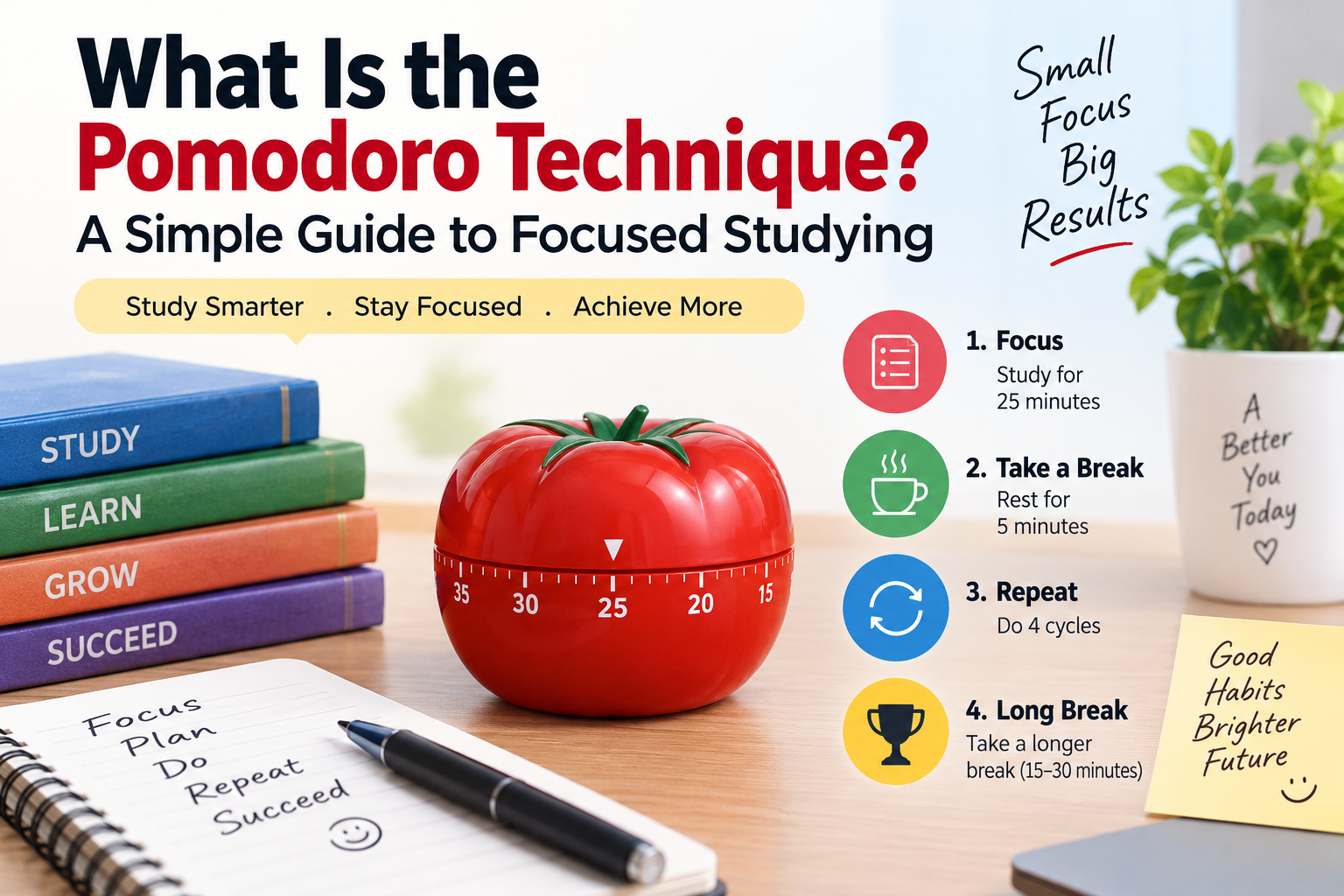
What Is the Pomodoro Technique? A Simple Guide to Focused Studying
The Pomodoro Technique exists precisely for moments like this: you sit down to study, fully intending to focus for hours — and within twenty minutes, you’re checking your phone, staring at the wall, or rereading the same paragraph for the fifth time. If this sounds familiar, you’re not alone, and the problem probably isn’t a lack of discipline. It’s that most people try to focus for far longer than their brain can realistically sustain.
The Pomodoro Technique offers a surprisingly simple fix for exactly this problem — and it was invented by accident, using nothing more than a kitchen timer. Here’s how it works, and why it’s remained popular for decades.
Table of Contents
- What Is the Pomodoro Technique?
- How a Tomato-Shaped Timer Started It All
- The Basic Steps: How to Actually Do It
- Why 25 Minutes Specifically?
- The Science Behind Why It Works
- What to Do About Interruptions
- Why an Analog Timer Might Work Better Than an App
- Which Subjects Benefit Most From This Method
- Common Mistakes People Make With the Technique
- How to Start Using It Today
1. What Is the Pomodoro Technique?
The Pomodoro Technique is a time management method that breaks work or study time into short, focused intervals — traditionally 25 minutes long — each followed by a short break. According to Wikipedia’s overview of the technique, each of these focused intervals is called a “pomodoro,” named after the Italian word for tomato.
At its core, the method is built around a simple idea: rather than trying to focus for hours at a stretch, you commit to short, intensely focused bursts of work, with guaranteed rest built directly into the structure.
2. How a Tomato-Shaped Timer Started It All

The technique was created by Francesco Cirillo in the late 1980s, when he was a university student struggling to focus on his own studies. According to Cirillo’s own account, it began as a small personal experiment: he challenged himself with the question, “Can I study for just two minutes without interruption?”
He used a kitchen timer shaped like a tomato to track these focused intervals — which is where the technique gets its name. What started as a personal coping strategy for exam preparation eventually grew into a structured method he later taught to individuals and teams, and which spread globally over the following decades.
3. The Basic Steps: How to Actually Do It
The core process is refreshingly simple:
- Choose one task you want to focus on
- Set a timer for 25 minutes (one “pomodoro”)
- Work on that single task until the timer rings, avoiding all other distractions
- Take a short 5-minute break once the timer ends
- Repeat this cycle, and after completing four pomodoros, take a longer break of 15–30 minutes
This structure gives you a clear, achievable goal for each work session, rather than facing the vague, often overwhelming pressure of “just focus for as long as possible.”
4. Why 25 Minutes Specifically?

Cirillo didn’t arrive at 25 minutes immediately. He initially experimented with much shorter and longer intervals — starting around two minutes and extending up to a full hour — before finding that 25-minute sessions worked best for maintaining genuine focus without becoming exhausting.
This specific duration also happens to align well with general research on human attention span, which suggests most people can sustain peak focus for approximately 20 to 45 minutes before experiencing noticeably diminishing returns.
5. The Science Behind Why It Works
The Pomodoro Technique isn’t just a productivity trick — it aligns with how the brain actually manages sustained attention. According to research on cognitive load, the brain requires periodic rest to consolidate information and restore its capacity for concentration, meaning marathon study sessions without breaks often become progressively less effective the longer they continue.
By working within this natural attention window and building in regular breaks, the technique aims to prevent the kind of mental exhaustion that leads to diminishing focus, while also helping shift your psychological relationship with time — turning it from a source of anxiety into a measurable, positive record of what you’ve actually accomplished.
6. What to Do About Interruptions

One of the technique’s core principles is that once a pomodoro begins, it should not be broken — not to check messages, answer a quick question, or address a sudden idea that pops into your head. Instead, any such distraction should simply be noted down to address later, once your current focused interval ends.
Cirillo specifically recommends tracking these interruptions as they happen, whether they come from external sources (a notification, a person interrupting you) or internal ones (a stray thought, sudden hunger, or the urge to check your phone) — and reflecting afterward on how to reduce them in future sessions.
7. Why an Analog Timer Might Work Better Than an App

While countless apps now exist to run the Pomodoro Technique digitally, Cirillo has specifically noted a preference for physical, analog timers over digital ones, believing they foster a more genuinely engaged mindset. The physical act of winding or setting a mechanical timer, and the visible, ticking countdown, can create a different psychological relationship with the passing time compared to glancing at a phone screen — a device already strongly associated with distraction for most people.
That said, for many students today, a simple digital timer or app remains a practical, accessible starting point, even if a physical timer offers a slightly different experience.
8. Which Subjects Benefit Most From This Method
The Pomodoro Technique tends to work particularly well for detail-oriented subjects requiring sustained concentration, such as mathematics, accounting, and computer programming, where working through complex problems benefits from focused, uninterrupted intervals. It also pairs well with reading-heavy coursework — including law, history, literature, or general exam revision — where structured breaks help prevent the glazed-over, unfocused feeling that often comes from hours of continuous reading.
Since the method is built around flexible, repeatable cycles, it can generally be adapted to almost any subject or task requiring sustained mental effort.
9. Common Mistakes People Make With the Technique
A common mistake is treating the Pomodoro Technique as nothing more than “work for 25 minutes, then take a break” — a drastically oversimplified version that misses much of the method’s actual structure and philosophy. Cirillo himself has noted that this stripped-down interpretation, while not technically wrong, risks people applying the technique mechanically without understanding the underlying principles that make it effective.
Other common mistakes include skipping the planning step of choosing a clear, single task before starting, breaking pomodoros early instead of noting distractions for later, and skipping the longer break after every fourth session, which can lead to cumulative fatigue over a long study day.
10. How to Start Using It Today
Getting started with the Pomodoro Technique requires no special tools or preparation:
- Pick one specific task you want to work on right now
- Set any timer — a phone app, a kitchen timer, or a simple online Pomodoro timer — for 25 minutes
- Commit to working only on that task until the timer rings, noting any distractions to handle later
- Take a genuine 5-minute break when the timer ends — step away, stretch, or rest your eyes
- After four completed pomodoros, take a longer 15–30 minute break before starting a new cycle
The simplicity of this system is precisely what has allowed it to spread from one university student’s personal experiment into a method used by students, developers, and professionals worldwide.
The Pomodoro Cycle at a Glance
| Step | Duration | What Happens |
|---|---|---|
| Choose a task | — | Pick one clear thing to focus on |
| Work interval (1 pomodoro) | 25 minutes | Focused work, no interruptions |
| Short break | 5 minutes | Step away, rest, recharge |
| Repeat | — | Complete 4 pomodoros total |
| Long break | 15–30 minutes | Extended rest before next cycle |
Who invented the Pomodoro Technique?
Francesco Cirillo, an Italian entrepreneur, created it in the late 1980s while a university student, using a tomato-shaped kitchen timer to structure his study sessions.
Why is it called the “Pomodoro”
“Pomodoro” is the Italian word for tomato, named after the tomato-shaped kitchen timer Cirillo originally used to time his focused work intervals.
Do I have to use exactly 25-minute intervals?
While 25 minutes is the traditional length Cirillo settled on after experimentation, some people adjust the duration slightly based on their own attention span, as long as they maintain the core structure of focused work followed by breaks.
What should I do if I get distracted during a pomodoro?
Note the distraction down to address later, rather than breaking your focused interval — this preserves the integrity of the method and helps you notice interruption patterns over time.
Is the Pomodoro Technique only useful for studying?
No. While popular among students, it’s also widely used by software developers, writers, and professionals across many fields for managing focused work sessions of any kind.
Conclusion
The Pomodoro Technique’s enduring popularity comes down to its simplicity: a tomato-shaped timer, a single focused task, and a guaranteed break, repeated in a structure that works with your brain’s natural attention span rather than against it. What began as one student’s personal experiment to survive exam preparation has become one of the most widely used focus techniques in the world — proof that sometimes the simplest tools are the ones that last.
(Related reading: How to Study Smarter: 10 Proven Techniques That Actually Work)