
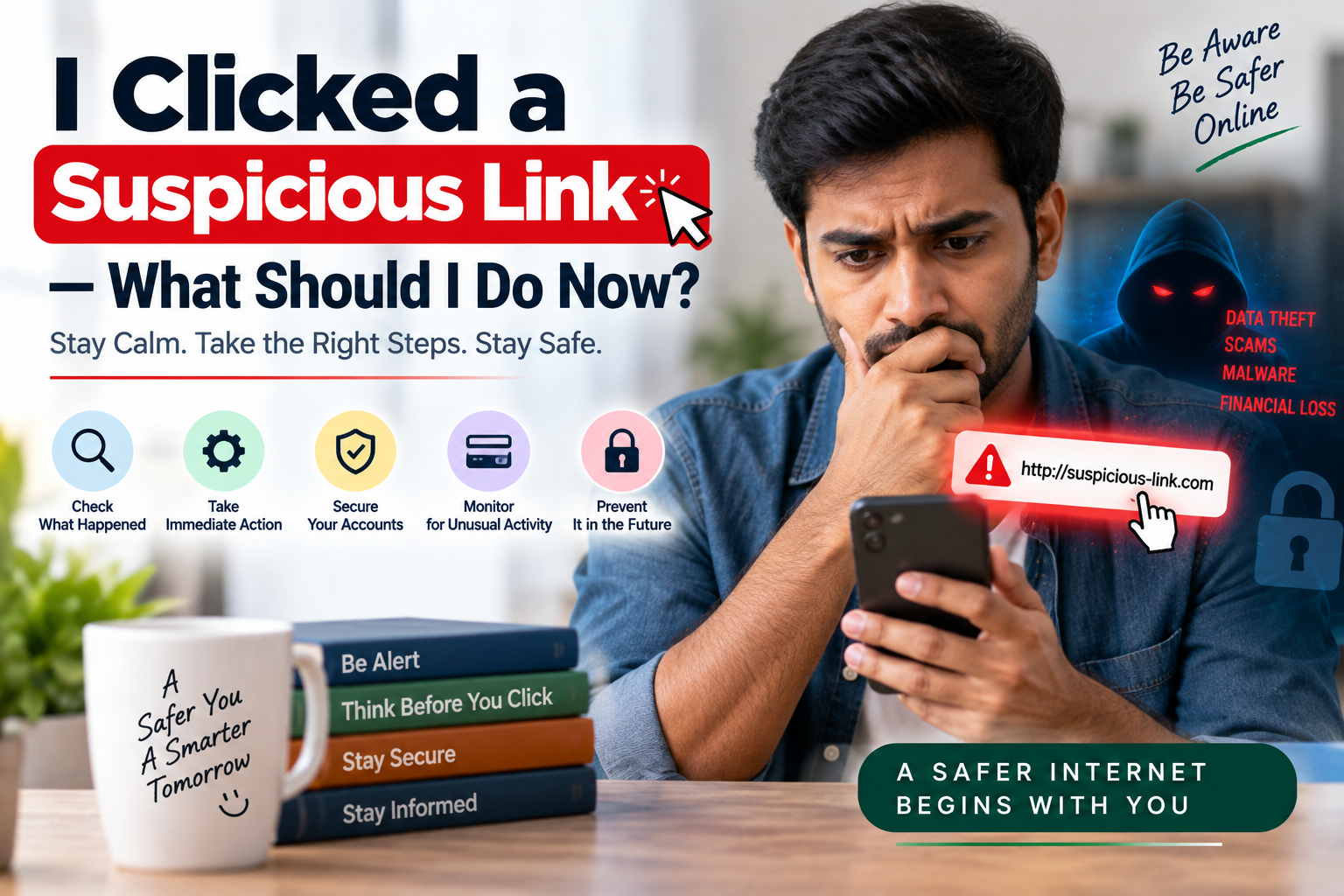
I Clicked a Suspicious Link — What Should I Do Now?
You tapped a link in a text message, email, or WhatsApp forward before fully thinking it through — and now something feels off. Maybe the page looked strange, maybe it asked for details you weren’t expecting to share, or maybe you simply realized a second too late that the message wasn’t quite right.
If this just happened to you, take a breath first. Clicking a suspicious link doesn’t automatically mean your device or accounts are compromised — but acting quickly and in the right order makes a real difference. Here’s exactly what to do, step by step.
Table of Contents
- Stay Calm — What Actually Happens When You Click
- Step 1: Disconnect From the Internet If Something Downloaded
- Step 2: Did You Enter Any Personal Information?
- Step 3: Change Your Passwords Immediately
- Step 4: Run a Malware Scan on Your Device
- Step 5: Monitor Your Bank and Card Accounts Closely
- Step 6: Report the Suspicious Link
- What If You Only Viewed the Page and Didn’t Type Anything?
- How to Spot a Suspicious Link Next Time
1. Stay Calm — What Actually Happens When You Click
Clicking a suspicious or phishing link can lead to one of two outcomes: it may trigger a malicious file download onto your device, or it may take you to a fake website designed to trick you into typing in sensitive information like passwords or card details.
Importantly, a single click doesn’t always mean you’re compromised. The actual risk depends on three things: what kind of link it was, whether anything downloaded automatically, and what you did after landing on the page. Understanding which scenario applies to you is the key to knowing how seriously to respond.
2. Step 1: Disconnect From the Internet If Something Downloaded
If clicking the link triggered an automatic download, or if a file opened on its own, the very first thing to do is disconnect your device from the internet — turn off Wi-Fi, or unplug your ethernet cable if you’re on a computer. This limits any malware’s ability to send your data out or download additional malicious files.
If nothing downloaded and you simply landed on a webpage without clicking anything further, you can skip this step and move on to checking what you may have entered.
3. Step 2: Did You Enter Any Personal Information?
This is the most important question in determining your next steps. Think carefully about what happened after the page loaded:
- You only viewed the page and didn’t type anything — your risk is much lower. Close the tab immediately and avoid entering any information.
- You typed a password, OTP, card number, or other personal details — you should treat this as compromised and act immediately using the steps below.
Being honest with yourself about which scenario applies is critical, since it determines how urgently you need to act.
4. Step 3: Change Your Passwords Immediately

If you entered login credentials on a suspicious page, change your password right away — but don’t do it by clicking any link from the suspicious message. Instead, go directly to the official app or type the website’s address manually into your browser.
If you reuse that same password on any other accounts, change those as well, since attackers often try reused passwords across multiple services once they obtain one. This is also a good moment to enable two-factor authentication (2FA) if you haven’t already, as it adds a layer of protection even if your password has been compromised.
5. Step 4: Run a Malware Scan on Your Device
Whether or not you’re certain something downloaded, it’s worth running a malware scan as a precaution. If you already have antivirus software installed, run a full scan and follow the prompts to quarantine or remove anything flagged as suspicious.
If you don’t have antivirus software and you’ve disconnected from the internet, avoid reconnecting just to download one — instead, use a different, unaffected device to download a trusted malware-scanning tool onto a USB drive, then install it on the affected device offline. If you’re not comfortable doing this yourself, taking the device to a professional is a reasonable next step.
6. Step 5: Monitor Your Bank and Card Accounts Closely
If there’s any chance you entered banking details, card numbers, or payment information on the suspicious page, contact your bank immediately to flag the situation — they may recommend blocking your card as a precaution, since fraudulent transactions can begin within minutes of a compromise.
Even if you didn’t enter payment details directly, it’s worth reviewing your recent bank and card statements over the following days for anything unfamiliar, since some phishing attempts are designed to harvest information gradually rather than immediately.
7. Step 6: Report the Suspicious Link
Reporting the link helps protect others from falling for the same scam, and in some cases can help you if you become a victim of fraud as a result.
In India, you can report cybercrime, including phishing attempts and suspicious links, directly to the government’s National Cyber Crime Reporting Portal, or call the national cybercrime helpline at 1930, which is specifically set up to help with financial fraud cases and can assist in freezing fraudulent transactions quickly if reported soon after they occur.
If the suspicious link impersonated a specific company — such as your bank or a delivery service — consider also forwarding the message to that company’s official fraud-reporting email address, so they can warn other customers.
8. What If You Only Viewed the Page and Didn’t Type Anything?
If you’re confident that you only saw the page and didn’t enter any information or trigger any download, your risk is genuinely low. In this case:
- Close the browser tab or app immediately
- Avoid clicking anything else on that page, including “close” or “back” buttons that appear inside the page itself — use your browser’s own controls instead
- Keep an eye on your accounts for the next few days out of general caution, even though the risk is minimal
It’s still worth staying a little more alert for follow-up scams for a while, since attackers sometimes know you’ve interacted with their message and may attempt to reach you again by phone or text.
9. How to Spot a Suspicious Link Next Time

While you can’t undo a click that’s already happened, a few habits can help you avoid this situation in the future:
- Hover before you click (on a computer) to see the actual destination URL, and check that it matches the company’s real website
- Be wary of urgency — messages that pressure you to “act now” or claim your account will be suspended are a classic phishing tactic
- Go directly to the source — if a message claims to be from your bank or a service you use, open the app or type the website address yourself instead of clicking the provided link
- Check for subtle misspellings in URLs, such as extra letters, unusual domain endings, or numbers replacing letters
Building this habit of pausing before clicking is, in the long run, far more effective than reacting after the fact.
What To Do If You Clicked a Suspicious Link — At a Glance
| Situation | Action |
|---|---|
| A file downloaded automatically | Disconnect from internet immediately |
| You only viewed the page | Close tab, avoid entering anything |
| You entered a password | Change it immediately (type URL manually) |
| You entered card/bank details | Contact your bank right away |
| Unsure if device is infected | Run a malware/antivirus scan |
| Want to report the scam | File a report at cybercrime.gov.in or call 1930 (India) |
Frequently Asked Questions
Will I definitely get hacked if I click a phishing link? Not necessarily. Clicking alone doesn’t guarantee compromise — the real risk depends on whether anything downloaded and whether you entered any personal information afterward.
Should I turn off my Wi-Fi if I clicked a suspicious link? Only if a file downloaded automatically or opened on its own. If you only viewed a webpage without any download or data entry, this step isn’t necessary.
I entered my password on a suspicious site — what’s the very first thing I should do? Change that password immediately by going directly to the official website or app — not through any link from the suspicious message — and update it on any other accounts where you reused the same password.
How do I report a phishing link in India? You can report it on the National Cyber Crime Reporting Portal or call the national cybercrime helpline at 1930, which can help with financial fraud cases.
Is it normal to feel anxious after clicking a suspicious link? Yes — phishing messages are specifically designed to prompt quick, reflexive clicks. Feeling caught off guard doesn’t mean you were careless; it means the scam worked as intended on a psychological level.
Conclusion
Clicking a suspicious link is more common than most people realize, and reacting calmly, in the right order, makes all the difference between a minor scare and a serious problem. Disconnect if needed, be honest with yourself about what you may have entered, change any exposed passwords, monitor your accounts, and report the scam so others can be protected too. A moment of carelessness doesn’t have to turn into lasting damage.
(Related reading: How to Identify Fake News Online: 10 Simple Ways to Verify Information)