
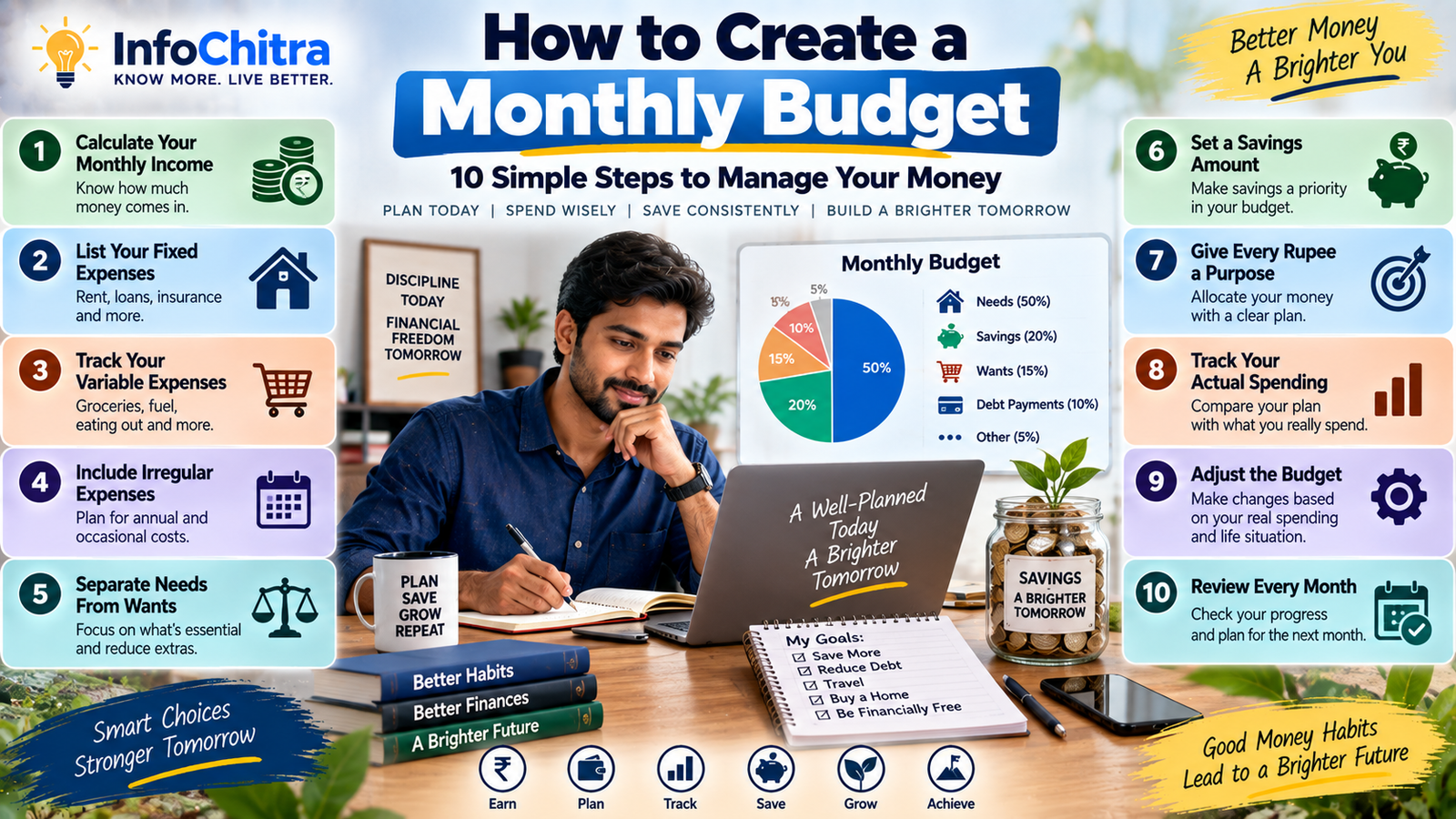
How to Create a Monthly Budget: 10 Simple Steps to Manage Your Money
Introduction
A monthly budget is not about stopping yourself from spending money. It is a simple plan that helps you understand how much money comes in, where it goes, and how much you can reasonably save or spend.
Consumer.gov describes a budget as a plan for deciding how money will be spent each month, while the CFPB recommends tracking income and spending and building a realistic working budget.
For someone starting from scratch, the goal is not to create a complicated spreadsheet. The goal is to create a simple monthly budget that you can actually follow.
1. Calculate Your Total Monthly Income
Start by finding out exactly how much money you expect to receive during the month.
Include:
- Salary or wages
- Freelance income
- Business income
- Pension or other regular income
- Other reliable sources of income
If your income changes from month to month, use a realistic estimate rather than assuming your best month will repeat.
Simple formula:
Total Monthly Income = All Expected Income
2. List Your Fixed Monthly Expenses
Fixed expenses are costs that are relatively predictable.
Examples include:
- Rent or home loan
- Insurance
- Loan payments
- School or tuition payments
- Internet
- Phone bills
- Subscriptions
Writing these down first helps you understand how much of your income is already committed.
3. Track Your Variable Expenses
Variable expenses can change from month to month.
Common examples include:
- Groceries
- Electricity
- Fuel
- Transportation
- Eating out
- Shopping
- Entertainment
- Household expenses
Consumer.gov recommends listing both bills and other spending when creating a budget.
4. Don’t Forget Irregular Expenses
One of the most common budgeting mistakes is planning only for monthly bills.
Some expenses happen only occasionally:
- Insurance renewals
- Vehicle maintenance
- School expenses
- Medical expenses
- Gifts
- Annual subscriptions
- Travel
- Home repairs
A better approach is to look at several months of spending so these less-frequent costs are not forgotten.
5. Separate Needs From Wants
Not every expense has the same priority.
Needs
Things you generally need to pay for:
- Housing
- Food
- Utilities
- Transportation
- Essential healthcare
- Required debt payments
Wants
Things that improve your lifestyle but may be reduced when necessary:
- Restaurant meals
- Entertainment
- Shopping
- Premium subscriptions
- Unnecessary upgrades
This distinction makes it easier to decide where to cut spending when your budget becomes tight.
6. Set a Savings Amount
Savings should not simply be whatever happens to remain at the end of the month.
If possible, include savings as a planned part of your monthly budget.
You might save toward:
- Emergency expenses
- A major purchase
- Education
- Travel
- Retirement
- Other financial goals
The exact amount depends on your income, expenses and financial situation. There is no single percentage that works for everyone.
7. Give Every Rupee a Purpose
After listing your income and expenses, compare the two.
Monthly Income − Monthly Expenses = Money Remaining
If you consistently have money left over, you can decide how much should go toward savings, debt repayment or other financial goals.
If expenses are higher than income, your budget is showing you that something needs to change. Consumer.gov similarly recommends reviewing the budget when expenses exceed income.
How to Identify Fake News Online: 10 Simple Ways to Verify Information
8. Track Your Actual Spending
Creating a budget is only the beginning.
During the month, record what you actually spend.
For example:
| Category | Planned | Actual |
|---|---|---|
| Groceries | ₹8,000 | ₹8,700 |
| Transport | ₹4,000 | ₹3,600 |
| Eating Out | ₹2,000 | ₹2,800 |
| Entertainment | ₹1,500 | ₹1,200 |
At the end of the month, compare your plan with reality.
This helps you discover where your money is actually going instead of relying on memory.
9. Adjust the Budget Instead of Abandoning It
Your first budget will probably not be perfect.
That is normal.
Perhaps groceries were underestimated. Maybe electricity was higher than expected. Or perhaps you spent more on eating out than planned.
Use the information from one month to make the next month’s budget more realistic.
The CFPB recommends creating a budget that reflects real spending and updating it when circumstances or spending habits change.
10. Review Your Budget Every Month
A monthly budget works best when it becomes a routine.
At the beginning of each month:
- Estimate your income.
- List your expected expenses.
- Set your savings target.
- Account for irregular expenses.
- Decide where you need to control spending.
At the end:
- Compare planned and actual spending.
- Identify overspending.
- Check your savings progress.
- Adjust next month’s plan.
That turns budgeting from a one-time exercise into an ongoing money-management habit.
A Simple Monthly Budget Example
Suppose someone takes home ₹50,000 per month.
A simple starting plan might look like:
- Essential expenses — ₹25,000
- Savings — ₹8,000
- Debt payments — ₹5,000
- Personal spending — ₹7,000
- Irregular/other expenses — ₹5,000
The numbers are only an example. A good budget should reflect the person’s actual income, obligations and priorities rather than blindly following a fixed formula.
The CFPB also notes that budgeting rules are guidelines, and people may need to create rules that fit their own circumstances.
Common Monthly Budgeting Mistakes
1. Forgetting small expenses
Small purchases can add up over an entire month.
2. Ignoring irregular expenses
Annual or occasional costs can suddenly disrupt a budget.
3. Making an unrealistic budget
A budget that is too restrictive is difficult to maintain.
4. Not tracking actual spending
Without tracking, it is difficult to know whether the plan reflects reality.
5. Treating savings as an afterthought
If savings are important, include them in the plan rather than waiting to see what remains.
FAQ
What is a monthly budget?
A monthly budget is a plan that compares your expected income with your expected expenses and savings for a month.
How do I start a monthly budget?
Start by listing your monthly income, fixed expenses, variable expenses, irregular expenses and savings goals.
How much money should I save every month?
There is no universal amount that works for everyone. The appropriate amount depends on income, expenses, debt and financial goals.
Should I track every expense?
Tracking expenses, at least for a period of time, can help reveal spending patterns and make your budget more realistic.
What should I do if my expenses are higher than my income?
Review the budget, identify expenses that can be reduced or postponed, and look for ways to increase available income. Avoid assuming that the solution is simply to borrow more.