
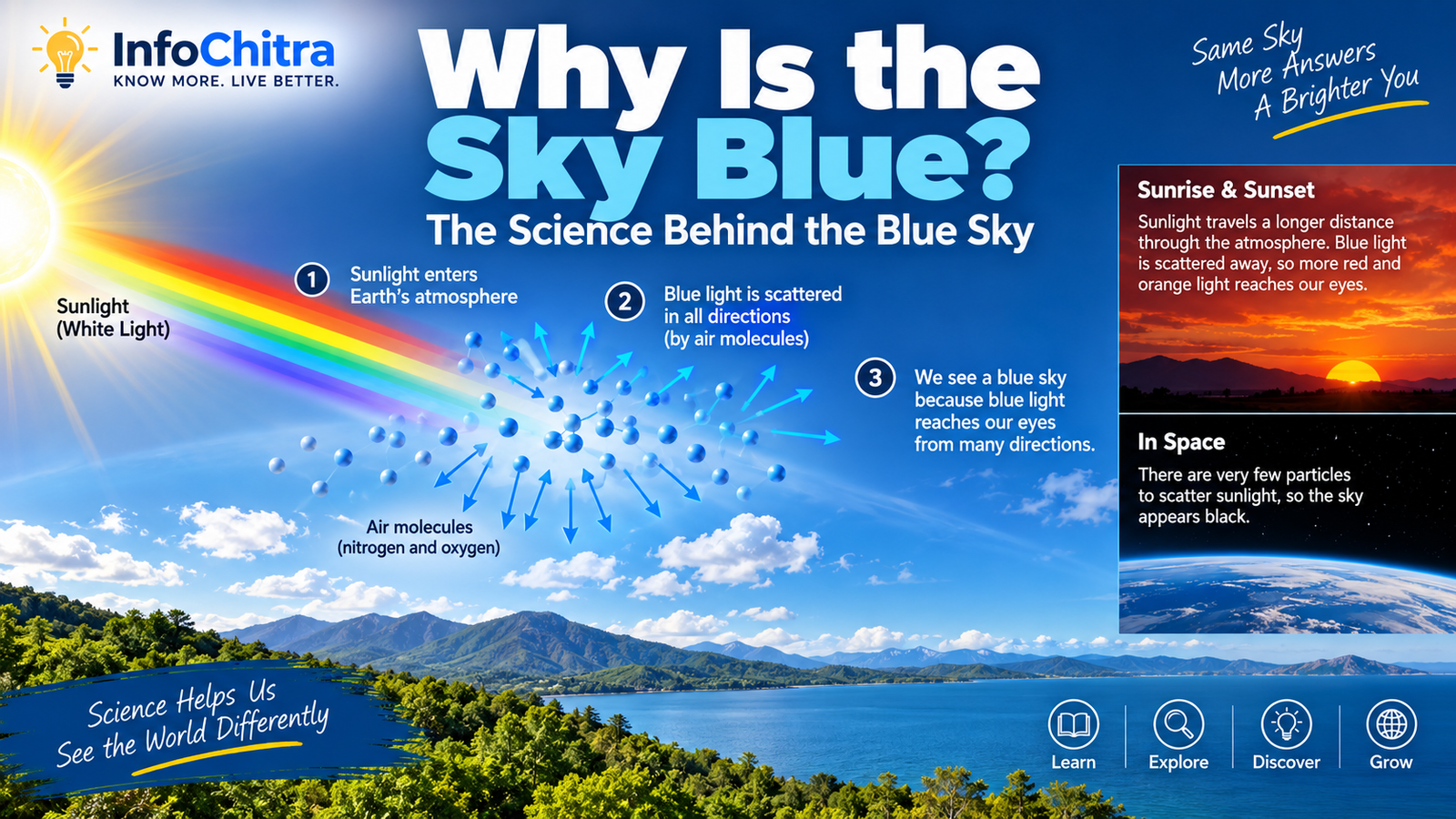
Why Is the Sky Blue? The Science Behind the Blue Sky
Look up at the sky on a clear day and you will usually see a beautiful shade of blue.
But have you ever wondered why the sky is blue?
The answer is connected to sunlight, Earth’s atmosphere and the way light interacts with tiny molecules in the air.
Although sunlight appears white to our eyes, it is actually made up of different colors of visible light. When sunlight enters Earth’s atmosphere, these colors behave differently as they interact with molecules in the air.
This process is responsible for the blue appearance of the daytime sky.
What Is Sunlight Made Of?
Sunlight may look white, but white light contains a range of visible colors.
These include:
- Red
- Orange
- Yellow
- Green
- Blue
- Indigo
- Violet
Each color has a different wavelength.
Red light has a longer wavelength, while blue and violet light have shorter wavelengths.
When sunlight travels through Earth’s atmosphere, these differences become important.
What Happens When Sunlight Enters the Atmosphere?
Earth’s atmosphere contains extremely small molecules, including nitrogen and oxygen.
When sunlight passes through the atmosphere, it interacts with these molecules.
The light is scattered in different directions.
This process is called Rayleigh scattering.
Shorter wavelengths of visible light are scattered much more strongly than longer wavelengths.
Blue light is therefore scattered throughout the atmosphere, making the sky appear blue when we look in directions away from the Sun.
Why Don’t We See a Violet Sky?
This is an interesting question.
Violet light has an even shorter wavelength than blue light and is scattered strongly.
So why isn’t the sky violet?
There are several reasons.
Our eyes are more sensitive to blue light than violet light. In addition, sunlight contains less violet light than some of the other shorter wavelengths, and some violet radiation is absorbed in the upper atmosphere.
As a result, the sky appears predominantly blue to human observers.
Why Does the Sky Change Color at Sunrise and Sunset?
The sky does not always look blue.
During sunrise and sunset, it can become:
- Orange
- Red
- Pink
- Yellow
- Purple
The reason is again connected to the way sunlight travels through the atmosphere.
When the Sun is low on the horizon, sunlight has to travel through a much greater distance of atmosphere before reaching your eyes.
Along this longer path, much of the blue light is scattered away from the direct path of sunlight.
The remaining direct sunlight contains proportionally more of the longer wavelengths, particularly red and orange.
This is why sunsets can appear dramatically different from the daytime sky.
Why Are Some Sunsets More Colorful Than Others?
Not every sunset looks the same.
The appearance of a sunset can be influenced by atmospheric conditions.
Particles and aerosols in the atmosphere can affect how light is scattered.
Dust, smoke, pollution, volcanic material and other particles can sometimes contribute to particularly vivid colors.
This means that two sunsets in different locations—or even on different days—can look completely different.
Does the Sky Look Blue Everywhere on Earth?
The basic physics of light scattering is the same, but the appearance of the sky can vary depending on atmospheric conditions and location.
For example, the amount of dust, moisture and other particles in the atmosphere can influence how the sky appears.
At very high altitudes, the sky can appear darker because there is less atmosphere above the observer to scatter sunlight.
Why Is Space Black?
If sunlight is passing through space, why doesn’t space look blue?
The answer is that space contains far fewer particles than Earth’s atmosphere.
On Earth, light is scattered by molecules in the atmosphere.
In the near-vacuum of space, there are not enough particles to scatter sunlight throughout the sky in the same way.
That is why astronauts see a dark or black sky even when the Sun is shining.
Why Does the Sky Look Red During Some Sunsets?
The basic process can be explained simply:
Sun low on horizon → longer atmospheric path → more short-wavelength light scattered away → more red and orange light reaches our eyes.
This is why a sunset can appear red or orange.
The exact colors can vary depending on atmospheric conditions.
Is the Ocean Blue Because It Reflects the Sky?
The sky and ocean can both appear blue, but the explanation is not simply that the ocean is a mirror reflecting the sky.
Water itself interacts with light in ways that contribute to its blue appearance, while reflections from the sky can also affect what we see.
So the color of the ocean is influenced by several factors, including water, depth, particles and reflected light.
A Simple Way to Remember the Science
You can remember the basic explanation in four steps:
Sunlight enters the atmosphere →
Air molecules scatter the light →
Blue light is scattered more strongly →
We see a blue sky.
It is a simple observation with a fascinating scientific explanation.
Frequently Asked Questions
Why is the sky blue?
The sky appears blue mainly because molecules in Earth’s atmosphere scatter shorter wavelengths of sunlight more strongly than longer wavelengths. Blue light is therefore scattered throughout the atmosphere and reaches our eyes from many directions.
Why is the sunset red?
At sunset, sunlight travels through a longer path in the atmosphere. More of the shorter blue wavelengths are scattered away, allowing more red and orange light to reach our eyes.
Why is space black?
Space contains very little matter compared with Earth’s atmosphere. Without enough molecules to scatter sunlight in all directions, the sky appears dark.
Is violet light scattered more than blue light?
Yes. Violet has a shorter wavelength than blue and is scattered strongly. However, human vision is more sensitive to blue, and other atmospheric and solar factors also contribute to the sky’s predominantly blue appearance.
What is Rayleigh scattering?
Rayleigh scattering is the scattering of light by particles much smaller than the wavelength of the light. In Earth’s atmosphere, this process strongly affects how we perceive the colors of the sky.
Final Thoughts
The next time you look at a clear blue sky, you are seeing the result of sunlight interacting with Earth’s atmosphere.
What looks like a simple blue color is actually the result of light, wavelength, atmospheric molecules and scattering working together.
And that is one of the fascinating things about science: sometimes the most ordinary things around us have the most interesting explanations.
The blue sky is not simply blue—it is a visible demonstration of physics happening above us every day.