
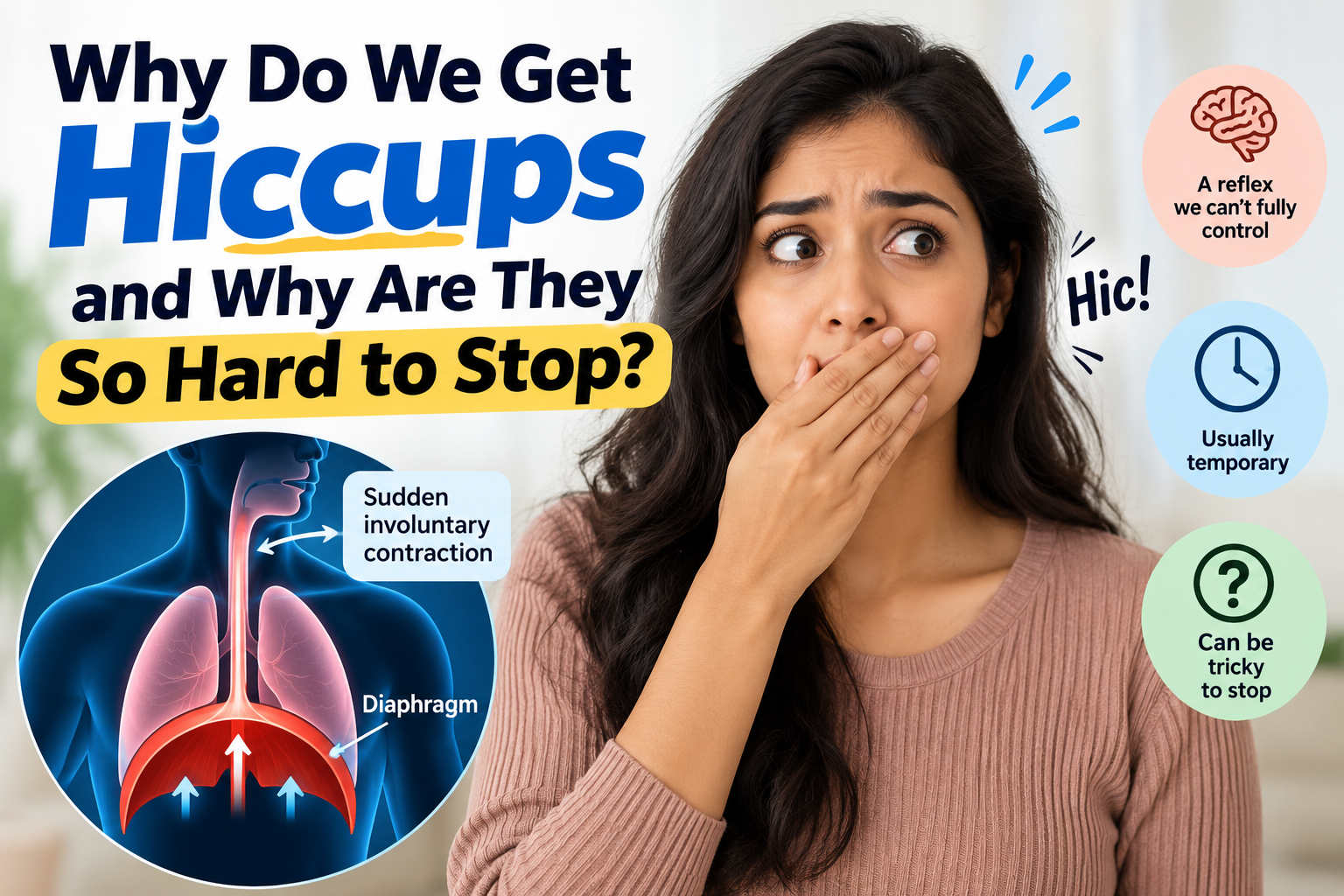
Why Do We Get Hiccups and Why Are They So Hard to Stop?
Hiccups have a way of striking at the worst possible moment: you’re in the middle of a meeting, a quiet meal, or a peaceful moment, and suddenly — hic — an involuntary, slightly embarrassing sound escapes your throat. A few seconds later, it happens again. And again. Hiccups are one of the most universal, oddly persistent bodily quirks humans experience, and yet surprisingly few people actually know what’s happening inside their body when they strike.
Understanding the real mechanics behind hiccups also explains something else: why so many “guaranteed cures” people swear by don’t actually have any solid science behind them. Here’s what’s really going on.
Table of Contents
- What a Hiccup Actually Is, Physically
- The Diaphragm: The Muscle Behind Every Hiccup
- Why the “Hic” Sound Happens
- Common Triggers That Irritate the Diaphragm
- Why Hiccups Are Considered a “Reflex Arc”
- Why This Reflex Might Actually Be Protective
- Do Any Home Remedies Actually Work?
- Why Holding Your Breath Is the Most Recommended Trick
- When Hiccups Signal Something More Serious
- What Science Still Doesn’t Fully Understand
1. What a Hiccup Actually Is, Physically

According to Britannica, a hiccup is a spasmodic contraction of the diaphragm that causes a sudden intake of breath, which is then involuntarily cut off by the closure of the glottis — the opening between your vocal cords. This combination of a sudden inhale followed by an abrupt stop is exactly what produces the distinctive “hic” sound.
In other words, a hiccup isn’t a single event — it’s a rapid, two-part sequence happening in your body almost simultaneously, and entirely outside your conscious control.
2. The Diaphragm: The Muscle Behind Every Hiccup

The diaphragm is a dome-shaped muscle located between your lungs and your stomach, and it plays a central role in ordinary breathing. Under normal conditions, it pulls downward when you inhale, creating space for your lungs to fill with air, and relaxes upward when you exhale, pushing air back out.
When something irritates this muscle, it can begin to spasm — contracting suddenly and involuntarily, completely outside the normal, steady rhythm of breathing. This spasm is the actual physical origin of every single hiccup.
3. Why the “Hic” Sound Happens

Once the diaphragm spasms, it forces a sudden, rapid intake of air up through your throat. As that air reaches your voice box, your vocal cords snap shut almost instantly, blocking the airflow. According to the McGill University Office for Science and Society, this rapid contraction-then-closure sequence is exactly what produces the characteristic “hic” sound.
This entire process happens in a fraction of a second, which is part of why hiccups feel so sudden and involuntary — because they genuinely are.
4. Common Triggers That Irritate the Diaphragm

While hiccups can sometimes happen with no identifiable cause at all, several common triggers are widely recognized as diaphragm irritants:
- Eating or drinking too quickly, which can cause rapid stomach distension
- Carbonated beverages, which introduce excess gas into the stomach
- Alcohol consumption, another common irritant
- Swallowing air, which can happen during activities like crying or laughing hard
- Spicy foods, which can irritate the digestive tract and surrounding nerves
- Sudden temperature changes, such as drinking something very cold or very hot quickly
Most of these triggers share a common thread: they all involve some form of rapid stomach distension or irritation, which appears to be the primary pathway to triggering a hiccup episode.
5. Why Hiccups Are Considered a “Reflex Arc”

Modern research describes hiccups as the result of a reflex arc — a signal that travels from your diaphragm to your brain and back again, coordinating the entire spasm-and-closure sequence automatically. This is similar in concept to other reflexes in the body, like the knee-jerk reaction to a doctor’s small hammer tap, where a stimulus triggers an automatic response without requiring any conscious thought.
According to McGill’s Office for Science and Society, the precise complexities of this particular reflex arc are still not fully understood by scientists, even though the basic mechanical sequence is well documented.
6. Why This Reflex Might Actually Be Protective

Interestingly, researchers believe the hiccup reflex may actually serve a protective purpose. Some scientists suggest that without this reflex arc in place, certain triggers might otherwise cause a person to hyperventilate — meaning hiccups could function as the body’s built-in mechanism for interrupting a potentially more disruptive breathing pattern before it fully develops.
This theory helps explain why hiccups, despite feeling like an annoying malfunction, are such a consistent and universal feature across human physiology, appearing in people of every age, including babies still developing in the womb.
7. Do Any Home Remedies Actually Work?
This is where the science gets genuinely murky. Countless home remedies exist — drinking water upside down, having someone startle you, eating a spoonful of sugar, sucking on a lemon — but according to multiple medical sources, the vast majority of these popular tricks lack solid scientific evidence supporting their effectiveness.
Most of these remedies likely work, when they do work, simply because hiccups tend to resolve on their own within a few minutes regardless of what you do — meaning the remedy often gets credit for timing that would have happened anyway.
8. Why Holding Your Breath Is the Most Recommended Trick

Among home remedies, breath-holding stands out as having somewhat more scientific reasoning behind it. Holding your breath increases carbon dioxide levels in your lungs, which may help relax the diaphragm and interrupt the reflex arc responsible for the hiccup cycle. Breathing into a paper bag works through a similar mechanism, altering your body’s oxygen-to-carbon dioxide balance.
While not universally guaranteed to work for every person or every hiccup episode, this approach is generally considered the most well-reasoned option among the many popular folk remedies people commonly try.
9. When Hiccups Signal Something More Serious
The vast majority of hiccup episodes are brief, lasting only a few minutes, and resolve completely on their own without any lasting concern. However, according to medical sources, hiccup bouts lasting longer than 48 hours are considered unusual and occasionally linked to an underlying health condition, ranging from digestive issues to disturbances in the nerve pathways connecting the brain and diaphragm.
In extremely rare documented cases, hiccups have been reported to persist for extended periods, sometimes requiring medical evaluation to identify and treat an underlying cause. If hiccups persist for more than two days, it’s generally recommended to consult a doctor rather than continuing to wait them out.
10. What Science Still Doesn’t Fully Understand

Despite hiccups being one of the most universally experienced human bodily quirks, researchers acknowledge there’s still meaningful uncertainty about the finer details of exactly why the reflex arc behaves the way it does, and why certain remedies seem to help some people but not others. This gap between how common hiccups are and how incompletely they’re understood is a good reminder that not every everyday bodily experience has been fully mapped out by modern science — even ones nearly everyone has experienced firsthand.
Hiccups at a Glance
| Aspect | What’s Happening |
|---|---|
| Root cause | Diaphragm spasm from irritation |
| The “hic” sound | Sudden inhale, followed by vocal cords snapping shut |
| Common triggers | Fast eating, carbonated drinks, alcohol, spicy food |
| Typical duration | A few minutes, resolving on its own |
| When to see a doctor | If hiccups persist beyond 48 hours |
| Most evidence-backed remedy | Holding your breath (raises CO2, may relax diaphragm) |
Frequently Asked Questions
What actually causes hiccups?
Hiccups are caused by a spasm of the diaphragm, usually triggered by irritation from rapid eating, carbonated drinks, alcohol, or swallowed air, which forces a sudden inhale followed by your vocal cords snapping shut.
Do home remedies for hiccups actually work?
Most popular remedies, like being startled or drinking water a certain way, lack strong scientific evidence — hiccups often simply resolve on their own around the same time these remedies are tried.
Is holding your breath actually effective for stopping hiccups?
It’s considered one of the more scientifically reasoned approaches, since it raises carbon dioxide levels in the lungs, which may help relax the diaphragm and interrupt the hiccup reflex.
When should I be concerned about hiccups?
If hiccups persist for longer than 48 hours, medical sources generally recommend consulting a doctor, since prolonged hiccups can occasionally indicate an underlying health issue.
Can babies get hiccups before they’re even born?
Yes, fetal hiccups are a normal, commonly observed occurrence, typically noticeable as rhythmic movements starting around the fourth or fifth month of pregnancy.
Next time hiccups strike:
try holding your breath for 10–20 seconds before reaching for a stranger remedy — it’s the trick with the most actual science behind it.
Try holding your breath for 10–20 seconds before reaching for a stranger remedy — it’s the trick with the most actual science behind it.
Conclusion
Hiccups are a strange reminder of just how much automatic, reflexive activity happens inside our bodies without any conscious input at all. While science hasn’t fully mapped out every detail of this particular reflex, understanding the basic mechanics — a diaphragm spasm followed by a snapping glottis — at least explains why so many “guaranteed” cures are really just well-timed distractions, waiting out a process your body was always going to resolve on its own.
(Related reading: The Human Body: 10 Amazing Facts You Never Knew)