
Why Is My Internet So Slow?
You open a website, but it takes forever to load. A YouTube video keeps buffering. Downloads that normally finish quickly suddenly seem painfully slow.
So you ask:
Why is my internet so slow?
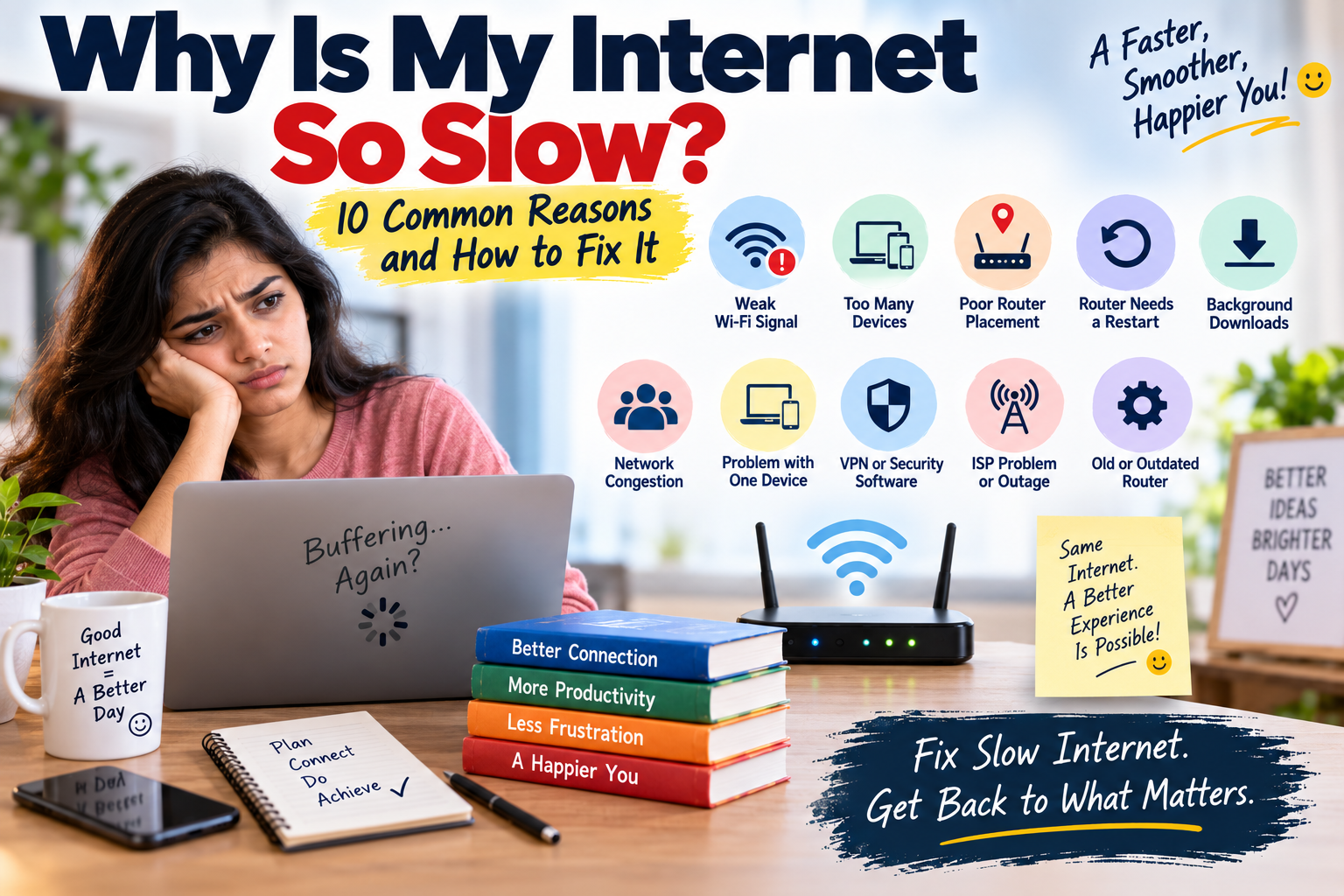
The problem isn’t always your internet plan. Slow internet can be caused by a weak Wi-Fi signal, too many connected devices, router placement, network congestion, background downloads, an old router, or even a problem with just one device.
The good news is that you can usually narrow down the problem with a few simple checks.
In this guide, we’ll look at the 10 most common reasons for slow internet and what you can do about each one.
First, Find Out Where the Problem Is
Before changing settings, try this simple test.
Test 1: Check another device
Connect another phone or laptop to the same Wi-Fi network.
- Only one device is slow: the problem may be that device.
- Every device is slow: the router, Wi-Fi network or internet service may be responsible.
- Only one website or app is slow: the problem may be with that particular service rather than your internet connection.
Microsoft also recommends comparing the same Wi-Fi connection on another device when troubleshooting slow connectivity.
This one test can save you from changing settings unnecessarily.
10 Reasons Why Your Internet Is So Slow
1. Your Wi-Fi Signal Is Weak

One of the simplest explanations is that you’re too far from the router.
Walls, floors, furniture and other physical obstacles can weaken Wi-Fi. The farther your device is from the router, the more likely performance will suffer.
Try this:
- Move closer to the router.
- Test the connection in different rooms.
- Keep the router in a relatively open location.
- Avoid hiding it inside cabinets or behind large objects.
- If your home is large, consider a mesh Wi-Fi system.
If the internet becomes noticeably faster when you’re close to the router, you have probably found the problem.
2. Too Many Devices Are Using the Internet

Your internet connection is shared among the devices connected to your network.
Imagine this:
- Smart TV streaming video
- Laptop downloading a large file
- Phone backing up photos
- Another person watching YouTube
- Gaming console downloading an update
All of these activities can compete for available bandwidth.
Google notes that multiple high-bandwidth activities can slow a Wi-Fi connection when the available bandwidth is being heavily used.
What to do
Temporarily disconnect devices you’re not using and pause:
- Large downloads
- Cloud backups
- Video streaming
- Game updates
- Software updates
Then test your internet again.
3. Your Router May Be in the Wrong Place
Router placement matters more than many people realize.
Putting the router in a corner, behind furniture or inside a cupboard can reduce the quality of the wireless signal.
A better location is:
Central + elevated + relatively unobstructed.
If possible, place the router closer to the centre of your home rather than at one extreme end.
Microsoft specifically recommends considering your home’s layout and testing Wi-Fi performance at different locations.
4. Your Router Needs a Restart

Sometimes the simplest solution works.
Your router can experience temporary connection problems or performance issues. Restarting the router gives the network equipment a chance to establish a fresh connection.
Simple restart
- Turn off or unplug the router.
- Wait for around 30 seconds.
- Turn it back on.
- Wait for the connection to return.
- Test the internet again.
Google’s Android troubleshooting guidance also recommends restarting the wireless router when troubleshooting connection problems.
Important: Don’t press the router’s Reset button unless you actually want to reset its configuration. A normal power restart is different from a factory reset.
5. Background Downloads Are Using Your Bandwidth
Sometimes your internet isn’t slow—you simply have something consuming most of your available connection.
Examples include:
- Windows updates
- Phone backups
- Cloud synchronization
- Large app downloads
- Game updates
- Video uploads
- Photo backups
Check what your devices are doing in the background before assuming that your ISP is responsible.
On Windows, Microsoft recommends checking for processes consuming significant network bandwidth when troubleshooting slow Wi-Fi.
6. Your Wi-Fi Network May Be Congested

Wi-Fi can become less efficient when there are many nearby wireless networks or sources of interference.
This can be especially noticeable in:
- Apartments
- Hostels
- Offices
- Dense residential areas
Your router may also support multiple Wi-Fi bands. Depending on the router and device, switching between available bands can sometimes improve performance.
Modern consumer Wi-Fi commonly uses 2.4 GHz, 5 GHz and, on compatible equipment, 6 GHz bands.
What can you try?
If your router offers separate network options, test the available bands from the same location.
Don’t assume one band is always better—the best choice depends on your device, distance and surroundings.
7. Only One Device Is Slow

This is an important clue.
If your phone works perfectly but your laptop is extremely slow, the internet connection itself may not be the problem.
The issue could be:
- Device software
- Wi-Fi adapter
- Background applications
- VPN
- Browser problem
- Network configuration
- Recently installed software
Microsoft recommends testing the same network on another device to determine whether the issue is device-specific.
Quick test
Connect the affected device to another Wi-Fi network.
If it remains slow there too, focus your troubleshooting on the device rather than your home router.
8. A VPN or Security App May Be Affecting the Connection
VPNs route your traffic through another server. Depending on the service and network conditions, that can affect connection performance.
Other third-party security or network-monitoring software can also interfere with connectivity.
Apple specifically notes that VPN and third-party security software can sometimes cause network connectivity problems.
Try this
If you’re using a VPN:
- Temporarily disconnect it.
- Open the same website or service.
- Compare the performance.
If the connection becomes normal after disconnecting the VPN, you’ve found an important clue.
Don’t permanently disable security software just because one test changes the speed. Instead, check the software’s settings or contact its provider if necessary.
9. Your Internet Provider May Be the Problem
Sometimes everything inside your home is working correctly.
Your ISP may be experiencing:
- A temporary outage
- Network maintenance
- Local congestion
- Service problems
- A problem with the line entering your home
Google notes that ISP-side issues can cause slow internet and recommends contacting the provider when recurring problems persist.
How to identify an ISP problem
Try this:
Device A → Device B → Router → ISP
If several different devices are slow even when you’re close to the router, the problem may be beyond your individual device.
Contact your ISP and ask whether there is a known service problem in your area.
10. Your Router or Network Equipment May Be Outdated

An old router can become a bottleneck, especially if:
- You have a high-speed internet plan.
- Many devices are connected.
- Your home has multiple rooms.
- You use 4K streaming or gaming.
- Your devices support newer Wi-Fi standards but your router doesn’t.
This doesn’t automatically mean you need to buy a new router.
First, determine whether the router is actually limiting your connection.
If your internet is consistently much faster when using a wired connection but significantly slower over Wi-Fi, the wireless network deserves closer investigation.
A Simple 5-Minute Slow Internet Checklist
If you don’t know where to start, follow these steps in order:
Step 1
Test another device.
Is everything slow or just one device?
Step 2
Move close to the router.
Does the connection improve?
Step 3
Pause large downloads and streaming.
Are other devices consuming bandwidth?
Step 4
Restart the router.
Wait for the connection to return and test again.
Step 5
Test at different times.
Is the internet slow all day or only during certain periods?
Step 6
Check your ISP.
If multiple devices remain slow, contact your internet provider.
Why Is My Internet Slow Only at Night?

This is a common question.
If your internet works well during the day but becomes noticeably slower during certain evening hours, network congestion may be one possible explanation.
However, don’t immediately assume your ISP is throttling you.
First check:
- How many people are using your connection?
- Are TVs streaming?
- Are phones backing up photos?
- Are game consoles downloading updates?
- Is your Wi-Fi signal weak in the room you’re using?
If the problem happens repeatedly even when your own network usage is low, contact your ISP and ask whether there is congestion or another service issue in your area.
Why Is My Internet Slow on My Phone but Fast on My Laptop?
This usually suggests that the problem may be specific to the phone rather than the internet connection itself.
Try:
- Turn Wi-Fi off and back on.
- Move closer to the router.
- Restart the phone.
- Test another Wi-Fi network.
- Compare Wi-Fi with mobile data.
- Check whether a VPN is active.
Google recommends restarting Android devices and switching between Wi-Fi and mobile data when diagnosing connection problems.
If the phone is slow on multiple Wi-Fi networks while the laptop works normally, investigate the phone rather than replacing the router.
Android and iPhone: Quick Checks
Android
On Android, you can check your Wi-Fi connection and signal strength from:
Settings → Network & internet → Internet
The exact wording can vary between manufacturers. Google also recommends moving closer to the router when the Wi-Fi signal is weak.
iPhone
If mobile data is consistently slow across different locations, the issue may involve your cellular network rather than your home Wi-Fi.
Apple recommends checking network conditions, trying another location or Wi-Fi connection, and contacting your network provider when mobile-data problems persist.
Don’t Replace Your Internet Plan Too Quickly
A faster plan isn’t always the answer.
If your real problem is:
Weak Wi-Fi → a faster plan may not solve it.
Bad router placement → a faster plan may not solve it.
One faulty device → a faster plan won’t solve it.
Too many devices → better network management may help first.
ISP outage → upgrading your plan won’t fix the outage.
Find the bottleneck first.
Then decide whether you actually need a faster plan, better router, mesh system or different ISP.
When Should You Contact Your Internet Provider?
Contact your ISP when:
- Multiple devices are consistently slow.
- Restarting the router doesn’t help.
- The problem occurs even close to the router.
- Your connection repeatedly drops.
- The problem persists for several days.
- Your speed is consistently far below what your service normally provides.
- You suspect a local outage or line problem.
Before contacting them, write down when the problem occurs and which devices are affected. This makes troubleshooting easier.
What If Nothing Works?
If you’ve tried the basic steps and the problem remains:
Device → Wi-Fi → Router → ISP
Work through the chain instead of randomly changing settings.
Test another device.
Then test another location.
Then restart the router.
Then compare different times.
Then contact the ISP if multiple devices are affected.
This approach helps you identify the actual cause instead of simply guessing.
Frequently Asked Questions
Why is my internet so slow all of a sudden?
A sudden slowdown can be caused by router problems, network congestion, background downloads, weak Wi-Fi, ISP problems or a temporary outage. Test another device and restart the router first.
Why is my Wi-Fi slow but my internet plan is fast?
Your internet plan describes the connection coming into your home, while Wi-Fi performance also depends on your router, device, distance, walls, interference and network usage.
Why is my internet slow on only one device?
If other devices work normally, the issue may be specific to that device. Check its Wi-Fi connection, background apps, VPN, software and network settings.
Does restarting the router make internet faster?
It can resolve temporary connection or router problems, but it won’t permanently increase the speed of your internet plan.
Why is my internet slow at night?
Evening slowdowns can happen because of increased network usage or congestion. Check your own household usage first, then contact your ISP if the problem is persistent.
Should I buy a new router if my internet is slow?
Not necessarily. First determine whether the router is actually the bottleneck. Test the connection near the router and on multiple devices before replacing equipment.
Conclusion
When you’re asking “Why is my internet so slow?”, don’t immediately blame your internet provider—or buy a faster plan.
Start with the basics:
Test another device → move closer to the router → check bandwidth usage → restart the router → check for interference → investigate the device → contact your ISP if necessary.
Once you identify where the slowdown is happening, the solution is usually much easier to find.
Having a different Wi-Fi problem?
👉 Phone Won’t Connect to WiFi? Here’s How to Fix It
This is a natural next article for readers who discover that their problem isn’t slow internet but a phone that won’t connect properly to Wi-Fi.