
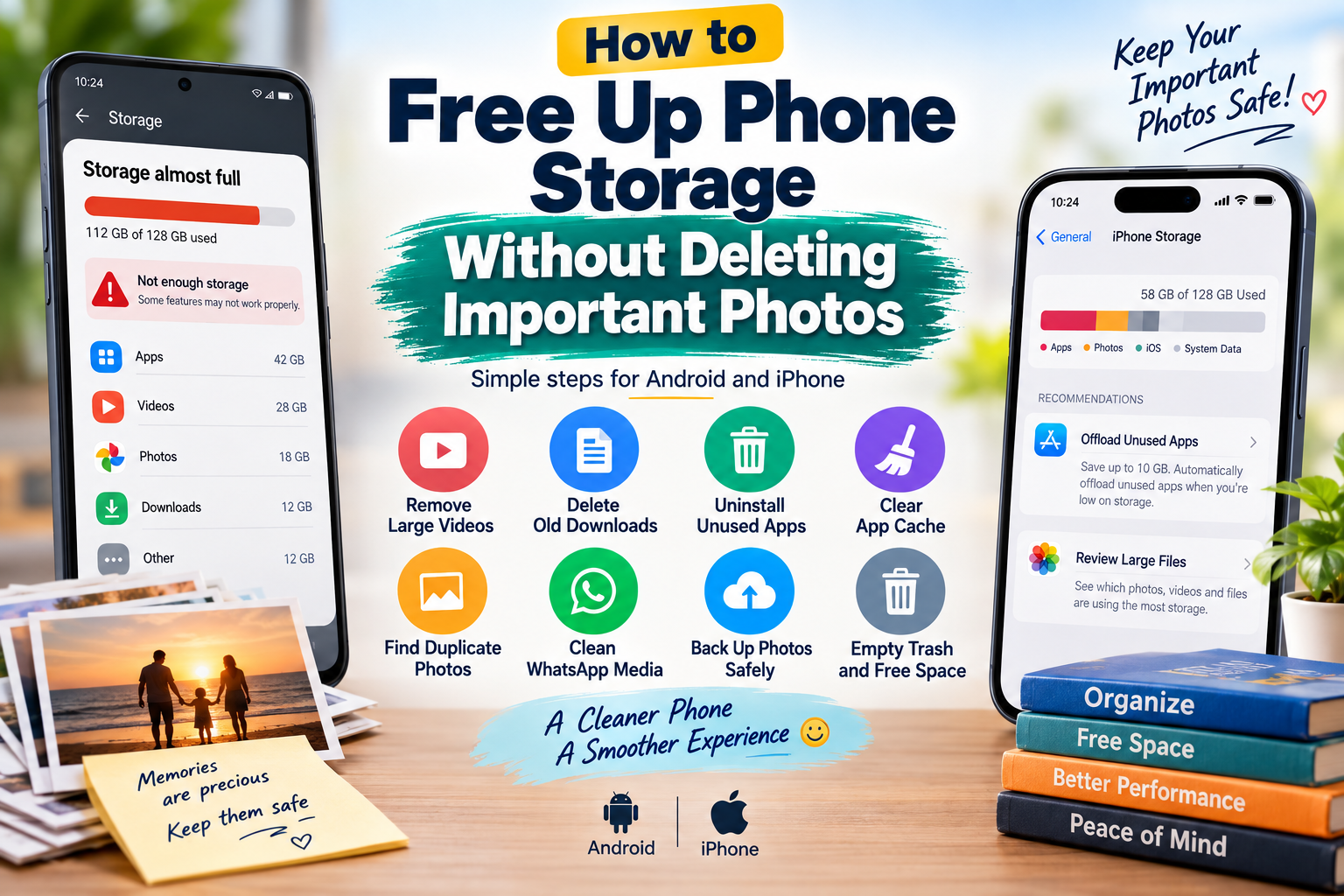
How to Free Up Phone Storage Without Deleting Important Photos
Phone Storage Full? Don’t Delete Everything Yet
Your phone says “Storage Almost Full” or “Storage Full.” You open your gallery and immediately think about deleting photos.
But photos may not be the only reason your phone is running out of space.
Large videos, downloaded files, unused apps, offline movies and music, screenshots, app data and other files can quietly consume a large amount of storage.
The good news is that you can often free up phone storage without deleting your important photos.
The safest approach is to first find out what is using your storage, then remove things you no longer need.
1. Check What Is Using Your Phone Storage
Before deleting anything, check your phone’s storage breakdown.
On Android
Open:
Settings → Storage
Depending on your phone manufacturer, the exact menu names may be slightly different.
Android’s storage screen can show categories such as apps, photos and videos, downloads and other files. Google recommends checking storage usage before deciding what to remove.
On iPhone
Go to:
Settings → General → iPhone Storage
You’ll see how much storage your device is using and how much is available. You can also see which apps are consuming the most space.
Why this step matters
Don’t assume:
“My phone has too many photos.”
You may discover that a few large videos, an unused app or downloaded files are actually responsible for most of the storage usage.
“Why Is My Phone Battery Draining So Fast?”
→ phone storage management / apps connection.
2. Delete Large Videos Before Important Photos

Videos can consume much more storage than ordinary photos.
Look for:
- Old videos
- Screen recordings
- Downloaded movies
- Duplicate videos
- Long WhatsApp videos
- Social-media videos you saved
- Videos you no longer need
If you have important family videos, travel videos or personal memories, don’t delete them just because your phone is full.
Back them up first.
This is one of the easiest ways to free space while protecting your important memories.
3. Remove Old Downloads
Your Downloads folder can become a hidden storage problem.
You may find:
- PDFs you no longer need
- Installation files
- Old documents
- Images downloaded from websites
- Videos
- ZIP files
- Duplicate files
Go through your Downloads folder and delete files that you have already used or no longer need.
Android specifically recommends deleting downloaded files that aren’t needed to save storage.
“Why Is My Phone Charging So Slowly?”
→ storage full → performance/troubleshooting connection.
4. Uninstall Apps You No Longer Use
Take a look at all the apps installed on your phone.
Ask:
Have I used this app recently?
If the answer is no, consider uninstalling it.
Games, video-editing apps, social-media apps and other large applications can take up significant storage.
On Android, you can also find options to automatically archive unused apps on supported devices. Google says archived apps can free space while keeping the app’s personal data so the app can be downloaded again later.
On iPhone
Go to:
Settings → General → iPhone Storage
Select an app to see its storage usage.
You may have options such as:
- Offload App
- Delete App
Offloading removes the app itself while keeping its documents and data, whereas deleting removes the app and its related data.
5. Clear App Cache — But Be Careful

Android users may see two different options:
- Clear cache
- Clear storage/data
They are not the same thing.
Google explains that clearing cache removes temporary data, while clearing storage permanently deletes an app’s stored data. Settings can vary between Android devices.
So don’t randomly tap Clear storage/data just because an app is using a lot of space.
If you’re unsure what an option does, check the app’s settings or manufacturer’s instructions first.
6. Back Up Your Photos Before Removing Them

This is the most important rule in this entire article:
Never delete important photos from your phone until you know they are safely backed up.
If you use Google Photos, make sure your photos have finished backing up before using any storage-cleanup feature.
Google’s Free up space feature can remove photos from the device after they’ve been backed up, while keeping the backed-up copies available in Google Photos.
This means you can potentially recover a large amount of phone storage without losing your photo library.
Important
Don’t simply assume that a photo is backed up.
Open Google Photos and verify that backup has completed.
“Phone Won’t Connect to WiFi?”
→ general smartphone troubleshooting cluster.
7. Find Screenshots, Blurry Photos and Duplicate Images
Your gallery may contain hundreds of images you don’t actually need.
Common examples include:
- Old screenshots
- Duplicate photos
- Blurry pictures
- Accidentally captured images
- Memes
- Downloaded images
- Multiple versions of the same photo
Google Photos’ storage-management tools can surface categories such as blurry photos, screenshots and large videos to help identify potential cleanup targets.
Instead of deleting your entire photo library, start with these low-value images.
8. Check WhatsApp and Other Messaging Apps
Messaging apps can quietly accumulate a lot of media.
Think about how many:
- Videos
- Photos
- GIFs
- Documents
- Voice messages
- Forwarded files
you receive every month.
If you’re in several active groups, the amount can become surprisingly large.
Check the storage-management section of your messaging app and look for large or unnecessary media.
But don’t delete important documents or family photos without checking them first.
“How to Take a Screenshot”
→ screenshots can accumulate as unnecessary files.
9. Remove Offline Downloads

Streaming services often allow you to download content for offline viewing or listening.
Check for:
- Downloaded movies
- TV shows
- Music
- Podcasts
- Offline maps
- Large documents
If you’ve already watched or listened to something, remove the offline copy.
You can download it again later if necessary.
Android’s official storage guidance specifically recommends removing downloaded movies, music and other media you no longer need.
10. Empty Trash and Recently Deleted
One commonly missed step is the Trash / Recently Deleted folder.
When you delete something, it may not disappear permanently immediately.
Depending on the app, deleted files may remain in a trash or recently deleted area.
So after reviewing your deleted files, check whether your device or app has a:
- Trash
- Bin
- Recently Deleted
section.
Be careful: permanently emptying a trash folder can make recovery impossible.
Google Photos, for example, warns that permanently deleted photos may not be recoverable.
How to Free Up Phone Storage Without Deleting Photos
If your main goal is to protect your photos, follow this order:
Step 1
Check your storage usage.
Step 2
Remove large videos you don’t need.
Step 3
Delete old downloads.
Step 4
Remove unused apps.
Step 5
Review messaging-app media.
Step 6
Remove offline movies, music and other downloads.
Step 7
Delete unnecessary screenshots and duplicate images.
Step 8
Check Trash / Recently Deleted.
Step 9
Back up important photos.
Step 10
Only then consider removing backed-up photos from your device.
This approach is much safer than randomly deleting hundreds of photos.
Android vs iPhone: Where to Start
| Task | Android | iPhone |
|---|---|---|
| Check storage | Settings → Storage | Settings → General → iPhone Storage |
| Review large apps | Storage settings | iPhone Storage |
| Remove unused apps | Uninstall / archive where supported | Offload / Delete |
| Check photos | Gallery / Google Photos | Photos / iCloud or Google Photos |
| Remove downloads | Files / relevant app | Files / relevant app |
| Clear cache | Available for many Android apps | iOS manages storage differently |
Android’s available options can vary by device and Android version, while Apple’s iPhone Storage screen provides storage recommendations and per-app usage information.
What You Should NOT Delete Just to Free Space
When storage is full, don’t panic-delete everything.
Be especially careful with:
Important family photos
Back them up first.
Personal videos
Make another copy before deleting them.
Important documents
Tax documents, certificates, IDs and other records may be difficult to replace.
App data
Don’t use Clear storage/data without understanding what will be removed.
Unknown system files
Don’t delete files simply because their names look unfamiliar.
Backup copies
Don’t delete a backup until you’ve confirmed that another usable copy exists.
What If Your Phone Is Still Full?
If you’ve cleaned unnecessary files and the storage is still nearly full, you have several options.
Move files to a computer
You can transfer important files to a computer and then remove the phone copies.
Google’s Android guidance also recommends copying files to a computer as one way to free device storage.
Use cloud storage
You can keep important photos and documents in a suitable cloud-storage service and remove local copies only after confirming the backup is complete.
Consider a larger-storage phone
If you regularly record lots of videos, download large files or use storage-heavy apps, your current storage capacity may simply be too small for your usage.
A Simple Monthly Phone Storage Routine

You don’t have to wait until your phone says “Storage Full.”
Once a month, spend five minutes checking:
1. Large videos
2. Downloads
3. Unused apps
4. Screenshots
5. Messaging media
6. Offline downloads
7. Trash / Recently Deleted
This small routine can prevent your storage from filling up unexpectedly.
Frequently Asked Questions
1. How do I free up phone storage quickly?
Check your storage breakdown first, then remove unnecessary videos, downloads, unused apps, offline media and other large files. Back up important photos before deleting them.
2. How can I free up storage without deleting photos?
Remove unused apps, large videos, downloads, screenshots, duplicate files and offline media first. If your photos are safely backed up, you can also remove their device copies using an appropriate storage-management feature.
3. Why is my phone storage full even after deleting files?
Trash or Recently Deleted folders, app data, cached files, downloads and other stored content may still be using space. Check your storage breakdown to identify what remains.
4. Is clearing cache safe on Android?
Clearing an app’s cache removes temporary data, but Clear storage/data is different and can permanently remove the app’s stored data. Check the option carefully before using it.
5. How do I free up storage on an iPhone?
Go to Settings → General → iPhone Storage and review the recommendations and apps using the most space. You can offload or delete apps depending on your needs.
6. Can I delete photos after backing them up to Google Photos?
Yes, if you have confirmed that the photos are safely backed up. Google Photos provides a Free up space feature that can remove backed-up copies from your device while keeping them available in your Google Photos library.
Read Next
Is Your Phone Battery Draining Too Fast?
Freeing up storage is only one part of keeping your phone working well.
If your phone also loses battery unusually quickly, find out why your battery is draining so fast and what you can do about it.
Google Android Help — Free up storage on your Android device Google Android Help
Google Photos Help — Free up space on your device Google Photos Help
Apple Support — iPhone Storage Apple Support