
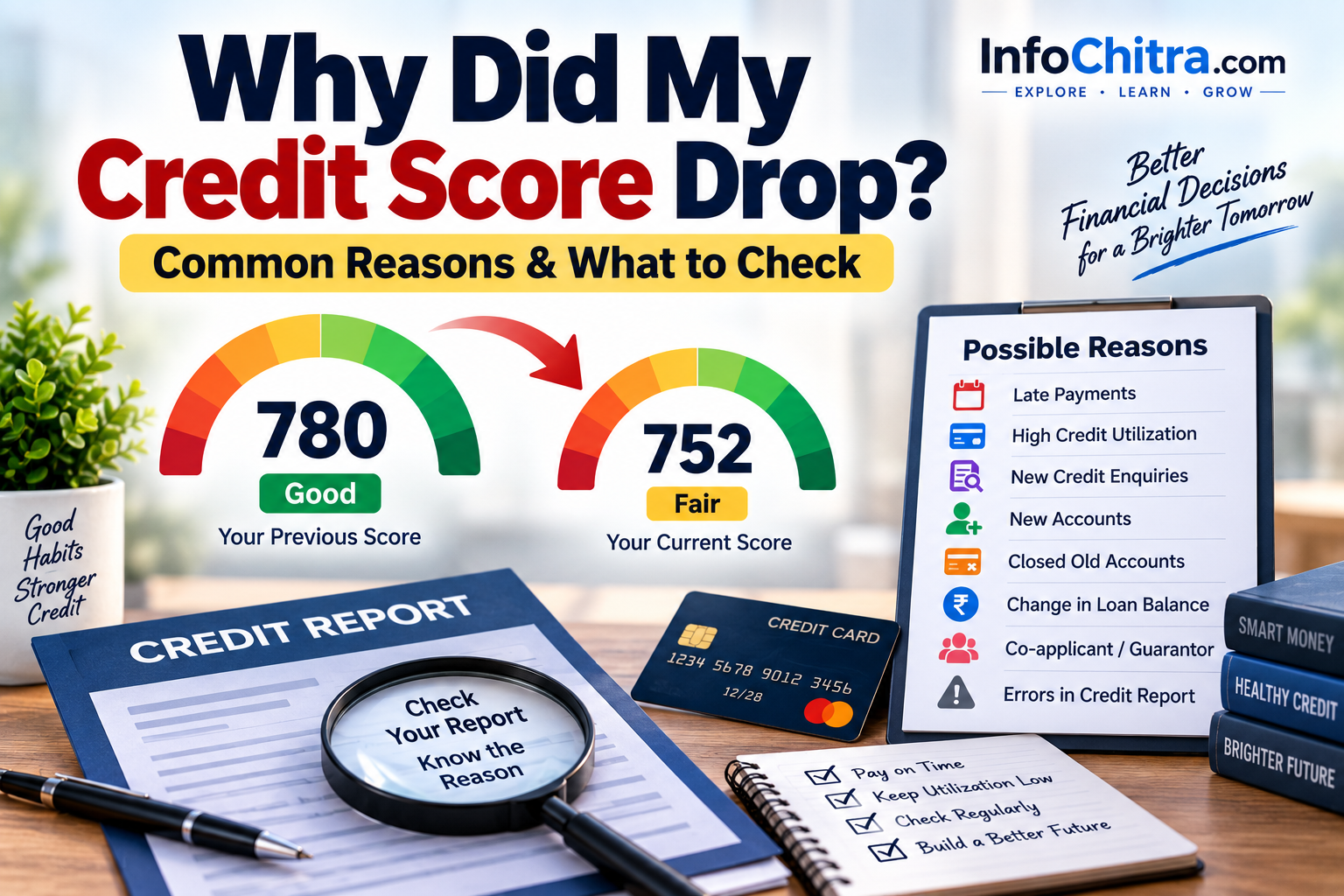
Why Did My Credit Score Drop?
You checked your credit score expecting it to be roughly the same as before.
Instead, you see that it has gone down.
That can be confusing, especially when you think:
“I paid my EMI on time. Why did my credit score drop?”
A credit score can change when new information is reported by lenders or when existing information on your credit report changes. TransUnion CIBIL says that factors such as payment history, credit utilization, age of credit, enquiries, account changes and outstanding balances can influence a CIBIL Score.
The good news is that a drop does not necessarily mean that you have done something seriously wrong.
The first step is to find what changed in your credit report.
1. A Late EMI or Credit Card Payment

One of the most important reasons a credit score can fall is a delayed or missed payment.
This can include:
- Home-loan EMI
- Personal-loan EMI
- Vehicle-loan EMI
- Credit-card payment
- Other reported credit obligations
Payment history is one of the major factors used in CIBIL’s scoring. Late payments and defaults can negatively affect the score.
Even one missed payment can matter
If you accidentally missed a payment, don’t assume the only solution is to stop using credit altogether.
Instead:
- Check your payment history.
- Confirm whether the payment was actually late.
- Pay any overdue amount as soon as possible.
- Set up reminders or automatic payment arrangements where appropriate.
- Continue making future payments on time.
2. Your Credit Card Utilization Increased

Another common reason is high credit utilization.
Credit utilization refers to how much of your available revolving credit you are using.
For example:
Credit limit: ₹1,00,000
Current balance: ₹70,000
Your utilization is approximately:
70%
A higher utilization can indicate greater reliance on available credit and may negatively affect your credit profile. CIBIL specifically lists credit utilization as a factor affecting the score.
Important point
You don’t necessarily need to stop using your credit card.
The important thing is to understand how much of your available credit is being used and whether the reported balance has increased significantly.
3. You Applied for Several Loans or Credit Cards

Every time you apply for certain forms of credit, the lender may access your credit report.
These accesses are recorded as credit enquiries.
If you apply for several loans or credit cards within a short period, multiple enquiries may appear on your report.
CIBIL says that repeated enquiries over a short period can negatively affect your score, although individual enquiries generally have only a limited impact.
Example
You apply for:
- Personal loan from Bank A
- Credit card from Bank B
- Personal loan from Bank C
- Another credit card from Bank D
Several lender enquiries could then appear on your credit report.
This is different from simply checking your own credit score. CIBIL states that checking your own score does not affect your score.
4. Your Credit Card Balance Increased

Sometimes there is no missed payment.
You paid the bill.
Yet your score changed.
One possible reason is that the balance reported by the card issuer increased.
For example:
Last reporting period:
Credit limit: ₹2,00,000
Reported balance: ₹30,000
Later:
Credit limit: ₹2,00,000
Reported balance: ₹1,00,000
Even if you subsequently pay the bill, the balance reported during a particular reporting cycle can affect what appears on your credit report.
CIBIL notes that lenders submit updated information periodically, so the timing of a payment and the reporting date can matter when you inspect your report.
5. You Closed an Old Credit Account
Closing an old credit account can change the information available in your credit profile.
The age of your credit accounts is one of the factors CIBIL identifies as relevant to the score.
This doesn’t mean that you should never close a credit card.
There can be perfectly valid reasons to close an account, such as:
- high annual fees
- an unwanted card
- poor service
- too many accounts
But before closing an old account, understand its fees, benefits and potential effect on your overall credit profile.
6. A Loan or Credit Card Account Was Added

A new loan or credit card changes your credit profile.
CIBIL says that changes such as new accounts, utilization and new enquiries can cause changes to the score and report.
For example, you may have recently:
- taken a personal loan
- purchased a vehicle using finance
- received a new credit card
- transferred a balance
- opened another credit facility
A score change after such an event does not automatically mean there is an error.
Check the Accounts and Enquiries sections of your report first.
7. Your Existing Loan Balance Changed
Your outstanding balances can also change your credit profile.
CIBIL identifies the long-term trend of outstanding balances among the information that can influence a score.
Suppose you have a personal loan.
Over time:
Outstanding balance → decreases
This shows repayment progress.
But if your overall outstanding credit suddenly increases because of a new borrowing facility, the information reported to the credit bureau can change.
8. You Are a Co-Applicant or Guarantor

Many people forget about credit obligations connected to loans where they are not the primary borrower.
If you are a guarantor, the loan can appear on your credit report.
CIBIL explains that a guarantor is responsible for ensuring repayment and that the loan can therefore appear in the guarantor’s credit information.
Similarly, an issue with a jointly held credit facility can potentially affect the credit history associated with the borrowers.
So if your score changed unexpectedly, check whether there are accounts connected to you that you may not have considered.
9. Your Credit Report Contains an Error
Not every credit-score drop is caused by something you did.
A reporting error is another possibility.
For example, your report could contain:
- an incorrect outstanding balance
- an account that doesn’t belong to you
- a payment that wasn’t updated
- an incorrect account status
- a duplicate account
- an unfamiliar enquiry
CIBIL says inaccurate or outdated information reported by lenders can result in errors in a credit report.
This is why checking the report, not just the score, is important.
10. A Payment You Recently Made Has Not Been Updated Yet
Imagine you paid off a loan yesterday.
You check your credit report today.
The old balance is still showing.
That does not necessarily mean your payment failed.
CIBIL says credit institutions generally submit data within 30–45 days, and a report checked shortly after repayment may not yet reflect the updated information.
So don’t panic if a very recent payment hasn’t appeared immediately.
Check the Date Reported information in your report and allow the reporting cycle to update.
11. Your Credit Score Can Change Even Without a Major Mistake

A credit score is calculated from information in your credit report.
That information changes over time.
For example:
Previous report
- ₹20,000 card balance
- no new enquiries
- old loan account
↓
New report
- ₹60,000 card balance
- one new enquiry
- updated loan balance
Even though you didn’t miss an EMI, your credit profile has changed.
Therefore, instead of asking only:
“Why did my score fall?”
ask:
“What changed in my credit report since my previous score?”
That question is usually much more useful.
What Should You Check If Your Credit Score Drops?
Don’t immediately apply for another loan or credit card.
First, follow this checklist.
Step 1: Check your latest credit report
Don’t look only at the three-digit score.
Look at the detailed report.
CIBIL reports include account information, payment history and enquiries.
Step 2: Check payment history
Look for:
- late payments
- missed payments
- overdue amounts
- incorrect payment status
Step 3: Check credit-card balances
Compare your current balances with your previous report.
Step 4: Check enquiries
Look for recent loan or credit-card enquiries.
If you don’t recognize one, investigate it.
Step 5: Check accounts
Make sure every loan and credit card belongs to you.
Step 6: Check recent repayments
If you recently paid a loan or card, remember that the update may take time to appear.
Step 7: Look for errors
If something is incorrect, raise a dispute with the relevant credit bureau and/or lender.
What If You Find an Unknown Credit Enquiry?
Don’t ignore it.
An unfamiliar enquiry could have several explanations.
You may have:
- forgotten an application
- applied through a comparison service
- had a lender check your report
- encountered an incorrectly reported enquiry
- experienced unauthorized activity
CIBIL recommends checking your applications and contacting the relevant lender if an enquiry is unexplained. If necessary, you can also raise a dispute with CIBIL.
If you see an account you never opened, treat that more seriously and contact the lender promptly.
What If the Credit Report Is Wrong?
If you identify incorrect information, don’t try to “fix” the score directly.
The underlying information needs to be corrected.
CIBIL states that it cannot independently modify information in its database without confirmation from the relevant credit institution.
You can raise a dispute through the CIBIL process.
CIBIL currently states that disputes should be resolved within 30 days under the applicable framework, and its compensation framework provides ₹100 per day for delays beyond that period, subject to the applicable conditions.
How to Prevent Unnecessary Credit-Score Drops
A few simple habits can help you maintain a healthier credit profile.
1. Pay your dues on time
Late payments can negatively affect your score.
2. Keep credit utilization under control
Avoid consistently using a very large portion of your available revolving credit.
3. Avoid unnecessary credit applications
Don’t apply for multiple loans and credit cards simply to compare approval possibilities.
4. Check your credit report regularly
Look for incorrect information and unfamiliar accounts.
5. Monitor old accounts
Understand what happens to your credit profile before closing an old account.
6. Don’t panic over one score change
A single score movement doesn’t tell you everything.
Look at the underlying report and identify the reason first.
Why Checking Your Own Credit Score Doesn’t Hurt It
This is an important distinction.
There is a difference between:
Self-check
You check your own credit score.
Lender enquiry
A bank or financial institution accesses your credit report as part of a credit application.
CIBIL states that checking your own CIBIL Score does not affect your score, while lender enquiries associated with credit applications can have an impact.
So you should not avoid checking your own report because you are afraid that checking it will lower your score.
How Long Does It Take for a Credit Score to Recover?
There isn’t one fixed number of days or months that applies to everyone.
It depends on why the score fell and what information is subsequently reported.
For example:
- An incorrect account may be corrected after a successful dispute.
- A recently reported balance may change in the next reporting cycle.
- A history of late payments may take longer to improve because it remains part of your credit history.
The key is to correct genuine errors and consistently maintain good repayment behaviour.
CIBIL’s own guidance emphasizes timely payments, controlled utilization, avoiding unnecessary applications and regularly checking the report.
A Simple Example
Imagine your score was:
780
Then you notice:
752
Instead of immediately worrying, compare your old and new credit reports.
You discover:
- No late EMI
- Credit-card balance increased
- One new credit-card enquiry
- No unknown account
Now you have a much clearer explanation for the change.
The next step is not necessarily to close every credit card.
Instead, understand the changes, reduce unnecessary borrowing where appropriate, make future payments on time and monitor the report.
Credit Score Drop: Quick Checklist
| What to check | Why it matters |
|---|---|
| Payment history | Late/missed payments can hurt the score |
| Credit utilization | Higher usage can negatively affect the profile |
| New enquiries | Multiple applications can have an impact |
| New accounts | Changes your credit profile |
| Old accounts | Credit age can matter |
| Outstanding balances | Changes can influence the score |
| Guarantor/co-borrower accounts | These may appear on your report |
| Unknown accounts | Could indicate an error or unauthorized activity |
| Recent payments | Updates may take time to appear |
| Report errors | Incorrect information should be disputed |
Frequently Asked Questions
Why did my credit score suddenly drop?
A score can fall because of changes in payment history, credit utilization, new enquiries, account information, outstanding balances or other changes reported by lenders. The exact reason can only be understood by comparing your current report with the previous one.
Why did my credit score drop even though I paid my EMI on time?
Possible reasons include a change in credit-card utilization, a new credit enquiry, a new account, changes in outstanding balances or updated information elsewhere in your credit report. Check the detailed report rather than assuming the change was caused by an EMI payment.
Does checking my own credit score lower it?
No. CIBIL states that checking your own CIBIL Score does not affect your score.
Does applying for a credit card affect my credit score?
A lender may make an enquiry when you apply for a credit card. A single enquiry generally has limited impact, but multiple applications or enquiries within a short period can affect your score.
Can high credit-card usage lower my credit score?
High credit utilization can negatively affect your credit profile. CIBIL identifies credit utilization as one of the major factors affecting the score.
What should I do if I find an incorrect account on my credit report?
Contact the lender associated with the account and raise a dispute with the credit bureau if the information is inaccurate. CIBIL provides an online dispute process for inaccuracies.
Final Takeaway
A drop in your credit score does not automatically mean that you missed a payment or made a serious financial mistake.
The score can change when information in your credit profile changes.
The most useful approach is simple:
Don’t panic → Check the report → Find what changed → Verify the information → Correct errors → Maintain good credit habits.
Your credit score is only one part of your credit profile. The detailed credit report tells you much more about why the number changed.
🔗 Continue Reading
10 Smart Ways to Improve Your Credit Score
This should be the primary internal link because it is the natural next step after a reader discovers why their score dropped.