
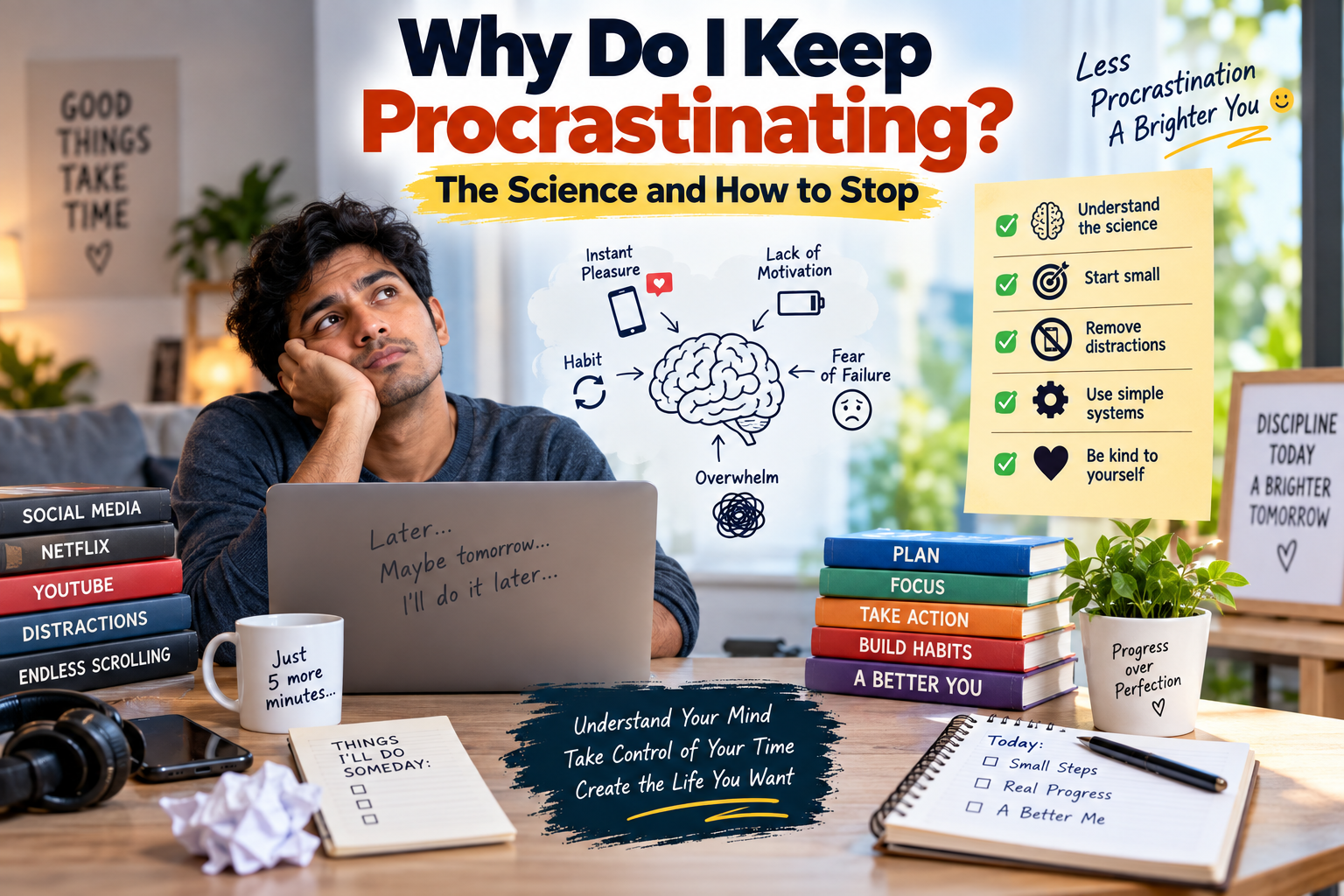
Why Do I Keep Procrastinating? The Science and How to Stop
If you keep asking yourself why you procrastinate, you already know the deadline is approaching and exactly what needs to be done. And yet, somehow, you find yourself reorganizing your desk, scrolling through your phone, or suddenly deciding now is the perfect time to clean the kitchen — anything except the actual task at hand. Afterward, you feel worse, not better, and promise yourself it won’t happen again next time.
If this cycle feels painfully familiar, the explanation isn’t laziness or poor willpower. Decades of psychological research point to something more specific — and understanding it is the first real step toward actually changing it.
Table of Contents
- Procrastination Isn’t About Time Management — It’s About Emotions
- Why Your Brain Prioritizes Feeling Good Right Now
- Fear of Failure Can Disguise Itself as Procrastination
- Why Overwhelming Tasks Get Pushed Aside
- The Perfectionism Trap
- Why We’re Bad at Predicting Our Future Selves
- Procrastination Can Become a Repeating Cycle
- When Procrastination Connects to Something Deeper
- What Actually Helps, According to Research
- A Simple First Step You Can Take Today
1. Procrastination Isn’t About Time Management — It’s About Emotions
For decades, procrastination was widely treated as a scheduling or discipline problem — something you could fix with a better planner or more willpower. Modern psychological research tells a different story. According to Dr. Fuschia Sirois, a leading procrastination researcher speaking with the American Psychological Association, procrastination is fundamentally an emotion regulation problem, not a matter of laziness or poor time management skills.
This reframing matters because it means the fix isn’t simply “try harder” or “manage your calendar better” — it’s understanding and addressing the emotional discomfort a task is creating in the first place.
2. Why Your Brain Prioritizes Feeling Good Right Now

At the core of procrastination is a very human tendency: prioritizing how you feel in this exact moment over how you’ll feel later. If a task feels boring, stressful, or unpleasant, avoiding it provides immediate emotional relief — even though, deep down, you know it will likely create more stress later when the deadline arrives.
This trade-off — short-term mood repair in exchange for longer-term consequences — is one of the most consistently identified drivers of procrastination across psychological research, and it explains why procrastination often persists even when someone fully understands it’s working against their own interests.
3. Fear of Failure Can Disguise Itself as Procrastination

Sometimes, what looks like avoidance is actually fear wearing a different costume. According to Psychology Today, people often put off tasks because they fear they won’t do them well, or worry about how the outcome will be judged by others. Delaying the task delays having to confront that possibility.
This form of procrastination can be particularly persistent, since the task itself often isn’t genuinely difficult — the real barrier is the emotional risk associated with attempting it and potentially falling short.
4. Why Overwhelming Tasks Get Pushed Aside

Large, vague, or complex tasks are especially prone to procrastination, simply because it’s unclear where to even begin. Cleaning an entire house, writing a lengthy report, or preparing for a major exam can feel so overwhelming as a single unit that avoiding the whole thing feels easier than tackling any single piece of it.
This is less about the difficulty of any individual step, and more about the psychological weight of facing an undefined, seemingly enormous task without a clear starting point.
5. The Perfectionism Trap

Perfectionism might seem like the opposite of procrastination, but the two are closely linked. According to research on procrastination types, one common pattern involves delaying tasks specifically out of fear they won’t be completed perfectly. If finishing something imperfectly feels worse than not finishing it at all, avoidance becomes a strange but logical-feeling way to protect yourself from that outcome.
This pattern often creates a frustrating loop: the closer the deadline gets, the higher the pressure to perform “perfectly” becomes, which paradoxically makes starting the task feel even more daunting.
6. Why We’re Bad at Predicting Our Future Selves

A subtler psychological factor is something researchers call affective forecasting — our surprisingly poor ability to accurately predict how we’ll feel or behave in the future. Most procrastinators genuinely believe they’ll feel more motivated, have more time, or be in a better headspace to tackle the task later.
In reality, “future you” usually faces the exact same reluctance “present you” is feeling right now — just with considerably less time remaining to deal with it.
7. Procrastination Can Become a Repeating Cycle
Procrastination doesn’t just create a one-time problem — it can establish a self-reinforcing pattern. Anxiety about a task leads to procrastination, which often leads to rushed, lower-quality work, which increases anxiety about similar future tasks, making procrastination more likely to happen again next time.
Recognizing this cycle is important, since breaking it usually requires addressing the underlying anxiety driving the avoidance, rather than simply trying to “push through” with more discipline on the next attempt.
8. When Procrastination Connects to Something Deeper

While procrastination itself isn’t classified as a mental illness, research indicates it can be closely linked to certain mental health conditions. According to clinical research on the topic, procrastination is associated with conditions including depression, anxiety, and ADHD — for example, low energy from depression, heightened worry from anxiety, or difficulty focusing on unstimulating tasks associated with ADHD can all contribute to chronic avoidance patterns.
This doesn’t mean every instance of procrastination signals an underlying condition — but if procrastination feels persistent, distressing, and difficult to manage despite genuine effort, it may be worth discussing with a mental health professional, particularly if it’s significantly affecting daily functioning.
9. What Actually Helps, According to Research
Psychological researchers have identified several evidence-based approaches that go well beyond generic advice like “just start”:
- Break tasks into smaller pieces — researchers studying executive functioning suggest that chopping overwhelming tasks into smaller, more manageable steps reduces the psychological weight that triggers avoidance in the first place
- Set meaningful personal deadlines — research on “precommitment” found that procrastinators who set self-imposed deadlines, especially ones with real consequences attached, performed measurably better than those without any interim deadlines
- Practice self-forgiveness — counterintuitively, some of the strongest research suggests that forgiving yourself for past procrastination, rather than harshly criticizing yourself, is associated with less procrastination on future tasks
- Address the emotion, not just the task — since procrastination is fundamentally about emotional regulation, directly acknowledging the specific discomfort (boredom, fear, overwhelm) a task creates can be more effective than generic productivity tips
10. A Simple First Step You Can Take Today

Given everything research reveals about procrastination, the most practical starting point isn’t a complex system — it’s picking the smallest possible piece of your avoided task and committing to just that one piece, right now, with a specific, short time limit attached.
This works precisely because it sidesteps the overwhelming, all-or-nothing framing that fuels most procrastination in the first place. Once you’ve started — even in a small, imperfect way — the psychological barrier that felt so large beforehand often turns out to be considerably smaller than it appeared.
Common Procrastination Triggers at a Glance
| Trigger | What It Looks Like | Research-Backed Fix |
|---|---|---|
| Task feels unpleasant | Avoiding boring or tedious work | Break into smaller, less daunting pieces |
| Fear of failure | Delaying to avoid potential judgment | Set low-stakes personal deadlines |
| Overwhelm | Task feels too large or vague | Identify one small, specific first step |
| Perfectionism | Avoiding starting unless it can be “perfect” | Accept an imperfect first attempt |
| Poor future prediction | Assuming “future me” will feel more ready | Act now rather than waiting to feel ready |
| Repeating anxiety cycle | Past rushed work increases future avoidance | Practice self-forgiveness, not self-criticism |
Frequently Asked Questions
Is procrastination the same as laziness?
No. Research consistently shows procrastination is primarily an emotion regulation problem, not a lack of effort or motivation — it’s about managing uncomfortable feelings a task creates, not an unwillingness to work.
Why do I procrastinate even when I know it will hurt me later?
This happens because the brain tends to prioritize immediate emotional relief over longer-term consequences, a well-documented pattern in procrastination research.
Can procrastination be linked to mental health conditions?
Yes, research associates chronic procrastination with conditions including depression, anxiety, and ADHD, though procrastination itself isn’t classified as a mental illness.
What’s the most effective way to stop procrastinating on a specific task?
Breaking the task into a smaller, specific first step and committing to just that piece, rather than trying to tackle the entire task at once, is one of the most consistently supported strategies in research.
Does being hard on myself for procrastinating help me stop?
No — research suggests the opposite. Self-forgiveness for past procrastination is associated with reduced procrastination on future tasks, while harsh self-criticism tends to reinforce the cycle.
Pick the task you’ve been avoiding, identify the smallest possible first step, and set a timer for just 10 minutes. You don’t have to finish it — you just have to start.
Conclusion
Procrastination isn’t a character flaw or a scheduling failure — it’s a deeply human response to uncomfortable emotions, rooted in how our brains weigh immediate relief against longer-term consequences. Understanding this shifts the entire approach: instead of demanding more willpower from yourself, the real path forward involves smaller steps, more self-compassion, and directly addressing the specific emotion a task is triggering, rather than fighting against it.
(Related reading: What Is the Pomodoro Technique? A Simple Guide to Focused Studying)