
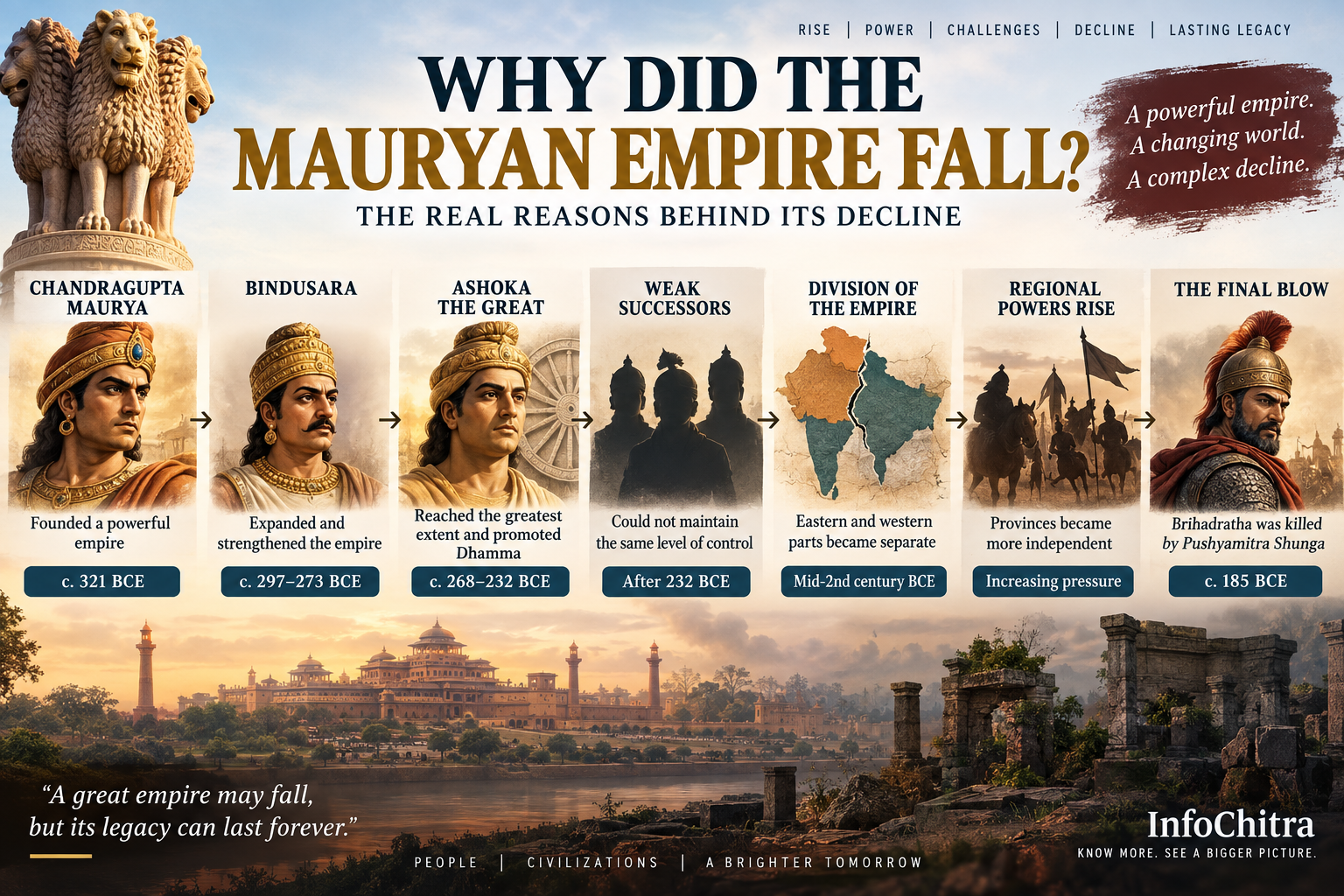
Why Did the Mauryan Empire Fall? The Real Reasons Behind Its Decline
The Mauryan Empire was one of the most powerful empires in ancient India. Founded by Chandragupta Maurya in the late 4th century BCE, it grew into a vast political power under his successors and reached its greatest territorial extent under Emperor Ashoka.
Yet this enormous empire did not survive for long after Ashoka’s death.
Ashoka died around 232 BCE, and within roughly half a century the Mauryan dynasty had come to an end. The last Mauryan ruler, Brihadratha, was killed by his commander-in-chief Pushyamitra Shunga, who established the Shunga dynasty. The Mauryan Empire is generally dated to about 321–185 BCE.
So, why did the Mauryan Empire fall?
The answer is more complicated than simply saying that Ashoka became a Buddhist or that his successors were weak. Historians have proposed several interconnected explanations, and there is still debate about the relative importance of each one.
1. The Empire Became Too Dependent on Strong Leadership
One of the biggest strengths of the Mauryan Empire was also one of its potential weaknesses.
The empire was highly centralized. Under powerful rulers such as Chandragupta Maurya and Ashoka, central authority could coordinate a huge territory.
But such a system also depended heavily on the ability of the ruler and central administration to maintain control.
When strong leadership disappeared, maintaining political unity became much more difficult.
Modern scholarship therefore tends to look beyond the simple idea of a single bad ruler and examine the structure of the Mauryan state itself. Romila Thapar’s study, for example, points to the highly centralized or “top-heavy” nature of the administration as an important part of the explanation.
2. Ashoka’s Successors Could Not Maintain the Same Level of Control

After Ashoka’s death, a succession of Mauryan rulers followed.
The historical record for these later rulers is much less clear than it is for Chandragupta and Ashoka. Different literary traditions provide conflicting details about the succession.
What is clearer is that the empire began losing its political cohesion.
The western and eastern parts of the empire were eventually associated with different rulers, including Kunala in the west and Dasharatha in the east. This division weakened the ability of the central government to maintain the unity that had existed under Ashoka.
This is one of the reasons historians often identify the succession after Ashoka as a major turning point.
3. The Empire Was Divided

A huge empire needs strong coordination.
After Ashoka, the Mauryan realm appears to have become increasingly fragmented.
The division between eastern and western territories was particularly important because it reduced the concentration of political authority at the imperial centre.
Oxford Academic’s summary of Thapar’s work identifies the partition of the empire into eastern and western sections as an immediate factor in the decline.
Once central authority weakened, distant regions became increasingly difficult to control.
4. Regional Powers Began to Become More Independent
The Mauryan Empire covered an enormous geographical area.
Maintaining control over distant provinces required administrators, military forces, communication networks and a steady flow of resources.
As central authority weakened, some regions became increasingly independent.
The empire consequently began shrinking rather than collapsing all at once.
The Metropolitan Museum of Art notes that by the time the Mauryan dynasty ended, the political landscape had changed considerably, with the Shunga dynasty becoming an important successor power in northeastern India.
This means the fall of the Mauryas was better understood as a process of political fragmentation than as one sudden event.
5. Managing Such a Large Empire Was Difficult

At its height, the Mauryan Empire controlled a vast portion of the Indian subcontinent.
The Metropolitan Museum describes Chandragupta’s empire as extending from Bengal in the east to Afghanistan in the west and southward to the Narmada River, while Ashoka later controlled most of the subcontinent except its far southern tip.
Controlling such a large territory in the ancient world was a huge administrative challenge.
Communication was slow.
Military movement took time.
Local conditions differed greatly from one region to another.
And the farther a province was from the imperial capital at Pataliputra, the harder it could be for the central government to respond quickly to problems.
So the sheer size of the empire likely increased the pressure on its political and administrative system.
6. The Centralized Administrative System Became a Problem Under Weaker Rulers
The Mauryan state developed an elaborate system of administration.
The Arthashastra, traditionally associated with Kautilya, provides an important picture of ancient Indian ideas about government, taxation, military organization and economic management, although historians debate exactly how and when the text was compiled.
Under a strong ruler, centralized administration could be highly effective.
But when central leadership weakened, the same concentration of authority could become a vulnerability.
If too much depended on the ruler and a relatively small central leadership structure, a succession of weaker rulers could cause the entire system to lose effectiveness.
This is why historians studying the decline often focus on institutions and administration, not just individual kings.
7. Economic and Administrative Pressures May Have Added to the Problem

Another explanation involves the financial demands of maintaining a large centralized state.
An empire required revenue to support:
- The army
- Government officials
- Roads and infrastructure
- Provincial administration
- The royal court
- Public and religious activities
Some historians have argued that financial pressures contributed to the weakening of the Mauryan state.
However, this point needs caution.
There is no strong historical basis for claiming that one specific economic crisis alone caused the empire to collapse.
Instead, economic pressures should be considered as one possible factor within a much larger combination of political and administrative problems.
8. Ashoka’s Buddhist Policies Were Not the Simple Cause of the Fall
This is one of the most common claims about the decline of the Mauryan Empire.
A popular explanation says:
Ashoka embraced Buddhism → stopped military expansion → weakened the army → empire collapsed.
But history is more complicated.
Ashoka did promote Buddhist ideas and emphasized Dhamma, and his inscriptions demonstrate his interest in ethical governance and non-violence. His reign also left an enormous cultural and architectural legacy.
However, historians do not agree that Buddhism or Ashoka’s personal religious policies alone caused the collapse.
The decline occurred over decades after Ashoka’s death and involved succession, political fragmentation, administration and regional pressures.
Therefore, saying “Ashoka destroyed the Mauryan Empire by becoming Buddhist” is an oversimplification.
9. External Pressure Increased as Mauryan Power Declined
As the empire became weaker, its northwestern territories became more vulnerable.
The political landscape beyond and around the Mauryan realm was changing, and new powers were becoming active in the region.
The Metropolitan Museum’s chronology records later Greco-Bactrian incursions into northern India and the emergence of other regional powers after the Mauryan period.
External pressure was therefore more likely to become dangerous because internal Mauryan authority was already weakening.
This is an important distinction.
Foreign pressure did not necessarily cause the original decline by itself; weakening central authority made the empire more vulnerable to outside challenges.
10. The Final Blow Came in 185 BCE

By the middle of the 2nd century BCE, the Mauryan Empire was already much weaker than it had been under Ashoka.
The final ruler was Brihadratha Maurya.
According to the historical tradition, Brihadratha was killed by his commander-in-chief Pushyamitra Shunga, who then established the Shunga dynasty.
This event, usually dated to around 185 BCE, marks the end of the Mauryan dynasty.
But it is important to understand that this assassination was the final event, not the entire explanation for the empire’s decline.
The empire had already been weakening for decades.
So, What Really Caused the Fall of the Mauryan Empire?
There was no single cause.
The decline was more likely the result of several problems developing together:
| Factor | How it contributed |
|---|---|
| Weak successors | Central authority became less effective |
| Division of the empire | Political unity weakened |
| Centralized administration | The system became vulnerable under weaker rulers |
| Regional independence | Provinces increasingly escaped central control |
| Large territorial size | Administration and communication became difficult |
| Financial pressures | Maintaining the imperial system required substantial resources |
| External pressure | Weakened borders became more vulnerable |
| Succession problems | Political stability declined after Ashoka |
Historians continue to debate the exact importance of these factors. The strongest explanation is therefore multi-causal, rather than blaming one ruler, one religion or one event.
The Interesting Lesson Behind the Mauryan Collapse
The story of the Mauryan Empire offers a lesson that goes beyond ancient Indian history.
Building a powerful empire is one challenge.
Keeping it together after a strong leader is gone is another.
The Mauryan state was able to create an enormous political structure under Chandragupta, Bindusara and Ashoka. But after Ashoka, the system struggled to maintain the same level of unity.
The fall therefore shows how leadership, succession, administration and regional political interests can determine whether a large state survives.
And although the Mauryan Empire disappeared, its influence did not.
Ashoka’s inscriptions, pillars, Buddhist patronage and artistic legacy continued to influence South Asian history. The famous Lion Capital of Ashoka at Sarnath, created around the 3rd century BCE, is one of the best-known surviving examples of Mauryan art.
Frequently Asked Questions
Why did the Mauryan Empire fall?
The Mauryan Empire declined because of several interconnected factors, including weak successors after Ashoka, political fragmentation, division of the empire, administrative difficulties, regional independence and increasing external pressure.
Did Ashoka cause the fall of the Mauryan Empire?
There is no strong basis for saying that Ashoka alone caused the fall. Historians generally explain the decline through multiple factors, especially the problems that developed after his death, including weak succession and political fragmentation.
When did the Mauryan Empire fall?
The Mauryan dynasty is generally considered to have ended around 185 BCE, when the last Mauryan ruler, Brihadratha, was killed by his commander-in-chief Pushyamitra Shunga.
Who defeated the Mauryan Empire?
The Mauryan Empire did not fall because of one external conqueror. It weakened gradually, and the dynasty finally ended when Pushyamitra Shunga killed Brihadratha and established the Shunga dynasty around 185 BCE.
Was the Mauryan Empire too large to control?
Its enormous size created significant administrative and communication challenges, especially when central leadership weakened. However, the size of the empire was only one factor among several that contributed to its decline.
What happened to India after the Mauryan Empire?
After the Mauryan dynasty ended, the subcontinent became politically more fragmented, with several regional powers emerging. The Shunga dynasty became an important power in northeastern India, while other kingdoms developed elsewhere.
Want to Explore More Ancient History?
Discover more fascinating stories about the civilizations, empires and historical events that shaped the world.
Conclusion
The Mauryan Empire did not collapse because of one mistake, one ruler or one religion.
Its decline was a gradual process shaped by weak succession, political division, administrative challenges, regional independence and other pressures.
The final end came around 185 BCE, but the process had begun decades earlier.
The bigger historical lesson is clear: an empire can become powerful through strong leadership, but its survival depends on whether its political and administrative institutions can remain stable when that leadership changes.