
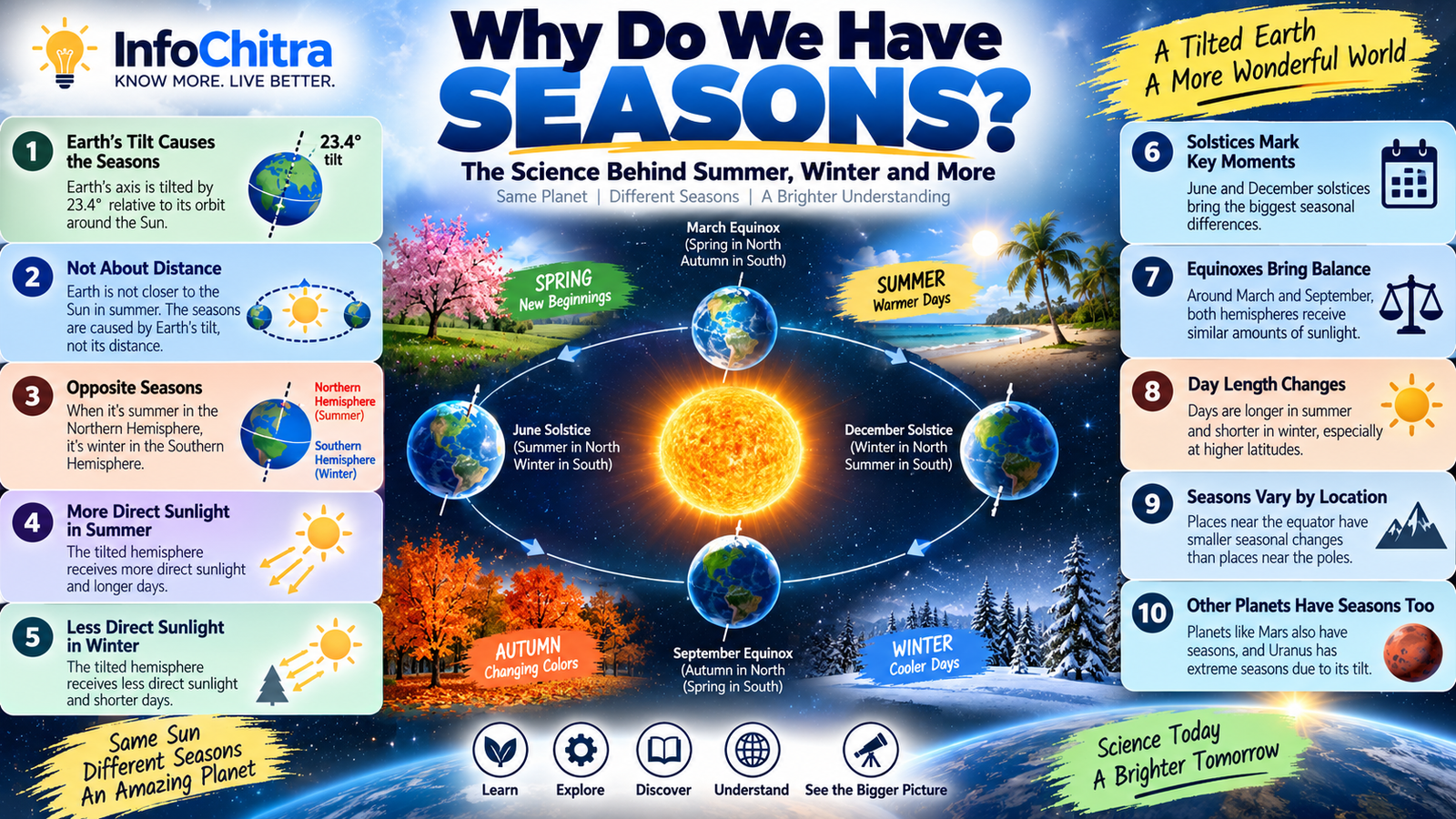
Why Do We Have Seasons? 10 Fascinating Facts About Earth’s Seasons
Have you ever wondered why we experience summer, winter, spring and autumn every year?
It might seem logical to think that summer happens because Earth gets closer to the Sun and winter happens because Earth moves farther away. But that explanation is incorrect.
The main reason Earth has seasons is the tilt of Earth’s axis. As Earth travels around the Sun, this tilt causes different parts of the planet to receive different amounts and angles of sunlight throughout the year.
Let’s explore the science behind Earth’s seasons through 10 fascinating facts.
1. Earth’s Tilt Causes the Seasons
The most important fact about Earth’s seasons is that our planet is tilted.
Earth’s rotational axis is tilted by about 23.4 degrees relative to the plane of its orbit around the Sun. As Earth travels around the Sun, this tilt causes one hemisphere to lean more toward the Sun while the other leans away.
When a hemisphere is tilted toward the Sun, it receives more direct sunlight and generally experiences summer.
When it is tilted away from the Sun, it receives less direct sunlight and experiences winter.
This cycle repeats every year.
2. Summer Is Not Caused by Earth Being Closer to the Sun
This is one of the most common misconceptions about seasons.
Earth’s orbit is slightly elliptical rather than being a perfect circle, so its distance from the Sun changes during the year.
However, this difference is not the main reason for our seasons.
In fact, the Northern Hemisphere experiences winter when Earth is relatively closer to the Sun and summer when Earth is relatively farther away. NASA specifically highlights this as evidence that Earth’s distance from the Sun does not explain the seasons.
The crucial factors are Earth’s axial tilt and the resulting angle and duration of sunlight.
Just as sunlight and Earth’s atmosphere help explain why the sky is blue, Earth’s position and axial tilt help explain why we experience different seasons.
3. The Northern and Southern Hemispheres Have Opposite Seasons
When it is summer in the Northern Hemisphere, it is winter in the Southern Hemisphere.
For example:
- Northern Hemisphere summer → Southern Hemisphere winter
- Northern Hemisphere winter → Southern Hemisphere summer
- Northern Hemisphere spring → Southern Hemisphere autumn
- Northern Hemisphere autumn → Southern Hemisphere spring
This happens because the two hemispheres are tilted in opposite directions relative to the Sun at the same time.
When the Northern Hemisphere is receiving more direct sunlight, the Southern Hemisphere is receiving less direct sunlight.
4. Summer Brings More Direct Sunlight
During summer, sunlight reaches the relevant hemisphere more directly.
This means solar energy is concentrated over a smaller area compared with sunlight arriving at a lower angle.
Summer also generally brings longer daylight hours in the hemisphere tilted toward the Sun.
Together, these factors increase the amount of solar energy received over the course of a day and contribute to warmer conditions.
5. Winter Brings Less Direct Sunlight
Winter is essentially the opposite situation.
When a hemisphere is tilted away from the Sun:
- Sunlight arrives at a lower angle.
- The energy is spread over a larger area.
- Days tend to be shorter.
- Nights tend to be longer.
The result is generally less solar heating.
This is why winter can be particularly extreme at high latitudes, where daylight can become very limited during parts of the season.
6. The Solstices Mark Important Seasonal Points
Two important points in Earth’s yearly journey are called solstices.
June Solstice
Around the June solstice, the Northern Hemisphere is tilted toward the Sun.
This produces:
- Summer in the Northern Hemisphere
- Winter in the Southern Hemisphere
- Longer daylight in much of the Northern Hemisphere
December Solstice
Around the December solstice, the situation reverses.
This produces:
- Winter in the Northern Hemisphere
- Summer in the Southern Hemisphere
- Longer daylight in much of the Southern Hemisphere
The solstices represent the points when the seasonal difference in sunlight between the hemispheres is particularly pronounced.
7. Equinoxes Occur Between the Solstices
The two other important points in the seasonal cycle are the equinoxes.
They occur around March and September.
During an equinox, neither hemisphere is strongly tilted toward or away from the Sun, and the two hemispheres receive relatively similar amounts of sunlight.
The equinoxes mark the approximate transitions between:
- Winter and spring
- Summer and autumn
The exact weather transition, however, can vary depending on location and climate.
8. Day Length Changes With the Seasons
Earth’s tilt affects not only temperature but also day length.
During summer, locations in the hemisphere tilted toward the Sun generally experience longer daylight periods.
During winter, they experience shorter daylight periods.
The effect becomes much stronger as you travel toward the poles.
Near the Arctic and Antarctic regions, seasonal daylight differences can become extreme, with periods of almost continuous daylight or darkness.
This is one reason seasonal differences can be much more dramatic near the poles than near the equator.
9. Different Places Experience Different Seasons
Not every location experiences seasons in exactly the same way.
Near the equator, temperatures can remain relatively consistent throughout the year compared with locations farther north or south.
At higher latitudes, the difference in sunlight between summer and winter becomes much greater.
The amount of solar energy received therefore varies significantly depending on latitude.
This is why a person living close to the equator can experience a very different seasonal pattern from someone living near the Arctic Circle.
10. Earth Is Not the Only Planet With Seasons
Earth is not unique in having seasons.
Other planets can experience seasonal changes as well, depending on factors such as their axial tilt, orbit and atmosphere.
Mars, for example, has an axial tilt of about 25.2 degrees, which is similar to Earth’s tilt of about 23.4 degrees. As a result, Mars also experiences seasonal changes.
Uranus is an especially unusual example. Its axis is tilted by about 98 degrees, producing extremely unusual seasonal patterns compared with Earth.
Studying seasons on other worlds helps scientists understand how planetary tilt, sunlight and atmospheric conditions influence climate.
Our planet has many fascinating characteristics beyond its seasonal cycle. Read more Earth facts to explore them.
Why Do We Have Seasons? The Simple Answer
If you remember only one thing from this article, remember this:
Earth has seasons because its axis is tilted as it travels around the Sun.
The tilt changes the angle and duration of sunlight received by different parts of Earth during the year.
Tilt + Earth’s orbit around the Sun = changing seasons.
Seasons at a Glance
| Season | Northern Hemisphere | Southern Hemisphere |
|---|---|---|
| Around March | Spring | Autumn |
| Around June | Summer | Winter |
| Around September | Autumn | Spring |
| Around December | Winter | Summer |
These are broad seasonal patterns; the exact dates and local weather conditions vary by location.
Common Misconceptions About Earth’s Seasons
Myth 1: Summer happens because Earth is closer to the Sun
Not true. Earth’s changing distance from the Sun is not the main cause of the seasons.
Myth 2: Winter means the Sun produces less heat
Not exactly. The seasonal difference we experience on Earth is primarily related to how sunlight reaches each hemisphere because of Earth’s tilt.
Myth 3: Every place experiences four distinct seasons
Not necessarily. Seasonal patterns vary considerably with latitude, geography, oceans and climate.
Myth 4: Seasons are caused by Earth’s orbit alone
Earth’s orbit matters because Earth moves around the Sun, but the axial tilt is the critical reason different seasons occur.
Frequently Asked Questions
Why do we have seasons?
We have seasons because Earth’s axis is tilted about 23.4 degrees. As Earth orbits the Sun, this tilt causes different hemispheres to receive different amounts and angles of sunlight during the year.
Why is summer hotter than winter?
During summer, the hemisphere tilted toward the Sun receives more direct sunlight and generally experiences longer daylight hours. This increases the amount of solar energy received.
Why is it summer in one hemisphere and winter in another?
The Northern and Southern Hemispheres are tilted in opposite directions relative to the Sun. When one receives more direct sunlight, the other receives less.
What are solstices?
Solstices occur around June and December and mark important points in Earth’s seasonal cycle when the difference in sunlight between the hemispheres is particularly pronounced.
What are equinoxes?
Equinoxes occur around March and September, when the two hemispheres receive relatively similar amounts of sunlight.
Does Earth’s distance from the Sun cause winter and summer?
No. Earth’s distance from the Sun changes during its orbit, but this is not the primary cause of Earth’s seasons. Earth’s axial tilt is the key factor.
Conclusion
The changing seasons are the result of a simple but remarkable feature of our planet: Earth is tilted.
As Earth travels around the Sun, that tilt changes how directly sunlight reaches each hemisphere and how long daylight lasts. The result is the familiar cycle of spring, summer, autumn and winter.
So the next time summer turns into autumn or winter gives way to spring, remember that the changing seasons are ultimately a consequence of Earth’s tilted axis, its orbit around the Sun and the way sunlight reaches our planet.