
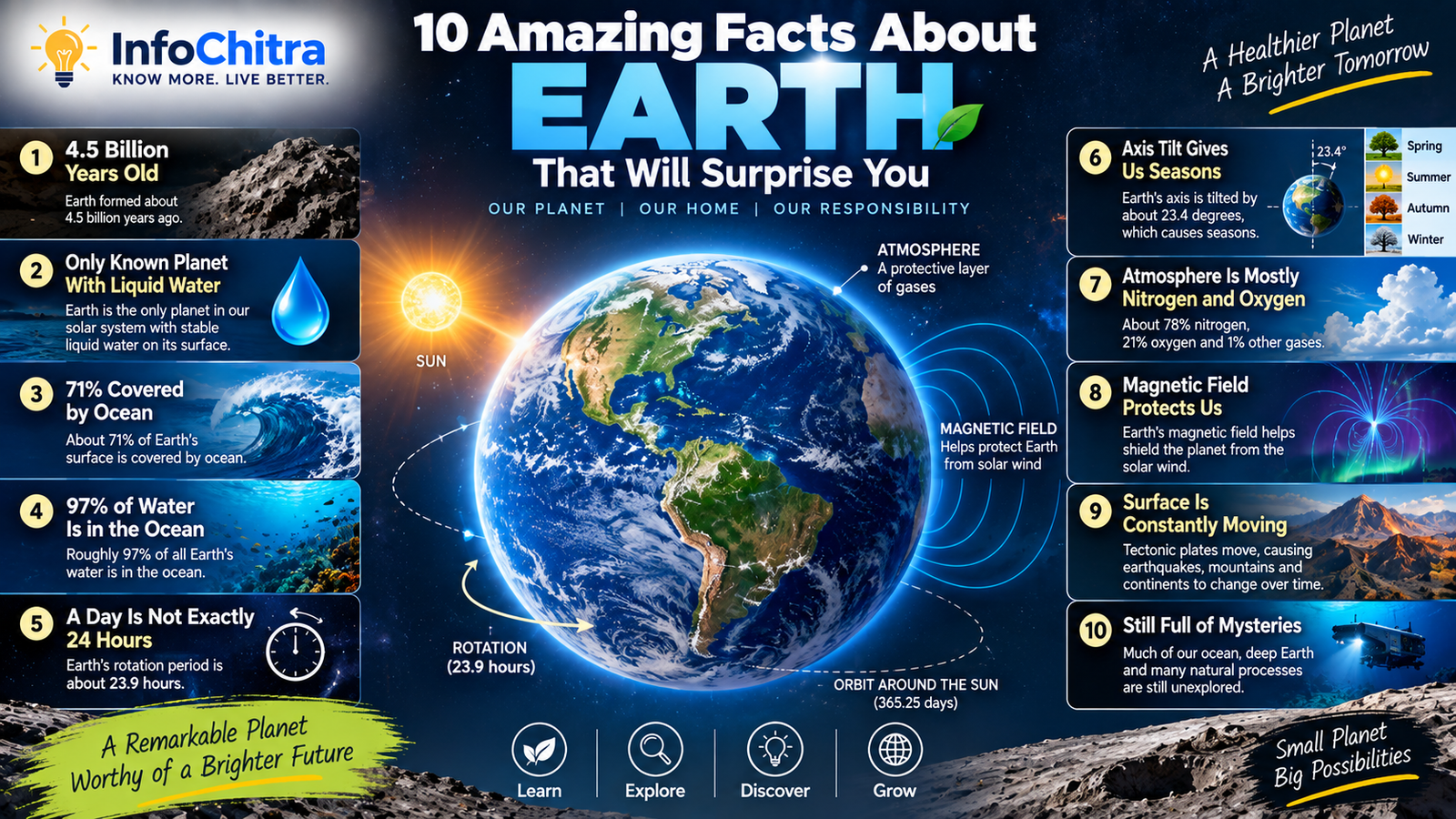
10 Amazing Facts About Earth That Will Surprise You
We live on Earth every day, but our home planet is far more fascinating than it may seem.
Earth is a rocky planet with vast oceans, a protective atmosphere, a magnetic field and a constantly changing surface. It rotates, orbits the Sun, moves through space and supports an extraordinary variety of life.
NASA describes Earth as the only planet in our solar system known to have abundant life and the only planet in our solar system with liquid water on its surface.
Here are 10 fascinating Earth facts that reveal just how unusual our planet really is.
1. Earth Is About 4.5 Billion Years Old
Earth formed billions of years ago as material in the early solar system came together under gravity.
Although the exact history of Earth’s formation is complex, scientists know that our planet is approximately 4.5 billion years old.
That means modern human civilization occupies only a tiny fraction of Earth’s history.
The planet has undergone enormous changes during that time, including the formation of continents, oceans, atmosphere and the biological systems that support life today.
2. Earth Is the Only Known Planet With Liquid Water on Its Surface
Water is one of the most important features that makes Earth suitable for life.
NASA notes that Earth is the only planet in our solar system with liquid water on its surface.
Earth’s temperature and atmospheric pressure allow large bodies of liquid water to remain stable for long periods.
Oceans, lakes, rivers, glaciers, groundwater and atmospheric water are all parts of Earth’s water system.
This does not mean water exists nowhere else in the solar system. Scientists have evidence of water ice and possible subsurface oceans on several worlds. But Earth is unique in having extensive, stable liquid water exposed at its surface.
3. About 71% of Earth’s Surface Is Covered by Ocean
If you look at Earth from space, its blue appearance is largely due to the enormous amount of water covering the planet.
NASA estimates that the global ocean covers approximately 71% of Earth’s surface.
The ocean isn’t just a huge collection of water. It plays an enormous role in Earth’s climate, weather and ecosystems.
Ocean currents move heat around the planet, while evaporation supplies moisture that eventually contributes to rainfall.
NOAA explains that the ocean stores solar energy and distributes heat and moisture around the globe, influencing weather and climate.
4. Almost All of Earth’s Water Is in the Ocean
The amount of water on Earth is enormous, but most of it is salty ocean water.
According to NOAA, approximately 97% of Earth’s water is found in the ocean. The remaining portion is distributed among glaciers and ice, groundwater, lakes, rivers and the atmosphere.
That means freshwater represents only a small fraction of the planet’s total water supply.
This is one reason freshwater resources are so important for people, agriculture and ecosystems.
5. A Day on Earth Is Not Exactly 24 Hours
We normally say that one day lasts 24 hours.
But Earth’s actual rotation period relative to the stars is slightly shorter.
NASA gives Earth’s rotation period as approximately 23.9 hours, while its orbit around the Sun takes about 365.25 days.
That extra quarter of a day in the orbital period is why our calendar needs a leap day approximately every four years.
So the familiar 24-hour day and 365-day year are useful calendar conventions based on astronomical cycles that aren’t exactly whole numbers.
Why Is the Sky Blue? The Science Behind the Blue Sky
6. Earth’s Axis Is Tilted — and That Gives Us Seasons
Earth does not orbit the Sun with its axis perfectly upright.
Its rotational axis is tilted by approximately 23.4 degrees relative to the plane of its orbit.
This tilt is one of the key reasons Earth experiences seasons.
When a hemisphere is tilted toward the Sun, it receives more direct sunlight and experiences warmer conditions. When it is tilted away, sunlight is less direct and conditions are generally cooler.
This is why the Northern and Southern Hemispheres experience opposite seasons.
7. Earth’s Atmosphere Is Mostly Nitrogen and Oxygen
The air around us may seem invisible and simple, but Earth’s atmosphere is a complex mixture of gases.
Near Earth’s surface, the atmosphere is approximately:
- 78% nitrogen
- 21% oxygen
- 1% other gases
The remaining gases include argon, carbon dioxide and other trace gases.
The atmosphere does much more than provide oxygen.
It helps regulate Earth’s temperature, supports the water cycle and protects the surface from much of the harmful radiation coming from space.
It also causes many meteoroids to heat up and burn as they enter the atmosphere.
8. Earth Has a Magnetic Field That Helps Protect the Planet
Deep inside Earth is a hot, metallic core.
The movement of electrically conductive material within Earth’s interior contributes to the planet’s magnetic field.
NASA explains that Earth’s magnetic field interacts with the solar wind and helps protect the planet from the space environment.
This magnetic environment is also connected to one of the most spectacular natural phenomena on Earth: the aurora.
When charged particles associated with the solar wind interact with gases in Earth’s upper atmosphere, they can produce glowing displays known as the northern and southern lights.
9. Earth’s Surface Is Constantly Moving
The ground beneath our feet may appear completely still, but Earth’s outer solid layer is constantly changing.
The lithosphere is divided into large tectonic plates that move over geological time.
According to NASA, plate movement can produce earthquakes, contribute to mountain building and create other major geological features.
This movement is incredibly slow from a human perspective, but over millions of years it can completely reshape continents and oceans.
Mountains can rise, ocean basins can form and coastlines can change.
Earth is therefore not a static planet — it is a dynamic one.
10. Earth Is Still Full of Mysteries
We have mapped enormous portions of Earth’s surface, sent spacecraft into orbit and studied the planet using satellites.
Yet there is still much to discover.
The ocean is a particularly important example.
NOAA notes that although the ocean covers about 70% of Earth’s surface, much of it remains poorly explored.
Scientists continue to discover new species, geological features and processes in the deep ocean.
So even though Earth is our home, we haven’t finished exploring it.
Frequently Asked Questions
What is the most interesting fact about Earth?
One remarkable fact is that Earth is the only planet in our solar system known to have extensive stable liquid water on its surface.
How old is Earth?
Earth is approximately 4.5 billion years old.
How much of Earth is covered by water?
Approximately 71% of Earth’s surface is covered by ocean.
How much of Earth’s water is in the ocean?
Approximately 97% of Earth’s water is in the ocean.
Why does Earth have seasons?
Earth’s approximately 23.4-degree axial tilt, combined with its orbit around the Sun, produces the seasonal cycle.
How long is an Earth day?
Earth completes one rotation in approximately 23.9 hours, although the conventional solar day is about 24 hours.
What gases make up Earth’s atmosphere?
Earth’s atmosphere near the surface is approximately 78% nitrogen, 21% oxygen and 1% other gases.
Does Earth have a magnetic field?
Yes. Earth’s magnetic field is generated by processes within the planet and helps protect Earth from the space environment.
Conclusion
Earth may be the planet we know best, but it is still full of extraordinary facts.
Its vast oceans, constantly moving tectonic plates, protective atmosphere, magnetic field and unique ability to support abundant life make it a remarkable world.
From the water beneath the ocean surface to the atmosphere high above us, Earth’s systems are connected in ways that scientists continue to study.
The more we learn about our planet, the more fascinating it becomes.
How to Identify Fake News Online: 10 Simple Ways to Verify Information