
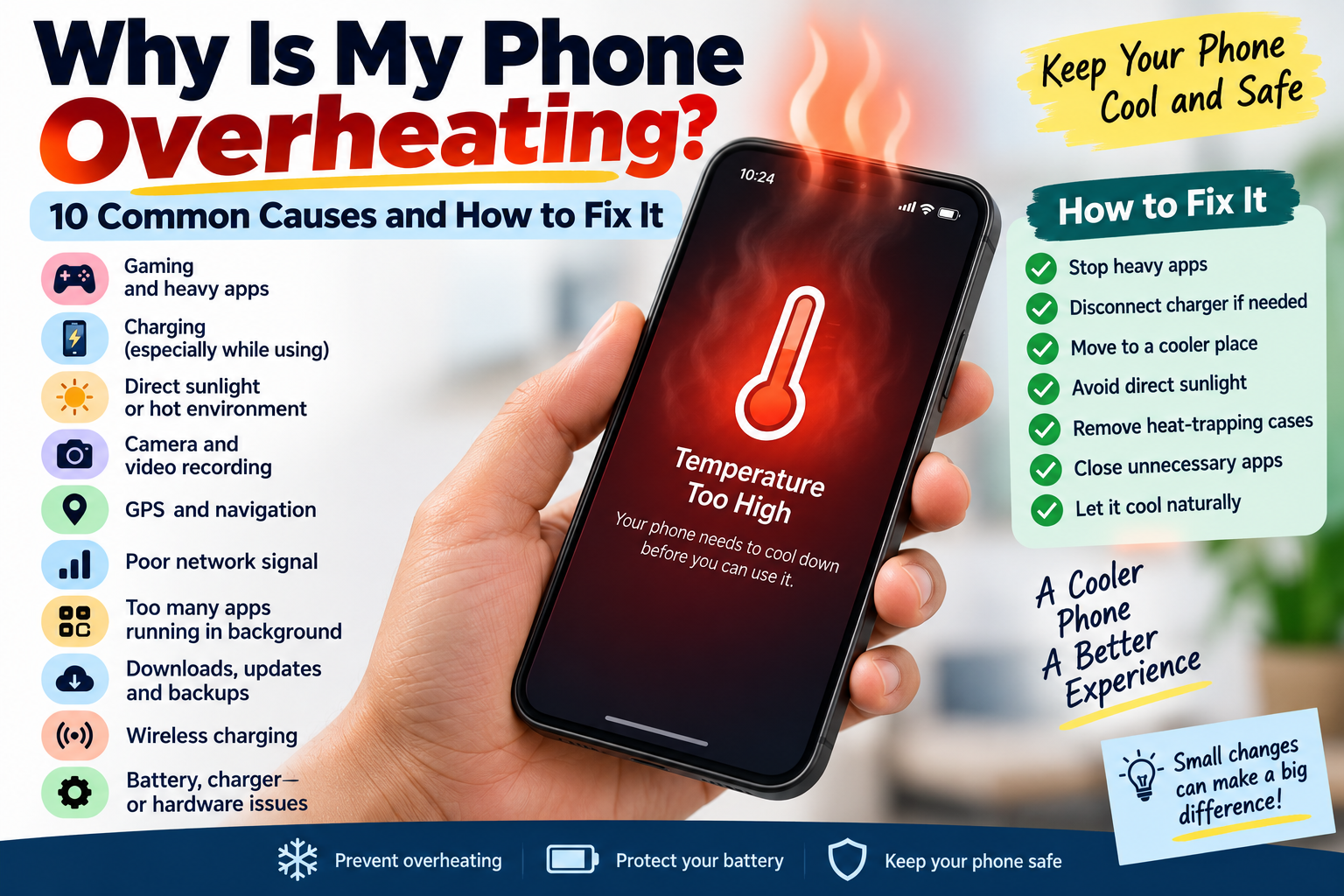
Why Is My Phone Overheating?
A phone can feel warm during demanding tasks such as gaming, video recording, navigation, video calls, wireless charging or large downloads. Some warmth is normal, but a phone that becomes unusually hot, repeatedly shows temperature warnings, slows down, stops charging or shuts down needs attention.
Both Android and iPhone devices have built-in temperature protections. For example, they may reduce performance, slow or pause charging, dim the display or temporarily disable certain features when temperatures become too high.
So, why is your phone overheating? Here are 10 common reasons and what you can do about them.
1. You’re Playing Heavy Games

Graphics-intensive games can put a lot of work on the processor and graphics hardware.
The longer you play, especially at high graphics settings and brightness, the more heat the phone can generate.
What to do
- Take regular breaks.
- Lower graphics quality if the game allows it.
- Reduce screen brightness.
- Avoid playing demanding games while charging.
- Move out of direct sunlight or other hot environments.
Gaming and other processor-intensive activities are listed by Apple and Google among situations that can make phones warmer.
2. You’re Using the Phone While Charging

Charging itself produces some heat. If you’re simultaneously gaming, watching high-resolution video, making a video call or using navigation, the phone has to handle both charging and heavy processing.
That combination can make it noticeably warmer.
What to do
If the phone becomes very hot:
- Stop demanding apps.
- Disconnect the charger if necessary.
- Move the phone to a cooler location.
- Allow it to cool before continuing.
Google specifically advises moving an excessively hot device to a cooler place and not using it until it has cooled.
3. Direct Sunlight or a Hot Environment

This is especially important in hot climates.
Leaving your phone:
- inside a parked car
- on a dashboard
- under direct sunlight
- near a heat source
- in a poorly ventilated location
can raise its temperature quickly.
Apple recommends using iPhone in an ambient temperature range of 0°C to 35°C and warns that very hot conditions can affect the device and battery.
What to do
Move the phone indoors or into shade and allow it to cool naturally.
Don’t try to cool an overheated phone by putting it in a refrigerator or freezer.
4. Your Camera Is Working Hard
Recording high-resolution video for a long time can make your phone warm.
The same can happen with:
- long video calls
- extended camera use
- high-resolution recording
- image processing
- live streaming
Google specifically lists high-definition video recording among activities that can increase device temperature.
What to do
Stop recording for a while and let the phone cool.
If you don’t need maximum resolution, using a lower recording setting may also reduce the workload.
5. GPS and Navigation Are Running for a Long Time

Navigation can use several phone components at once:
- GPS/location
- mobile network
- display
- processor
- sometimes Bluetooth
Using navigation for a long period, especially in direct sunlight inside a vehicle, can therefore make the phone hotter.
Apple specifically identifies GPS/navigation in hot conditions as a situation that can contribute to excessive temperature.
What to do
- Keep the phone out of direct sunlight.
- Reduce screen brightness when practical.
- Avoid placing it on a hot dashboard.
- Give it a break when navigation is no longer needed.
6. Poor Mobile Signal Can Increase Workload
When cellular reception is weak, the phone may work harder to maintain a connection.
This can become more noticeable when you’re:
- inside a building with poor signal
- travelling through areas with weak coverage
- using mobile data heavily
- using the phone as a hotspot
Google lists tethering/hotspot use and large data transfers among activities that can raise device temperature.
What to do
If possible, use a reliable Wi-Fi connection rather than mobile data for heavy downloads or streaming.
7. Too Many Resource-Heavy Apps Are Running

Sometimes the problem isn’t one obvious app.
A combination of:
- video streaming
- social media
- cloud backup
- file transfers
- navigation
- downloads
- background processing
can keep the processor and network components busy.
What to do
Close or stop the apps you don’t need and check whether the phone becomes cooler.
If the problem repeatedly returns after opening a particular app, that app may deserve further investigation.
8. The Phone Is Downloading, Uploading or Restoring Data
A phone can become warm while:
- restoring a backup
- transferring large files
- uploading photos
- downloading large files
- setting up a new device
- completing a major software update
These processes can temporarily increase processor and network activity.
Both Google and Apple identify setup, backup restoration and software updates as situations in which a phone may become warmer.
What to do
If there is no temperature warning, allow the process to finish.
The phone should generally cool down once the intensive activity is complete.
9. Wireless Charging Can Produce More Heat
Wireless charging can make a phone warmer than normal.
Apple notes that wireless charging can cause a device to feel warm, while Google recommends keeping the device cool and well ventilated during charging.
What to do
- Use a compatible charger.
- Keep the phone on a hard, ventilated surface.
- Avoid charging in direct sunlight.
- If your case causes excessive heat during charging, try removing it.
Apple also notes that iPhone can automatically slow or pause charging when its temperature becomes too high.
10. There Could Be a Battery, Charger or Hardware Problem

If your phone gets unusually hot even when you’re barely using it, don’t simply assume it’s normal.
Pay particular attention if overheating happens together with:
- sudden battery drain
- repeated unexpected shutdowns
- charging problems
- a damaged phone
- a damaged charging cable or adapter
- a battery that appears swollen
- repeated temperature warnings
A damaged device or battery can present a safety risk. Google advises against using a damaged phone and recommends contacting support if the device isn’t working properly or has been damaged.
What to do
Stop using the device if it becomes dangerously hot or shows signs of physical battery damage, disconnect it from power if safe to do so, and seek manufacturer or qualified service support.
What Should You Do If Your Phone Gets Very Hot?
Use this simple sequence:
Stop heavy apps
↓
Disconnect the charger if it’s charging
↓
Move the phone away from sunlight/heat
↓
Remove any heat-trapping situation, such as an unsuitable case if appropriate
↓
Leave it unused until it cools
↓
Restart it if necessary
↓
Check whether the problem returns
Google specifically recommends disconnecting a very hot phone from power, moving it to a cooler place and not using it until it has cooled.
For iPhone, Apple similarly recommends moving an overheated device to a cooler environment away from direct sunlight and allowing it to cool.
What You Should NOT Do
If your phone is overheating:
❌ Don’t put it in a refrigerator or freezer
A sudden temperature change can cause other problems, including condensation.
❌ Don’t keep using demanding apps
Don’t continue gaming or recording video while the phone is already excessively hot.
❌ Don’t cover it with a blanket or pillow while charging
Phones and chargers need adequate ventilation. Google specifically warns against covering devices or chargers with bedding while connected to power.
❌ Don’t use a damaged charger or cable
Damaged charging accessories can create safety risks.
Why Does My Phone Get Hot While Charging?
Some warmth while charging is normal.
But excessive heat can happen when you combine charging with:
- gaming
- video streaming
- navigation
- high brightness
- wireless charging
- hot surroundings
- an unsuitable or damaged charging accessory
Modern phones can automatically slow or pause charging when temperatures become too high.
Why Does My Phone Get Hot When I’m Not Using It?
If this happens occasionally, background activity may be responsible.
Possible causes include:
- backup or cloud syncing
- app updates
- large downloads/uploads
- poor network conditions
- system setup or update activity
- a problematic app
But repeated overheating while the phone is idle deserves more attention, particularly if battery drain or other unusual behavior occurs at the same time.
Android vs iPhone: What Happens When They Get Too Hot?
| Situation | Android | iPhone |
|---|---|---|
| Charging | May slow down or pause | May slow down or pause |
| Performance | May be reduced | May be reduced |
| Display | May dim | May dim |
| Network | Some functions may be limited | Cellular functions may be reduced |
| Extreme temperature | May shut down | May show a temperature warning and temporarily restrict use |
Exact behavior varies by model and software version. Google’s Pixel documentation and Apple’s iPhone documentation both describe built-in thermal protections.
When Should You Be Concerned?
A phone becoming warm during demanding activity isn’t automatically a problem.
It’s more concerning when:
- it becomes extremely hot repeatedly
- it overheats while idle
- it repeatedly shuts down
- charging repeatedly stops because of temperature
- the battery drains unusually fast
- the phone or battery is physically damaged
- you see swelling or other signs of battery damage
In these situations, consider contacting the phone manufacturer’s support or a qualified service provider rather than repeatedly trying home fixes.
Frequently Asked Questions
Why is my phone overheating?
Common causes include gaming, video recording, navigation, heavy apps, charging, wireless charging, direct sunlight, poor ventilation, large data transfers and software activity.
Is it normal for a phone to get warm?
Yes. Phones naturally generate heat during processing, charging, camera use and other demanding activities. The concern is excessive or persistent heat.
Why does my phone get hot while charging?
Charging generates heat, and the temperature can increase further if you use demanding apps at the same time or charge in a hot environment.
Should I put my phone in the refrigerator if it overheats?
No. Let it cool naturally in a cooler environment away from direct sunlight and heat.
Why does my phone overheat when I’m not using it?
Background downloads, syncing, updates, poor network conditions or a problematic app can sometimes cause activity while the phone appears idle.
Can overheating damage a phone battery?
Repeated exposure to excessive heat can affect battery performance and longevity. Apple specifically warns that very hot conditions can permanently shorten battery life.
Is your phone overheating and also losing battery unusually fast? These two problems can often be related. Learn what may be causing rapid battery drain and what you can do to improve your phone’s battery life.
Final Takeaway
A warm phone isn’t necessarily a sign that something is wrong. Heavy apps, charging, gaming, navigation, camera use, wireless charging and hot surroundings can all increase temperature.
The key is to identify whether the heat is temporary and connected to a demanding activity or whether the phone is repeatedly overheating without an obvious reason.
If your phone becomes very hot, stop intensive activity, disconnect it from power if appropriate, move it away from heat and let it cool. If overheating keeps happening or is accompanied by battery or hardware problems, get the device checked.