
India’s Education System in 2026: 10 Ways NEP Is Changing Learning
India’s education system is undergoing one of its most significant transformations in decades. Six years after the National Education Policy (NEP) 2020 was introduced, 2026 marks a turning point where many of its reforms have moved from paper to practice — reshaping classrooms, curricula, and career pathways across the country.
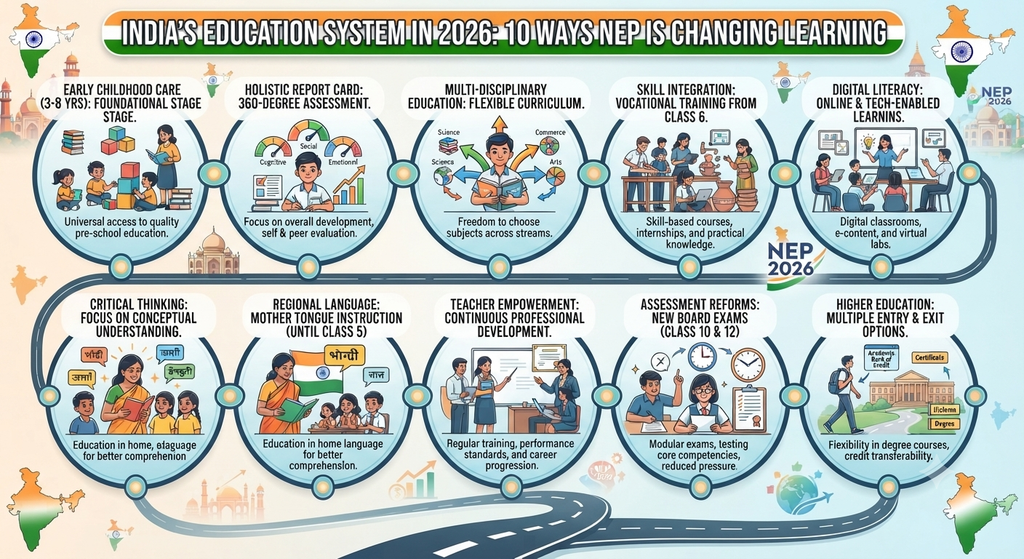
From how young children begin school to how college students earn degrees, NEP’s changes are visible at every level of India’s education system. Here are 10 ways India’s education system is changing in 2026.
Table of Contents
- The 10+2 System Has Been Replaced by 5+3+3+4
- Classrooms Are Shifting from Rote Learning to Competency-Based Education
- AI and Computational Thinking Now Start in Class 3
- A Third Language Begins in Class 6
- NEP Board Exam Changes Are Set for 2028
- The Academic Bank of Credits Is Changing How Degrees Work
- The APAAR ID Gives Every Student a Digital Identity
- The No-Detention Policy Has Been Removed for Classes 5 and 8
- Digital Learning Is Expanding Rapidly Across Institutions
- Teacher Training Has Become More Structured
1. The 10+2 System Has Been Replaced by 5+3+3+4
One of the most fundamental shifts under NEP has been the replacement of the traditional 10+2 schooling structure with a new 5+3+3+4 framework, covering children from ages three to eighteen. This structure divides education into a Foundational stage, Preparatory stage, Middle stage, and Secondary stage, creating a more gradual and developmentally appropriate progression through school.
This change reflects a broader goal of aligning India’s education system with how children actually develop cognitively and emotionally at different ages, rather than treating schooling as a single uniform block.
2. Classrooms Are Shifting from Rote Learning to Competency-Based Education
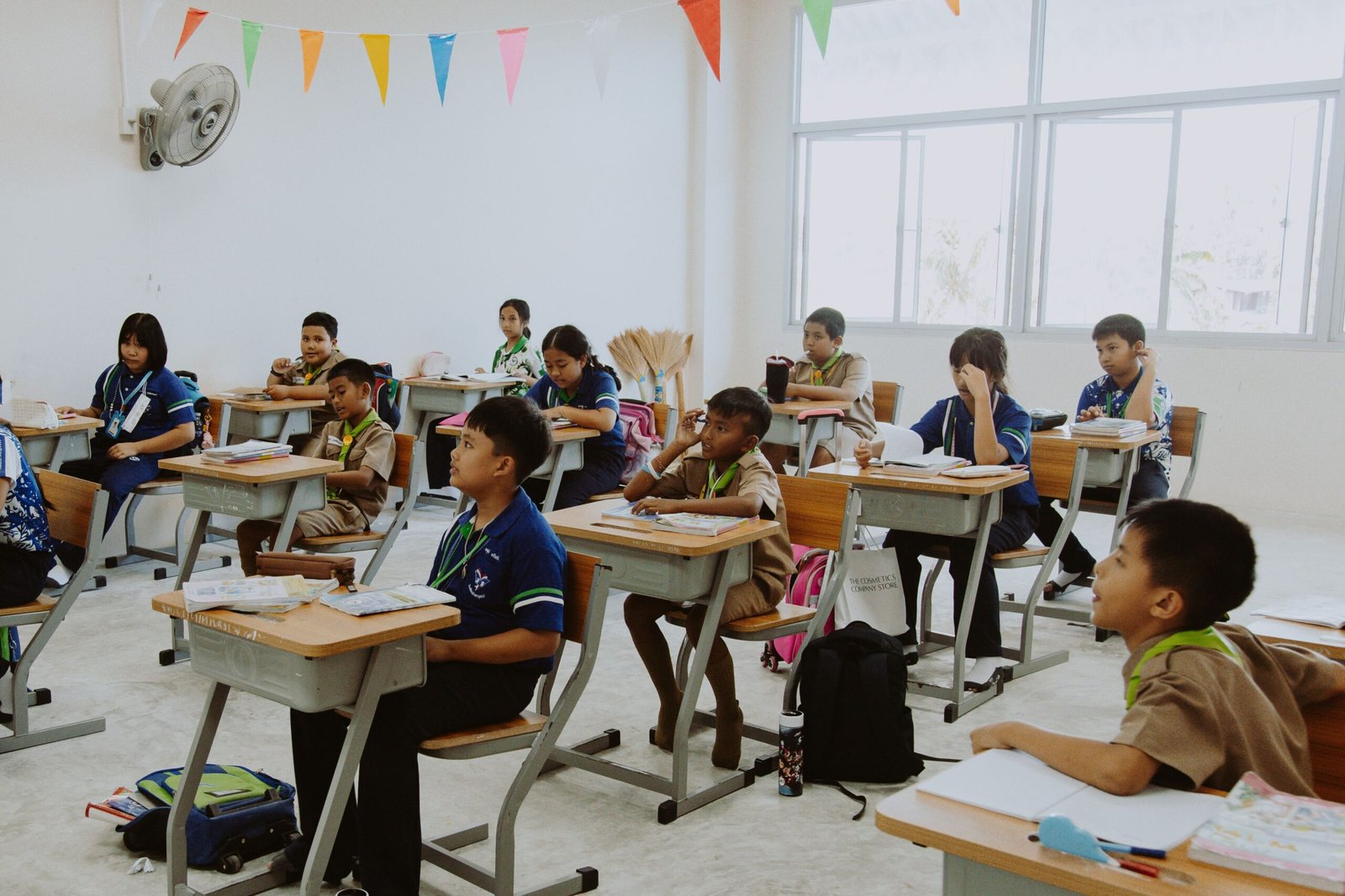
For decades, India’s education system was often criticized for emphasizing memorization and exam performance over genuine understanding. According to EducationWorld’s 2026 coverage of NEP implementation, a typical Indian classroom today reflects a shift toward competency-based assessments and a more flexible curriculum, moving away from rigid, exam-driven learning models.
This shift is intended to help students build critical thinking and problem-solving skills that are more directly useful in real-world and workplace situations.
3. AI and Computational Thinking Now Start in Class 3
Reflecting the growing importance of technology, students in Class 3 are now being introduced to artificial intelligence concepts and computational skills as part of the standard curriculum. This marks a significant shift from earlier decades, when computer science was typically introduced much later in a student’s education, if at all.
Starting this exposure early is intended to build comfort and familiarity with AI-related thinking well before students reach college or the workforce.
4. A Third Language Begins in Class 6
Under NEP’s multilingual education framework, students from Class 6 onward are now required to study a third language, in addition to their existing subjects. This policy is designed to promote multilingualism and help preserve India’s vast linguistic diversity, while also encouraging teaching in regional languages and mother tongues at earlier stages of education.
This approach reflects NEP’s broader emphasis on linguistic and cultural inclusivity as a core part of India’s education system.
5. NEP Board Exam Changes Are Set for 2028
While full implementation is still gradually rolling out, NEP outlines significant changes to India’s Board Exam system, with major structural changes expected to take effect from 2028. These changes are intended to reduce the intense, single-attempt pressure traditionally associated with board exams and move toward assessment models that better reflect a student’s overall learning and skill development.
Because these changes are being phased in gradually, students currently in school may experience a mix of older and newer assessment approaches during the transition period.
6. The Academic Bank of Credits Is Changing How Degrees Work
One of the most practically significant reforms has been the introduction of the Academic Bank of Credits (ABC). Under the traditional system, a student who dropped out of a degree program would typically lose all academic progress made up to that point. With ABC, students can now pause their education without losing accumulated credits, and later resume or transfer them toward completing a degree.
This flexibility directly addresses a long-standing rigidity in India’s higher education system, where fixed multi-year degree structures often failed to accommodate students facing financial, personal, or career-related disruptions.
7. The APAAR ID Gives Every Student a Digital Identity
Alongside the Academic Bank of Credits, NEP has introduced the APAAR ID — a unique digital identity for students that links directly to their academic records. This digital identity system is designed to make it easier to track a student’s educational journey across institutions, reducing paperwork and administrative friction when students transfer, apply for further education, or seek employment verification.
Together with the ABC system, the APAAR ID represents a broader digitization of how India manages and verifies educational credentials.
8. The No-Detention Policy Has Been Removed for Classes 5 and 8
A notable change to earlier education policy has been the removal of the no-detention policy for Classes 5 and 8. Previously, students in these grades were automatically promoted to the next class regardless of exam performance. Under the revised policy, students who do not pass year-end exams in these classes may now be held back, making it mandatory to demonstrate a certain level of academic achievement before progressing.
This change has sparked debate among educators, with supporters arguing it restores accountability, while critics raise concerns about the impact on vulnerable students.
9. Digital Learning Is Expanding Rapidly Across Institutions
Digital education has become a central pillar of NEP implementation in 2026. Universities and colleges across the country are adopting large-scale digitization of academic processes, from records management to online and hybrid learning delivery. This transformation is aimed at making education more accessible and scalable, particularly for students in remote or underserved areas.
This expansion reflects a broader national push to use technology not just as a teaching tool, but as core infrastructure for how educational institutions operate.
10. Teacher Training Has Become More Structured
Recognizing that NEP’s success ultimately depends on teachers, continuous professional development programs have become significantly more structured in 2026. Traditional one-time workshops are increasingly being replaced by ongoing online and hybrid training programs, designed to help teachers adapt to competency-based assessment methods and new curriculum requirements.
This shift acknowledges that large-scale curriculum reform cannot succeed without equally significant investment in preparing the teachers responsible for delivering it in classrooms.
NEP 2026 Changes at a Glance
| Reform | Key Change |
|---|---|
| School structure | 10+2 replaced with 5+3+3+4 |
| Curriculum approach | Shift to competency-based assessment |
| Technology education | AI and computational skills from Class 3 |
| Language policy | Third language required from Class 6 |
| Board exams | Major changes expected by 2028 |
| Higher education credits | Academic Bank of Credits (ABC) |
| Student identity | APAAR ID for digital academic records |
| Promotion policy | No-detention removed for Classes 5 and 8 |
Frequently Asked Questions
What is NEP 2020? The National Education Policy (NEP) 2020 is a major reform introduced by the Government of India to restructure the country’s school and higher education systems, moving toward a more flexible, skill-based, and multidisciplinary approach.
What is the 5+3+3+4 structure? It is the new schooling framework that replaced the traditional 10+2 system, dividing education into Foundational, Preparatory, Middle, and Secondary stages for students aged three to eighteen.
What is the Academic Bank of Credits? It is a system that allows students to accumulate and store academic credits, enabling them to pause and resume their education without losing prior academic progress.
Has the no-detention policy been completely removed? It has been removed specifically for Classes 5 and 8, meaning students in these grades may now be held back if they do not pass year-end exams.
When will board exam changes take effect? Major structural changes to India’s board exam system are expected to take effect from 2028, as part of NEP’s phased implementation.
Conclusion
Six years into its rollout, NEP 2020 has moved well beyond policy documents and into the daily reality of Indian classrooms. From new grade structures and technology education to flexible degree systems and digital student identities, India’s education system in 2026 looks meaningfully different from just a few years ago. As implementation continues gradually across states and institutions, the coming years will be critical in determining how fully these reforms translate into better learning outcomes nationwide.
(Related reading: Online Learning: 10 Powerful Ways to Learn Better)