
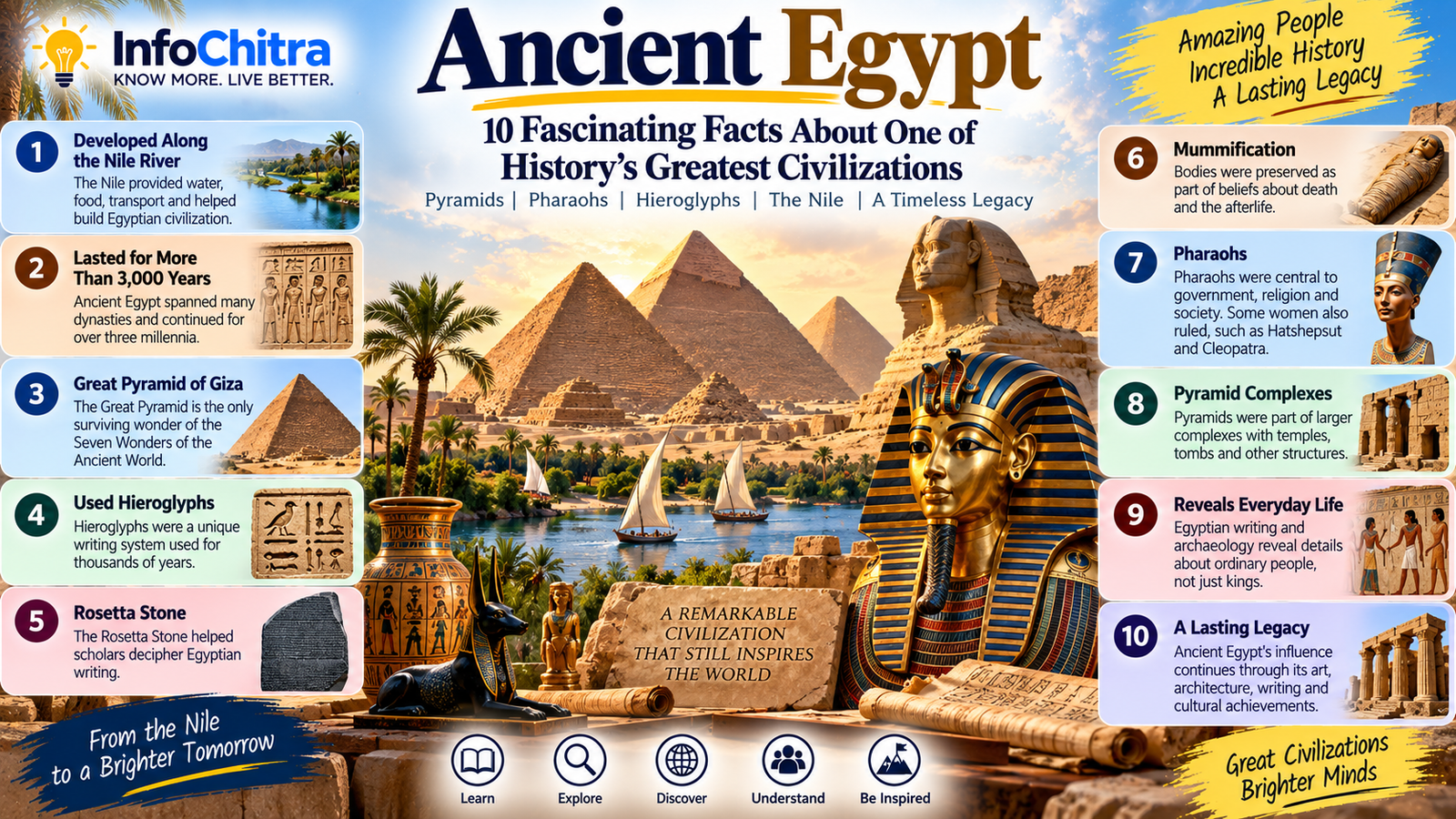
Ancient Egypt: 10 Fascinating Facts About One of History’s Greatest Civilizations
Few ancient civilizations have captured the world’s imagination like Ancient Egypt.
The pyramids of Giza, the Sphinx, hieroglyphs, mummies and stories of pharaohs have become some of the most recognizable symbols of the ancient world. But Ancient Egypt was much more than its monuments and royal tombs.
For thousands of years, people living along the Nile developed complex systems of government, writing, religion, agriculture, architecture and trade. The civilization left behind an enormous archaeological record that continues to help researchers understand the ancient world. The British Museum describes Ancient Egypt as a civilization that lasted for more than three thousand years.
Here are 10 fascinating facts that reveal why Ancient Egypt remains so important in world history.
Ancient Egypt was one of several early civilizations that developed complex societies; the Indus Valley Civilization was another remarkable civilization of the ancient world.
1. Ancient Egypt Developed Along the Nile River
The Nile was central to the development of Egyptian civilization.
Much of ancient Egyptian settlement and agriculture developed along the Nile Valley, where water and fertile land supported farming communities.
The river also provided an important transportation route through the country. The British Museum notes that early Egyptian communities developed along the Nile and that agricultural advances and increasing social organization helped create the foundations of the later Egyptian state.
The Nile therefore influenced much more than farming. It affected:
- Where people lived
- How crops were produced
- Transportation
- Trade
- Political organization
- Religious and cultural life
Without understanding the Nile, it is difficult to understand Ancient Egypt.
2. Ancient Egypt Lasted for More Than 3,000 Years
Ancient Egypt was not a short-lived kingdom.
Its history stretched across numerous periods and dynasties, with political changes, foreign rulers and periods of division along the way.
The British Museum’s timeline places the unification of Upper and Lower Egypt around 3100 BC and traces Egyptian history through successive periods lasting into the first centuries AD.
This extraordinary length of time means that “Ancient Egypt” actually covers many different generations and historical periods.
Egyptian culture changed considerably over those centuries, even though many traditions continued.
3. The Great Pyramid of Giza Is the Only Surviving Ancient Wonder
The pyramids are among the most famous monuments ever constructed.
The Great Pyramid of Giza, built for Pharaoh Khufu, is the only surviving member of the traditional Seven Wonders of the Ancient World.
UNESCO describes it as the only surviving wonder of the ancient world and one of humanity’s most important monuments.
The pyramid was part of a much larger complex of monuments, tombs and structures around the ancient Egyptian capital region of Memphis.
The Giza pyramids demonstrate the extraordinary organizational and architectural capabilities of ancient Egyptian society.
4. Ancient Egyptians Used Hieroglyphs
Ancient Egyptian writing is instantly recognizable because of its distinctive symbols.
These symbols are known as hieroglyphs.
They could represent objects, sounds and ideas and were used for thousands of years. The British Museum notes that hieroglyphic writing developed in Egypt around the late fourth millennium BC and continued for centuries.
Hieroglyphs were not simply decorative pictures.
They recorded information about:
- Religion
- Government
- Royal activities
- Trade
- Everyday life
- Literature
- Personal names
Other forms of Egyptian writing, including hieratic and demotic scripts, were also developed for more practical forms of writing.
5. The Rosetta Stone Helped Unlock Egyptian Writing
For centuries, scholars could see Egyptian hieroglyphs but could not fully understand them.
That changed after the discovery of the Rosetta Stone in 1799.
The stone contained the same decree written in three scripts, including hieroglyphs, demotic and ancient Greek. Because Greek could already be understood, the inscription provided an important key for deciphering the Egyptian scripts.
The work of scholars, especially Jean-François Champollion, eventually transformed understanding of Ancient Egypt.
The decipherment opened access to thousands of years of Egyptian written history.
6. Mummification Was Connected to Beliefs About Death and the Afterlife
Mummification is one of the most recognizable practices associated with Ancient Egypt.
Ancient Egyptians developed techniques for preserving bodies, including drying the body using natron, a naturally occurring salt, followed by oils and wrapping. The British Museum describes the development of artificial preservation techniques as part of ancient Egyptian funerary practices.
Mummification was connected to Egyptian beliefs about death and the afterlife.
Funerary objects, tombs and written texts were also important parts of these beliefs.
However, mummification practices changed over time and were not identical throughout the entire history of Egypt.
7. Pharaohs Were Central to Egyptian Government and Religion
The pharaoh was not simply a political leader in the modern sense.
Egyptian kingship was closely connected with religion, government and ideas about maintaining order in society.
Kings commissioned temples, monuments and tombs and played important roles in religious life.
Ancient Egypt also had periods when women held significant political power. For example, the British Museum’s timeline identifies Neferusobek as one of the early female rulers of Egypt.
Later Egyptian history also included famous female rulers such as Hatshepsut and Cleopatra, although they belonged to very different periods.
8. The Pyramids Were Part of Larger Complexes
When people think of Egyptian pyramids, they often imagine only the giant triangular structures.
In reality, pyramid complexes could include:
- Temples
- Tombs
- Causeways
- Smaller pyramids
- Other ceremonial structures
- Burial areas
UNESCO’s description of Memphis and its necropolis highlights the extensive collection of pyramids, tombs, temples and settlements associated with the ancient Egyptian capital region.
The pyramids therefore formed part of a much larger religious and funerary landscape.
9. Ancient Egyptian Writing Reveals Everyday Life, Not Just Kings
One of the most fascinating aspects of Egyptian archaeology is that surviving writing does not only describe rulers and religious ceremonies.
Egyptian texts can reveal details about ordinary human concerns.
The British Museum notes that deciphered Egyptian writing has revealed evidence of letters, business dealings, personal relationships, poetry and everyday activities.
This makes Ancient Egypt much more relatable.
People in ancient Egypt:
- Worked
- Farmed
- Traded
- Raised families
- Wrote letters
- Managed businesses
- Celebrated festivals
- Created art and literature
The archaeological record allows historians to study both monumental achievements and aspects of ordinary life.
10. Ancient Egypt Left a Legacy That Still Shapes Our Understanding of History
Ancient Egypt’s influence extends far beyond the pyramids.
Its surviving monuments, writing, art, religious traditions and archaeological sites provide researchers with an enormous source of information about the ancient world.
The Memphis and its Necropolis World Heritage Site includes pyramids, tombs, temples and settlements spanning different periods of Egyptian history. UNESCO recognizes the site as exceptional evidence of the development and organization of pharaonic civilization.
Even today, archaeological discoveries and new research continue to add information to our understanding of Ancient Egypt.
That is one reason the civilization remains one of the most studied cultures in human history.
Ancient Egypt at a Glance
| Topic | Key Fact |
|---|---|
| Location | Northeastern Africa |
| Major river | Nile |
| Early unification | Around 3100 BC |
| Writing | Hieroglyphs and other scripts |
| Famous monuments | Pyramids, temples and tombs |
| Famous site | Giza |
| Famous writing discovery | Rosetta Stone |
| Preservation practice | Mummification |
| Political system | Pharaoh-led kingdoms and periods of foreign rule |
| Historical legacy | Thousands of years of archaeological and written evidence |
Why Were the Pyramids Built?
The pyramids were primarily connected with royal burial and funerary beliefs.
They were part of larger complexes designed around the burial and commemoration of kings.
The development of Egyptian funerary monuments can be seen across sites such as Saqqara, Dahshur and Giza. UNESCO identifies the Pyramid of Djoser at Saqqara as the earliest pyramid and the Great Pyramid of Giza as the only surviving ancient wonder.
The pyramids therefore represent not only engineering achievements but also the religious and political world of ancient Egyptian society.
How Were Egyptian Hieroglyphs Deciphered?
The Rosetta Stone was the crucial breakthrough.
Its inscription appeared in three scripts, including ancient Greek, allowing scholars to compare the known Greek text with the Egyptian writing.
The decipherment work culminated in the early 19th century, particularly through the work of Jean-François Champollion. The British Museum describes the 1822 breakthrough as a major turning point that opened access to thousands of years of Egyptian history.
Frequently Asked Questions
What was Ancient Egypt?
Ancient Egypt was one of the world’s major early civilizations, developing along the Nile in northeastern Africa and lasting for more than three thousand years.
When did Ancient Egypt begin?
The political unification of Upper and Lower Egypt is generally placed around 3100 BC, although Egyptian communities and cultures existed along the Nile long before that.
Why is Ancient Egypt famous?
Ancient Egypt is famous for its pyramids, temples, hieroglyphs, mummies, pharaohs, art, architecture and extensive historical record.
What is the Great Pyramid of Giza?
The Great Pyramid was built for Pharaoh Khufu and is the only surviving wonder of the traditional Seven Wonders of the Ancient World.
What are Egyptian hieroglyphs?
Hieroglyphs were a writing system used to record the ancient Egyptian language. They were used for thousands of years and appeared on monuments, tombs and other objects.
What was the Rosetta Stone?
The Rosetta Stone is an inscribed stone containing the same decree in three scripts, including Greek, hieroglyphs and demotic. It played a crucial role in deciphering Egyptian hieroglyphs.
Did Ancient Egyptians really use mummies?
Yes. Egyptians developed techniques for preserving bodies as part of funerary practices connected to beliefs about death and the afterlife.
Conclusion
Ancient Egypt was far more than a civilization that built pyramids.
For thousands of years, people along the Nile developed writing, agriculture, government, architecture, religious traditions, art and systems of social organization that left an extraordinary record behind.
The pyramids may be its most famous monuments, but hieroglyphs, temples, tombs, papyri and archaeological discoveries allow us to see a much broader picture of Egyptian civilization.
And that is what makes Ancient Egypt so fascinating: thousands of years after its great kingdoms rose and fell, its people continue to teach us about the history of humanity.