
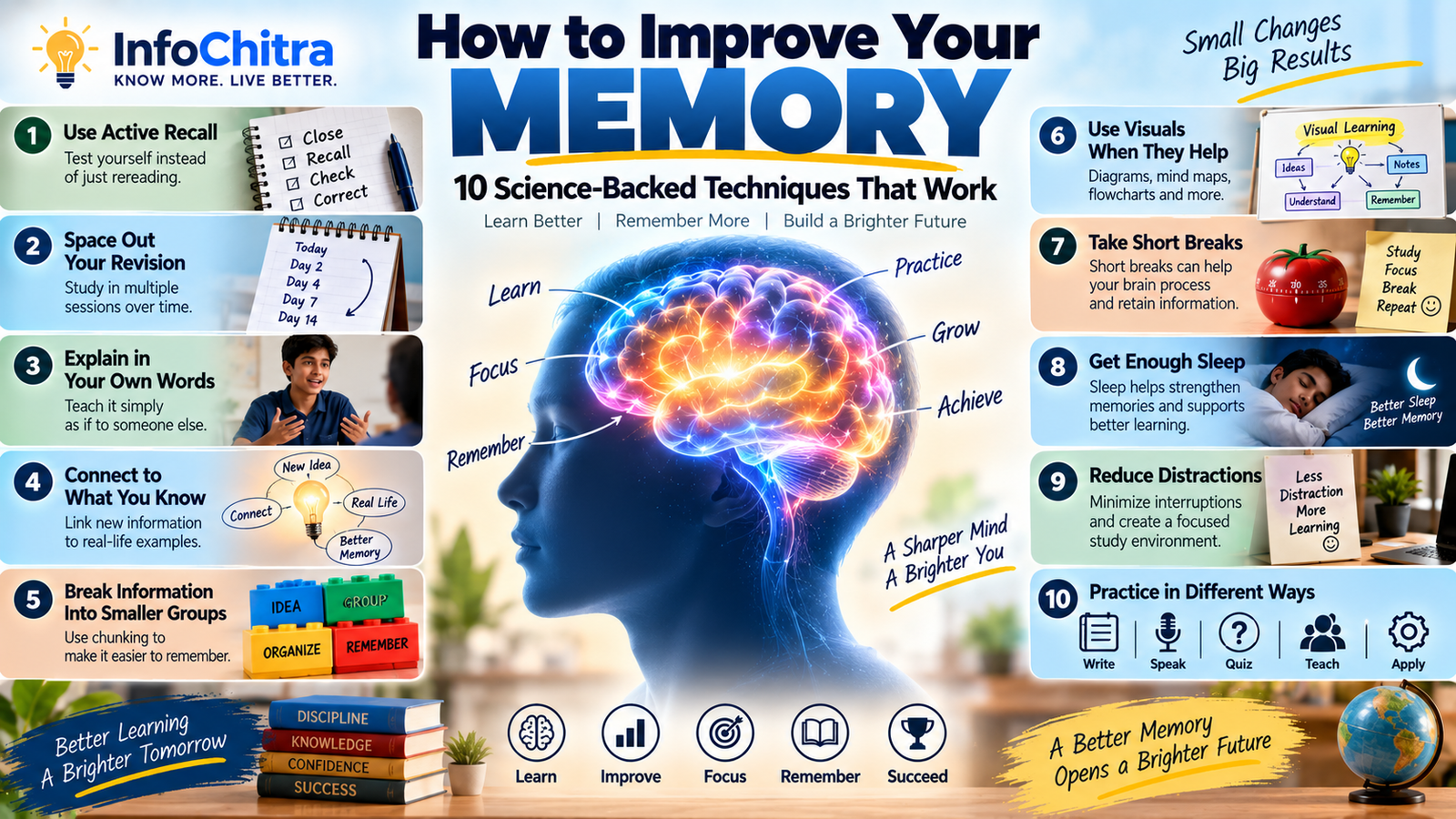
How to Improve Your Memory: 10 Science-Backed Techniques That Work
Forgetting something you studied yesterday can be frustrating.
You may read the same chapter several times, highlight important sentences and spend hours reviewing your notes — yet still struggle to remember the information when you actually need it.
The good news is that effective learning is not simply about spending more hours with a textbook.
Research on learning has identified strategies such as retrieval practice and spaced practice that can make learning more effective. A major review in Nature Reviews Psychology describes spacing and retrieval practice as well-supported approaches for improving learning across different settings and age groups.
Memory is also influenced by sleep, attention, practice and how meaningfully new information is connected to what you already know.
So, how can you improve your memory?
Here are 10 practical, evidence-based techniques that can help.
1. Use Active Recall Instead of Just Rereading
One of the simplest ways to improve learning is to test yourself.
Instead of reading a page repeatedly, close the book and try to explain what you remember.
For example, after studying a chapter about the human heart, ask yourself:
- What are the four chambers?
- What does each chamber do?
- How does blood move through the heart?
- Can I explain the process without looking at my notes?
This is called retrieval practice.
The Learning Scientists describe retrieval practice as bringing information back to mind rather than simply putting information into the mind through repeated exposure. Research has found that the act of retrieving information can itself strengthen later memory.
A simple method
After studying a topic:
Close → Recall → Check → Correct
Try to remember first. Then check your notes and correct what you missed.
How to Study Smarter: 10 Proven Techniques That Actually Work
2. Space Out Your Revision
Studying everything in one long session may feel productive, but spreading learning across multiple sessions can be more effective for long-term retention.
This approach is called spaced practice.
Instead of studying a chapter for three hours on one day, you could revisit it briefly over several days.
For example:
Day 1: Learn the topic
Day 2: Quick recall
Day 4: Practice questions
Day 7: Review again
Day 14: Final retrieval
The exact schedule doesn’t need to be perfect.
The important idea is to give yourself multiple opportunities to retrieve information over time rather than concentrating all your study into one session.
Research reviews identify spacing as an effective learning strategy across different domains.
3. Explain What You Learned in Your Own Words
If you can explain something simply, you probably understand it better.
After learning a concept, put your textbook aside and explain it as though you were teaching someone else.
For example, instead of memorizing:
“Photosynthesis is the process by which green plants convert light energy into chemical energy.”
Try explaining it naturally:
“Plants use sunlight to help turn water and carbon dioxide into food, while releasing oxygen.”
The goal isn’t to replace accurate definitions when they are required in an exam.
The goal is to make the underlying idea meaningful and easier to retrieve.
4. Connect New Information to Something You Already Know
New information becomes easier to understand when you connect it to existing knowledge.
Suppose you are learning about Earth’s atmosphere.
You already know that the sky appears blue.
You can connect that familiar observation with the new concept of Rayleigh scattering.
Now you’re not learning an isolated term. You’re attaching the new information to something you already understand.
Try asking:
- What does this remind me of?
- How is this connected to something I already know?
- Can I find a real-world example?
- Why does this make sense?
These connections can make information more meaningful and easier to recall.
5. Break Large Information Into Smaller Groups
Trying to remember a long list of unrelated information can be difficult.
Breaking information into meaningful groups can make it easier to handle.
This is often called chunking.
For example, instead of remembering:
1 9 4 7 2 0 2 6
you might group it as:
1947 | 2026
Similarly, a student studying a large chapter can divide it into:
Definition → Causes → Process → Examples → Effects
Rather than attempting to remember an enormous block of information at once, you create a structure that is easier to navigate.
Why Is the Sky Blue? The Science Behind the Blue Sky
6. Use Visuals When They Actually Help
Some information is easier to remember when it is represented visually.
You can use:
- diagrams
- flowcharts
- timelines
- mind maps
- simple drawings
- labelled illustrations
- tables
For example, instead of memorizing the stages of a biological process as a paragraph, create a simple flow diagram showing the sequence.
Visual organization can help you see relationships between pieces of information.
However, don’t turn every page of notes into an elaborate artwork.
The visual should make the information clearer, not simply more decorative.
7. Take Short Breaks During Learning
Memory and learning aren’t necessarily improved by sitting continuously for hours.
Short breaks can be useful, particularly during skill learning.
NIH research has reported evidence that brief periods of rest can help the brain replay and strengthen recently practiced skills.
A practical approach is to divide a longer study session into focused periods with short breaks.
For example:
30–45 minutes focused study → short break → continue
The ideal duration can vary from person to person and from task to task.
The important principle is to avoid treating exhaustion as proof of effective studying.
8. Get Enough Sleep
Sleep isn’t simply time when learning stops.
Research has shown that sleep plays an important role in memory consolidation — the processes through which newly learned information becomes more stable over time.
NIH educational material also explains that sleep helps strengthen memories formed during the day.
This is particularly important for students.
Staying awake all night before an examination may give you more hours with your books, but it doesn’t necessarily give you better learning.
A better approach is to combine:
Focused study + revision + adequate sleep
rather than relying on last-minute all-night preparation.
9. Reduce Distractions While Studying
Memory begins with attention.
If you’re constantly switching between:
- textbooks
- social media
- messages
- videos
- notifications
- unrelated websites
you make it harder to maintain focused attention on the material.
Try creating a distraction-reduced study environment.
For example:
Phone away → One task → Focused session → Short break
You don’t need a perfectly silent room or expensive study setup.
Even small changes can help reduce unnecessary interruptions.
Artificial Intelligence: 10 Powerful Ways AI Is Changing Our Lives
10. Practice Retrieving Information in Different Ways
Don’t always test yourself in exactly the same way.
If you are studying a topic, try several forms of retrieval:
Write
Write everything you remember without looking at your notes.
Speak
Explain the concept aloud.
Quiz
Answer questions about the topic.
Teach
Pretend you are explaining it to another student.
Apply
Use the concept to solve a problem.
This makes learning more flexible.
Retrieval practice has been studied extensively, and research-based learning resources recommend it as a practical way to strengthen learning and identify gaps in understanding.
A Simple Memory Improvement Routine
You don’t have to use all ten techniques every day.
A simple routine could look like this:
Before studying
Remove distractions and decide exactly what you want to learn.
During studying
Understand the concept rather than simply copying it.
After studying
Close your book and use active recall.
The next day
Try to retrieve the information again.
A few days later
Review and practice again.
At night
Get adequate sleep.
This combines several evidence-supported principles: attention, retrieval, spacing and sleep.
What About Memory Supplements or “Brain Boosters”?
You may see products online claiming to dramatically improve memory.
Be cautious with such claims.
Having a better memory isn’t usually about finding one magical food, pill or shortcut.
For students and healthy adults, practical learning behaviours — such as effective retrieval, spaced practice, focused study and adequate sleep — have much stronger relevance to everyday learning than simply looking for a quick memory hack.
If someone has a persistent or unusual problem with memory that interferes with everyday life, that is different from ordinary forgetfulness and may warrant professional medical advice.
Frequently Asked Questions
What is the best way to improve memory?
There isn’t one technique that works perfectly for everyone. However, retrieval practice and spaced practice have strong research support for improving learning and retention.
How can I remember what I study?
Instead of repeatedly rereading, close your notes and try to recall the information. Then check your answer and repeat the process later.
Does sleep improve memory?
Research indicates that sleep supports memory consolidation and can help strengthen newly learned information.
Is rereading good for memory?
Rereading can have a role in learning, especially when first becoming familiar with a topic. But relying on rereading alone is generally less effective than combining study with retrieval and spaced practice.
How often should I revise?
There is no single perfect revision schedule for every learner or subject. A useful approach is to revisit information across multiple sessions rather than putting all revision into one session.
Can exercise improve memory?
Physical activity has broad benefits for health and brain function, but this article focuses specifically on learning strategies with direct relevance to studying and memory.
Is active recall the same as memorization?
Not exactly. Active recall means deliberately trying to retrieve information from memory. The retrieval process itself can strengthen learning, rather than simply repeating information passively.
Conclusion
Improving your memory doesn’t require a complicated system.
The most useful change may simply be to stop measuring learning by how many hours you sit with a book and start measuring it by how well you can retrieve and use what you learned.
Use active recall. Space your revision. Connect new ideas to what you already know. Break complex information into manageable parts. Take useful breaks, reduce distractions and give your brain enough sleep.
Most importantly, make learning an active process.
The goal isn’t to remember everything forever.
The goal is to make important knowledge easier to understand, retrieve and use when you need it.