
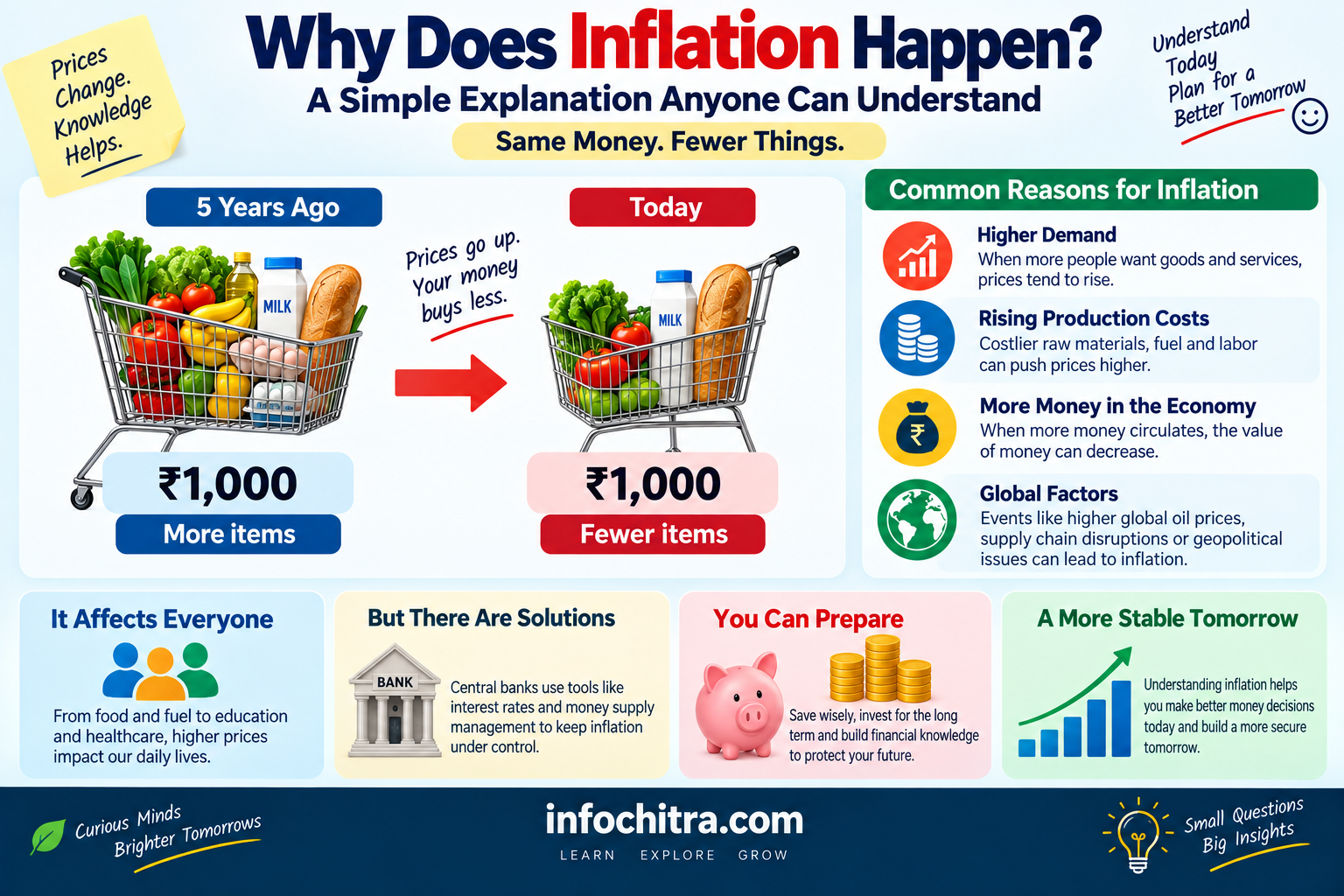
Why Does Inflation Happen? A Simple Explanation Anyone Can Understand
Inflation shows up everywhere you look: you notice it every year, in every country, as the same grocery basket costs more than it did last year. A cup of coffee that cost a few cents decades ago now costs several dollars. Your salary might have gone up too, yet somehow it doesn’t feel like it stretches as far as it used to. This everyday experience has a name — inflation — and understanding why it happens is far simpler than most explanations make it sound.
This guide breaks inflation down into plain, everyday language, without economic jargon, so you can actually understand what’s happening to prices around you — no matter which country you live in.
Table of Contents
- What Inflation Actually Means
- Reason 1: Too Many Buyers, Not Enough Goods (Demand-Pull Inflation)
- Reason 2: It Costs More to Make Things (Cost-Push Inflation)
- Reason 3: People Expect Prices to Rise, So They Do
- Why Printing More Money Can Cause Inflation
- Why a Little Inflation Is Actually Considered Healthy
- What Happens When Inflation Gets Too High
- Why Your Salary Doesn’t Always Keep Up
- How Central Banks Try to Control Inflation
- What This Means for You, Practically
1. What Inflation Actually Means
At its simplest, inflation is a sustained rise in the general level of prices for goods and services across an economy over time. The key word here is “general” — inflation isn’t about one specific product getting more expensive (like a single fruit having a bad harvest year), but about prices rising broadly, across many different things you buy.
The practical effect of inflation is that your money buys less than it used to. If your income doesn’t rise at the same pace as prices, your actual purchasing power — what you can afford with the same amount of money — quietly shrinks over time.
2. Reason 1: Too Many Buyers, Not Enough Goods (Demand-Pull Inflation)
One of the most intuitive causes of inflation happens when demand for goods and services grows faster than businesses can supply them. Economists call this “demand-pull” inflation — demand is essentially pulling prices upward.
Think of concert tickets for a hugely popular artist: if there are only a limited number of seats but millions of fans want tickets, prices get pushed up simply because far more people want in than there’s room for. The same basic logic can play out across an entire economy — when people collectively have more money to spend and are eager to spend it, but the supply of goods can’t keep pace, prices across many products tend to rise.
3. Reason 2: It Costs More to Make Things (Cost-Push Inflation)
The second major type of inflation works from the opposite direction. “Cost-push” inflation happens when the cost of producing goods and services goes up — for example, due to rising wages, higher raw material costs, or increased fuel and transportation expenses.
When it costs businesses more to make and deliver their products, they typically pass at least some of that added cost on to customers through higher prices, simply to maintain their profit margins. This is why events like a spike in oil prices can ripple outward into higher prices for seemingly unrelated goods — since transportation costs affect nearly everything that needs to be shipped or delivered.
4. Reason 3: People Expect Prices to Rise, So They Do
Perhaps the most psychologically interesting driver of inflation is what economists call “inflation expectations.” If businesses and workers genuinely believe prices will keep rising in the future, they tend to act in ways that actually make that expectation come true.
Workers negotiate for higher wages in advance to keep pace with expected future price increases, and businesses raise prices proactively to protect their margins against costs they expect to rise. This creates a kind of self-reinforcing cycle — the belief that inflation is coming becomes one of the reasons it actually does.
5. Why Printing More Money Can Cause Inflation

A commonly cited long-term cause of inflation is a country’s central bank increasing the money supply too rapidly — essentially creating more currency without a matching increase in the actual goods and services available in the economy. According to McKinsey’s explainer on inflation, sustained, long-lasting inflation is largely driven by what’s known as easy monetary policy, where a central bank keeps interest rates too low or grows the money supply too quickly.
The basic logic here is straightforward: if there’s significantly more money circulating in an economy chasing roughly the same amount of goods, each individual unit of that currency ends up being worth relatively less — which shows up as rising prices.
6. Why a Little Inflation Is Actually Considered Healthy
It might seem like zero inflation, or even falling prices, would be ideal — but most economists and central banks actually target a small, steady amount of inflation, often around 2% per year. According to the Cleveland Federal Reserve, when demand and supply factors aren’t pushing inflation up or down, it typically settles near this underlying baseline level.
A small, predictable amount of inflation encourages people to spend and invest money rather than hoard it, and gives businesses room to adjust wages and prices gradually, rather than facing the shock of sudden price drops, which can actually discourage economic activity and spending.
7. What Happens When Inflation Gets Too High
While mild inflation is considered normal and even beneficial, high or rapidly accelerating inflation creates real problems. When prices rise faster than incomes, purchasing power erodes quickly, making everyday essentials — food, housing, transportation — noticeably harder to afford, especially for people on fixed incomes.
In extreme historical cases, when governments printed excessive amounts of money to cover spending, some countries experienced hyperinflation, where prices rose so dramatically and rapidly that everyday currency became nearly worthless within weeks or months, forcing people to spend money almost immediately before it lost significant value.
8. Why Your Salary Doesn’t Always Keep Up
One of the most frustrating aspects of inflation for ordinary people is that wages often don’t rise at the same pace as prices, at least not immediately. Businesses typically review and adjust salaries on a fixed schedule — annually, for example — while prices for everyday goods can shift much more frequently and unpredictably.
This creates a lag effect: even in a period of moderate inflation, many workers experience a temporary decline in their real purchasing power until their wages eventually catch up, if they do at all.
9. How Central Banks Try to Control Inflation

Most countries have a central bank — such as the Federal Reserve in the US, the Reserve Bank of India, or the European Central Bank — specifically tasked with keeping inflation within a target range. Their primary tool is adjusting interest rates: raising rates makes borrowing more expensive, which tends to slow down spending and cool off demand-pull inflation, while lowering rates makes borrowing cheaper, encouraging more spending when inflation is too low.
This is why news about central bank interest rate decisions often dominates financial headlines — these decisions directly aim to influence how fast or slow prices rise across the entire economy.
10. What This Means for You, Practically
Understanding inflation’s basic mechanics can help you make more informed personal financial decisions. Since money sitting completely idle gradually loses purchasing power to inflation over time, many people choose to invest a portion of their savings in assets that have historically outpaced inflation over the long run, rather than keeping all their money in low-interest accounts.
It also helps explain broader patterns you might notice — why wages, prices, and interest rates all seem to move together in the news, and why occasional, moderate price increases across the economy aren’t necessarily a sign that something has gone wrong, but rather a normal, expected feature of how modern economies function.
Main Causes of Inflation at a Glance
| Cause | What It Means | Simple Example |
|---|---|---|
| Demand-pull | Too many buyers, not enough supply | Concert tickets selling out, driving prices up |
| Cost-push | Production costs rise, prices follow | Fuel prices rising, raising transport costs |
| Inflation expectations | Belief in future price rises causes them | Workers demanding raises in advance |
| Money supply growth | More currency without more goods | Excess money printing devalues currency |
Frequently Asked Questions
What is the simplest definition of inflation? Inflation is a sustained, general rise in prices across an economy over time, which reduces how much your money can actually buy.
Is some inflation actually good for the economy? Yes. Most central banks target a small, steady inflation rate (often around 2%) since it encourages spending and investment rather than money-hoarding, and gives room for gradual wage and price adjustments.
Why do wages sometimes lag behind rising prices? Salaries are typically reviewed on a fixed schedule, such as annually, while prices can rise more frequently, creating a temporary gap where purchasing power declines until wages catch up.
How do central banks control inflation? Primarily by adjusting interest rates — raising rates to slow spending and cool inflation, or lowering rates to encourage spending when inflation is too low.
What is hyperinflation? An extreme, rapid form of inflation, often caused by excessive money printing, where prices rise so quickly that currency can lose significant value within weeks or months.
Conclusion
Inflation isn’t some mysterious economic force — it’s the predictable result of a few identifiable factors: demand outpacing supply, rising production costs, self-fulfilling expectations, and changes in how much money is circulating in an economy. Understanding these basic mechanics won’t stop prices from rising, but it does turn a confusing, often anxiety-inducing topic into something genuinely understandable — wherever in the world you happen to be reading this.
(Related reading: How to Create a Monthly Budget: 10 Simple Steps to Manage Your Money)