
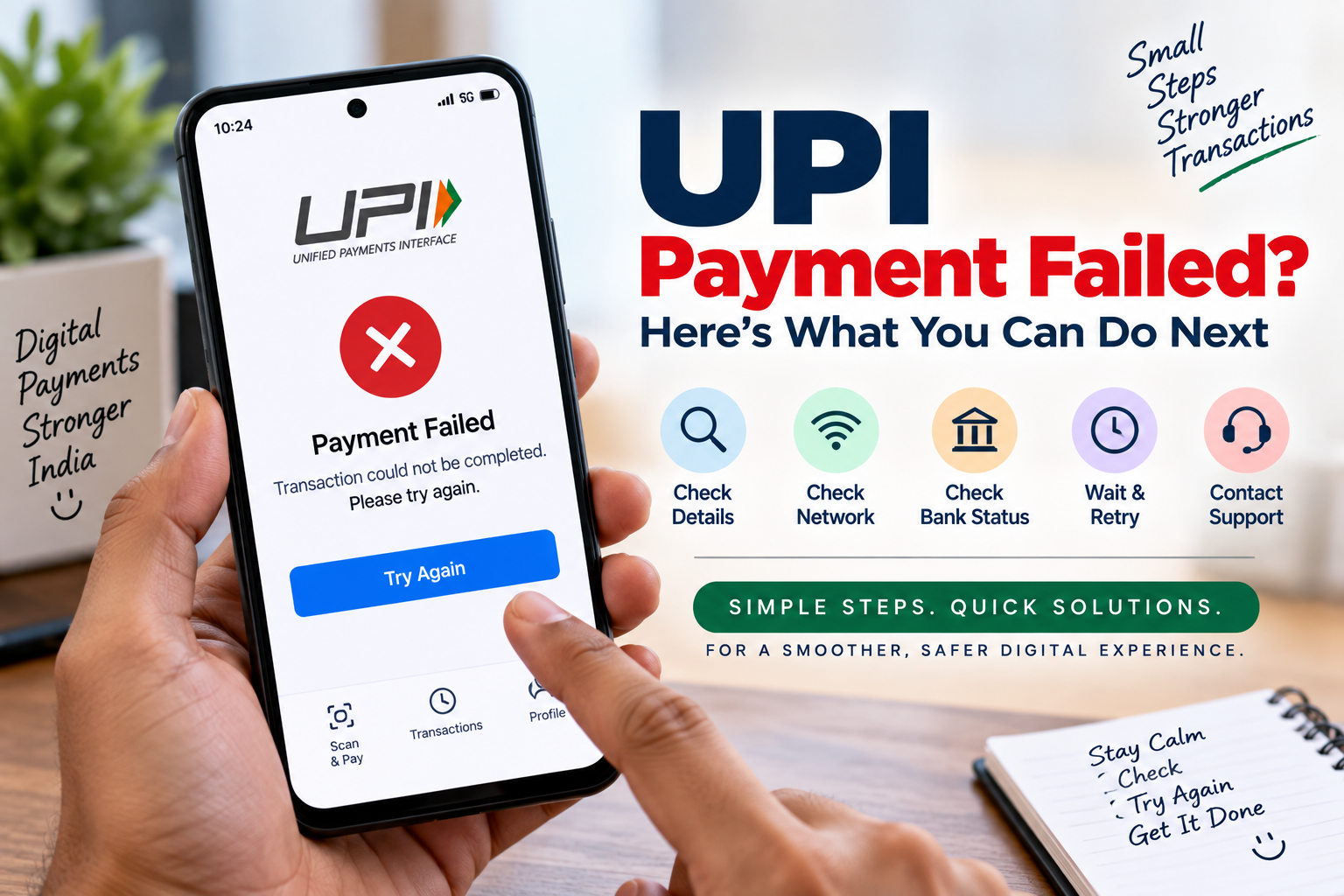
UPI Payment Failed? Here’s Why It Happens and How to Fix It
You’re standing at a shop counter, or trying to send money to a friend, and suddenly your screen shows “Payment Failed.” Worse, sometimes the money even leaves your account, but the person on the other end never receives it. If this has happened to you, you’re far from alone — UPI payment failures affect millions of transactions across India every single day.
The good news is that most UPI failures have simple, identifiable causes, and in almost every case, your money is safe. This guide walks through exactly why UPI payments fail and what to do at each step, so you’re not left guessing the next time it happens.
Table of Contents
- Common Reasons Why UPI Payment Failed
- My Money Was Deducted, But the Payment Still Failed — What Now?
- Why Does My UPI PIN Keep Getting Rejected?
- Why Do Payments Fail Even With a Good Internet Connection?
- What Are UPI Daily Transaction Limits, and Did I Hit One?
- How Long Does a UPI Refund Actually Take?
- What to Do If You Don’t Get a Refund
- How to Prevent UPI Failures in the Future
1. Common Reasons Why UPI Payment Failed
A UPI payment can fail for several different reasons, and the cause isn’t always obvious from the error message alone. The most common reasons include:
- Incorrect UPI PIN — the single most frequent cause of failed transactions
- Insufficient balance in your linked bank account
- Poor or unstable internet connection, causing the request to time out
- Bank server downtime or heavy load, especially common on salary days, the 1st of the month, or during festivals
- Wrong UPI ID or account details entered by mistake
- Daily transaction limits being reached
- Temporary app glitches on either your UPI app or your bank’s system
Understanding which of these applies to your situation is the first step toward fixing — or simply waiting out — the problem.
2. My Money Was Deducted, But the Payment Still Failed — What Now?
This is one of the most stressful UPI situations, but it’s important to know: if your money was deducted and the payment shows as failed, it will almost always be automatically refunded to your account, typically within one working day.
This happens because your bank had already processed the debit on its end before the failure occurred, usually due to a delay or timeout on the receiving bank’s side or NPCI’s system. The reversal process is automatic in most cases — you generally don’t need to do anything except wait. According to Paytm’s guide on UPI transaction failures, if money is debited but not received, you should contact your bank or the payment system’s support for assistance.
What you should do right now:
- Check your UPI app’s “Transaction History” to confirm the status shows as “Failed” or “Pending”
- Check your bank’s SMS alerts or bank statement to confirm the debit
- Wait until the next working day before assuming something is wrong
3. Why Does My UPI PIN Keep Getting Rejected?
If your UPI PIN keeps failing even though you’re confident you’re entering it correctly, a few things could be going on:
- You may be entering your UPI PIN where the app expects your app login password, or vice versa — these are two different codes
- Your PIN may have been reset or changed on another device without your knowledge
- Repeated wrong attempts may have temporarily locked your UPI PIN as a security measure
What to do: If you’re unsure of your current UPI PIN, reset it directly within your UPI app using your debit card details or Aadhaar-linked verification, rather than continuing to guess — repeated failed attempts can trigger additional security holds on your account. MobiKwik’s troubleshooting guide notes that a UPI PIN is a 4–6 digit code linked to your bank account, separate from your app’s login password or ATM PIN — a common source of confusion.
4. Why Do Payments Fail Even With a Good Internet Connection?
It’s a common misconception that UPI failures always mean something is wrong on your end. In reality, a large share of failures happen due to issues with your bank’s servers or NPCI’s infrastructure — not your phone or internet connection at all.
Bank and payment networks often experience heavy traffic during predictable high-volume periods, such as salary disbursement days, month-end bill payments, or major festivals, when millions of people are transacting simultaneously. During these windows, even correctly entered transactions can time out or fail due to system load rather than any mistake on your part.
What to do: If your internet connection is clearly stable and the payment still fails, simply wait a few minutes and retry, rather than assuming there’s a deeper problem to troubleshoot.
5. What Are UPI Daily Transaction Limits, and Did I Hit One?
Every UPI account has daily transaction limits, set by both NPCI and your individual bank, and these limits can vary depending on your bank and account type. If you’ve made several transactions in a single day, it’s possible you’ve reached your daily cap — even if each individual payment amount seems small.
This is a commonly overlooked reason for failures, since most people assume a failed payment always means a technical problem rather than a limit-related restriction.
What to do: Check your bank’s specific UPI daily limit (this information is usually available in your banking app or via customer care), and if you’ve hit it, simply wait until the next day or use an alternative payment method for the remaining amount.
6. How Long Does a UPI Refund Actually Take?
When a UPI payment fails after your account has already been debited, the standard refund timeline is within one working day, according to most banks and payment providers. In practice, many refunds happen much faster — often within a few hours — but banking regulations allow up to one business day for the reversal to complete.
It’s important to avoid retrying the same payment multiple times in quick succession while waiting for a refund, as this can sometimes create confusion with duplicate debits or trigger additional fraud-prevention holds on your account.
7. What to Do If You Don’t Get a Refund
If more than one working day has passed and your deducted amount still hasn’t been refunded, here’s the escalation path to follow:
- Check your transaction history in the UPI app first, to confirm the exact status and reference number
- Contact your bank’s customer support, providing the transaction reference number (UTR) and the exact date and time of the failed payment
- File a formal complaint with your bank if the issue isn’t resolved through initial support
- Escalate to NPCI’s dispute redressal system if your bank is unable to resolve the issue, since NPCI oversees the underlying UPI infrastructure connecting all banks
Keeping a note of the transaction reference number (UTR) immediately after a failed payment makes this entire process significantly faster if escalation becomes necessary.
8. How to Prevent UPI Failures in the Future
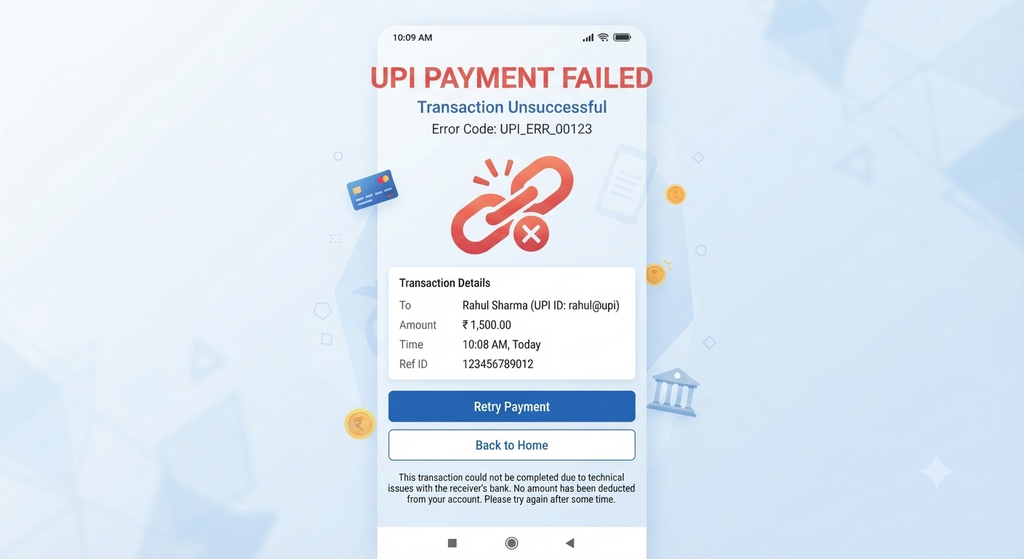
While you can’t control bank server issues or network congestion, a few habits can meaningfully reduce how often you run into UPI payment failures:
- Double-check the UPI ID or QR code before confirming any payment, especially for new recipients
- Keep your UPI app updated to the latest version, since outdated apps are more prone to bugs
- Avoid making payments during known high-traffic periods (like the very start or end of the month) when timing isn’t critical
- Keep a backup payment method — such as a debit card or a secondary UPI-linked account — for situations where your primary method fails
- Avoid rapid repeated retries immediately after a failure, since this can sometimes trigger temporary fraud-prevention restrictions
UPI Payment Failure Reasons at a Glance
| Reason | What It Means | What To Do |
|---|---|---|
| Incorrect UPI PIN | Wrong PIN entered | Reset PIN via debit card/Aadhaar |
| Insufficient balance | Not enough funds linked | Add funds, retry |
| Poor internet connection | Weak network during transaction | Check connection, retry |
| Bank server downtime | High traffic or maintenance | Wait a few minutes, retry |
| Daily transaction limit reached | Too many transactions that day | Wait until next day or use alternate method |
| Wrong UPI ID/account details | Mistyped recipient info | Double-check before confirming |
Frequently Asked Questions
Will I lose my money if a UPI payment fails? No. If money is deducted during a failed transaction, it is automatically refunded to your account, typically within one working day.
Why does UPI fail even when I have enough balance? This usually points to a network issue, bank server downtime, or a daily transaction limit being reached, rather than a balance problem.
Can I retry a failed UPI payment immediately? It’s better to wait a few minutes before retrying, especially if the failure was due to network or server issues, to avoid duplicate debits or fraud-prevention holds.
What is a UTR number, and why does it matter? The UTR (Unique Transaction Reference) number identifies your specific transaction. Keeping a note of it makes resolving disputes with your bank or NPCI significantly faster.
Who do I contact if my bank can’t resolve a failed UPI payment? If your bank is unable to resolve the issue, you can escalate the complaint to NPCI’s dispute redressal system, which oversees the overall UPI network.
Conclusion
A failed UPI payment can be frustrating in the moment, but in the vast majority of cases, it’s a temporary, easily explained issue — and your money is safe. Understanding the common causes, knowing the standard refund timeline, and having a clear escalation path for the rare cases that need it can turn a stressful moment into a simple, five-minute fix.
(Related reading: UPI and Digital Payments in India 2026: 10 Ways India Is Leading the World)