
Space: 10 Amazing Facts About the Universe
Space has fascinated humanity for as long as we’ve looked up at the night sky, and the more we learn about it, the stranger and more astonishing it becomes. From planets that could float in a bathtub to galaxies racing away from each other at incredible speeds, the universe is full of details that sound more like science fiction than science fact.
Thanks to decades of research from NASA, ESA, and astronomers around the world, we now understand more about our cosmos than ever before — yet it remains full of surprises. Here are 10 amazing facts about space that reveal just how extraordinary the universe really is.
Table of Contents
- One Million Earths Could Fit Inside the Sun
- Saturn Could Float in a Giant Bathtub
- The Universe Is Expanding — And Accelerating
- There Are Over 176 Known Moons in Our Solar System
- No One Can Hear You Scream in Space
- Comets Are Leftovers from the Solar System’s Birth
- Halley’s Comet Only Appears Once Every 76 Years
- Mars Has Roughly One-Third of Earth’s Gravity
- Ceres Is Both a Giant and a Dwarf
- The Milky Way and Andromeda May Not Collide After All
1. One Million Earths Could Fit Inside the Sun
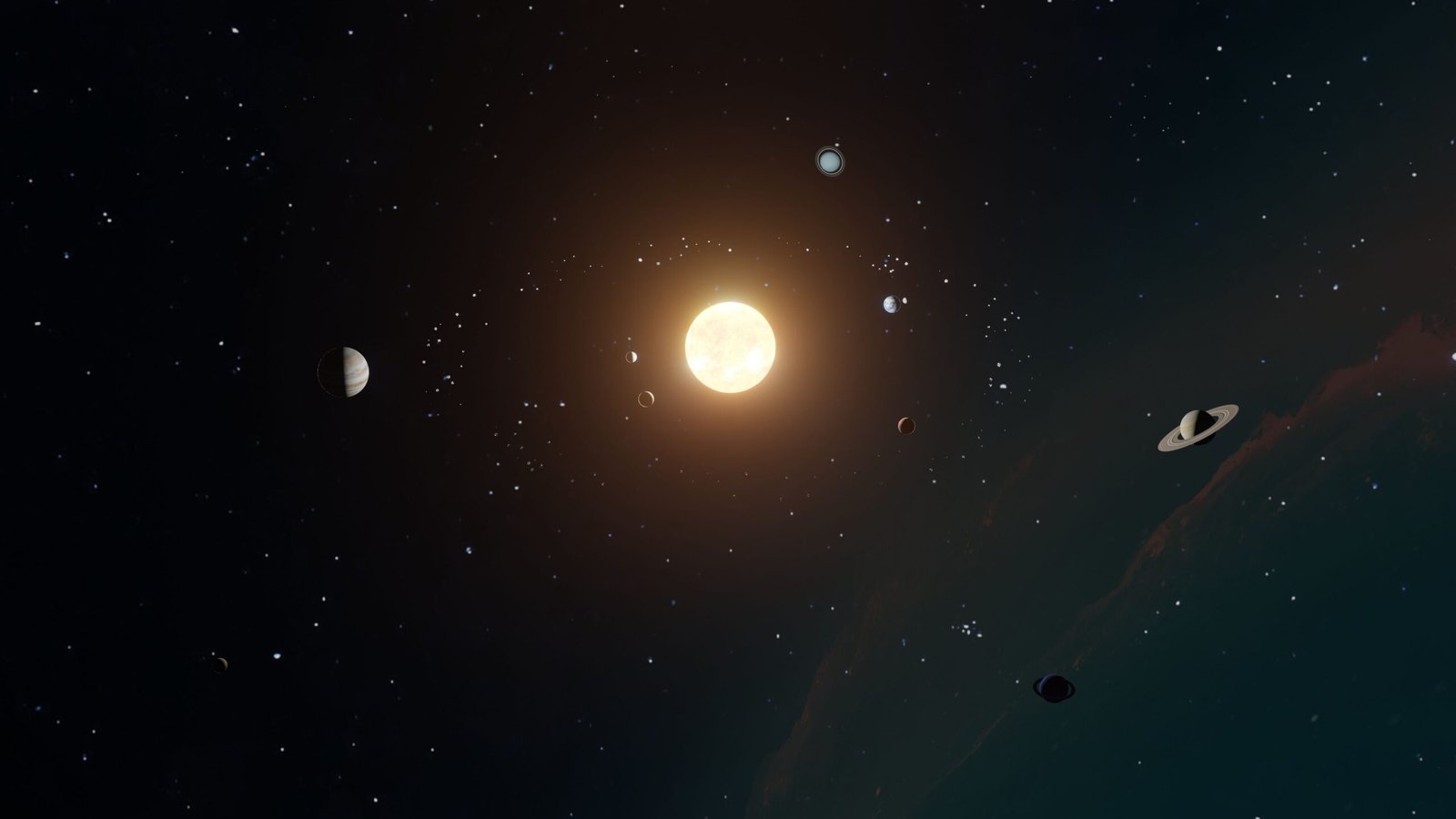
Despite being considered just an average-size star, the Sun is so enormous that approximately one million Earths could fit inside it. This staggering size comparison helps put into perspective just how vast even a “typical” star can be — and reminds us how relatively small our home planet truly is on a cosmic scale.
Understanding scale like this is one of the first steps toward grasping just how immense the universe beyond our solar system really is.
2. Saturn Could Float in a Giant Bathtub
One of the most surprising space facts is that Saturn is the only planet in our solar system that is less dense than water. According to NASA’s JPL Extreme Space Facts resource, this means that, in theory, Saturn could float in a bathtub — if anyone could build one large enough to hold it.
This unusual property comes from Saturn’s composition, which is made up primarily of hydrogen and helium gas, giving it a much lower overall density than rocky planets like Earth.
3. The Universe Is Expanding — And Accelerating
Since the Big Bang, most objects in space have been steadily moving away from one another. What’s even more remarkable is that this expansion isn’t slowing down — it’s actually accelerating. Scientists attribute this acceleration to a mysterious force known as dark energy, a discovery that significantly reshaped our understanding of cosmology in recent decades.
This ongoing acceleration remains one of the biggest open questions in modern astrophysics, with researchers still working to fully understand what dark energy actually is.
4. There Are Over 176 Known Moons in Our Solar System
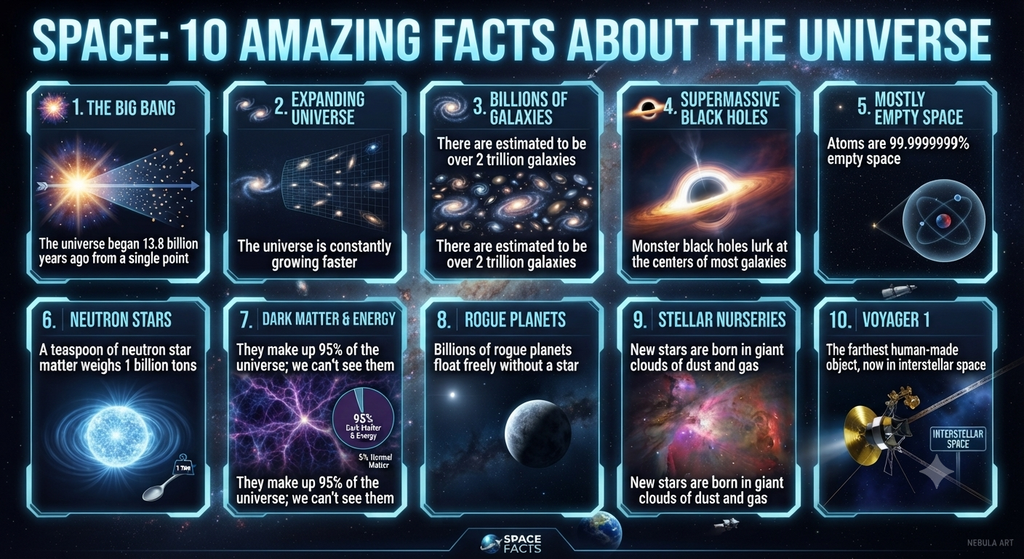
Our solar system is home to a surprisingly large number of moons — at least 176 confirmed moons orbiting the various planets. Some of these moons are larger than the planet Mercury itself, highlighting just how varied and unexpected the objects orbiting our Sun can be.
This number continues to grow as astronomers use increasingly powerful telescopes to detect smaller and more distant moons around the outer planets.
5. No One Can Hear You Scream in Space
Contrary to countless movie sound effects, space is actually completely silent. Since space is a vacuum with no air or atmosphere, sound waves have no medium through which to travel. This means that even the loudest scream would produce absolutely no sound audible to anyone nearby in space.
This fact is a favorite among astronomy educators, as it highlights just how fundamentally different the physics of space is compared to life on Earth.
6. Comets Are Leftovers from the Solar System’s Birth
Comets are essentially cosmic leftovers, formed billions of years ago during the same period that created our solar system. Often described as giant “space snowballs,” comets are made up of ice, dust, and rocky material, and they orbit the Sun in very large, elongated paths.
Because their orbits are so large, some comets only become visible from Earth once every few decades or even centuries, making each appearance a notable astronomical event.
7. Halley’s Comet Only Appears Once Every 76 Years
Among the most famous comets, Halley’s Comet is visible from Earth roughly once every 76 years. It was last seen in 1986 and isn’t expected to return until 2061, meaning most people will only get the chance to witness it once or twice in their lifetime.
This long, predictable cycle has made Halley’s Comet one of the most historically documented astronomical events, with recorded sightings dating back centuries.
8. Mars Has Roughly One-Third of Earth’s Gravity
Mars has a gravitational pull that is approximately one-third as strong as Earth’s. In practical terms, this means a person capable of dunking a basketball on Earth would find it dramatically easier on the Martian surface, thanks to the reduced gravitational force.
This lower gravity is also a key consideration for scientists planning future crewed missions to Mars, as it affects everything from astronaut mobility to long-term bone density concerns.
9. Ceres Is Both a Giant and a Dwarf
Ceres holds a unique double distinction in our solar system. It is the largest and most massive object in the main asteroid belt between Mars and Jupiter, accounting for roughly one-third of the belt’s total mass. At the same time, Ceres is classified as the smallest of the known dwarf planets — a category that also includes Pluto and Eris — and it is the only dwarf planet located within the asteroid belt itself.
This combination of being simultaneously the “biggest” and “smallest” in different categories makes Ceres one of the more fascinating oddities of our solar system.
10. The Milky Way and Andromeda May Not Collide After All
For years, astronomers believed the Milky Way and the neighboring Andromeda Galaxy were on a collision course, expected to merge into a single giant galaxy in roughly 4 to 4.5 billion years. However, a more recent analysis combining data from NASA’s Hubble Space Telescope and the European Space Agency’s Gaia mission has found the outcome far less certain — putting the odds of a collision within the next 10 billion years at only about 50-50.
This updated finding is a good reminder that even long-established ideas in astronomy can change as new data and more precise measurements become available.
Space Facts at a Glance
| Fact | Detail |
|---|---|
| Earths that fit inside the Sun | About 1 million |
| Only planet less dense than water | Saturn |
| Known moons in our solar system | 176+ |
| Halley’s Comet visibility cycle | Once every 76 years |
| Mars gravity compared to Earth | About one-third |
| Milky Way–Andromeda collision odds | Roughly 50-50 (within 10 billion years) |
Frequently Asked Questions
How many Earths could fit inside the Sun? Approximately one million Earths could fit inside the Sun, despite it being considered only an average-size star.
Why is space completely silent? Space is a vacuum with no air or atmosphere, so sound waves have no medium through which to travel, making it silent.
When will Halley’s Comet be visible again? Halley’s Comet was last seen in 1986 and is not expected to return until 2061, as it becomes visible roughly once every 76 years.
Is Saturn really less dense than water? Yes, Saturn is the only planet in our solar system less dense than water, meaning it could theoretically float if placed in a large enough body of water.
Will the Milky Way definitely collide with Andromeda? Not necessarily. While earlier research suggested a near-certain future collision, newer data puts the odds at roughly 50-50 within the next 10 billion years.
Conclusion
From planets that could float in water to a universe that never stops expanding, these space facts reveal just how strange and wondrous our cosmos truly is. As telescopes and space missions continue to advance, our understanding of the universe keeps evolving — proving that even long-held scientific ideas can shift as new discoveries emerge.
(Related reading: 10 Amazing Facts About Earth That Will Surprise You)